Trial Design: Time, Features, and Human Help
A trial should let a user reach value before asking for payment. Read the three design levers, a worked example, and where trials mislead.
A trial is a structured opportunity for a buyer to experience value before committing. Most trials fail not because the product is weak but because the design asks for a decision before the user has reached the moment the product is useful. The levers are time, feature access, and human help.
Direct answer:
Design a trial around reaching a specific value moment within the window, with full access to the features needed for it and a clear path to help.
Demand-generation principles explain the decision stage a trial serves, and AAPOR's standards apply if you survey trial users about their experience. The boundary: a trial that ends before value is reached measures nothing useful, and no structure guarantees conversion, as the publication standard states for marketing claims.
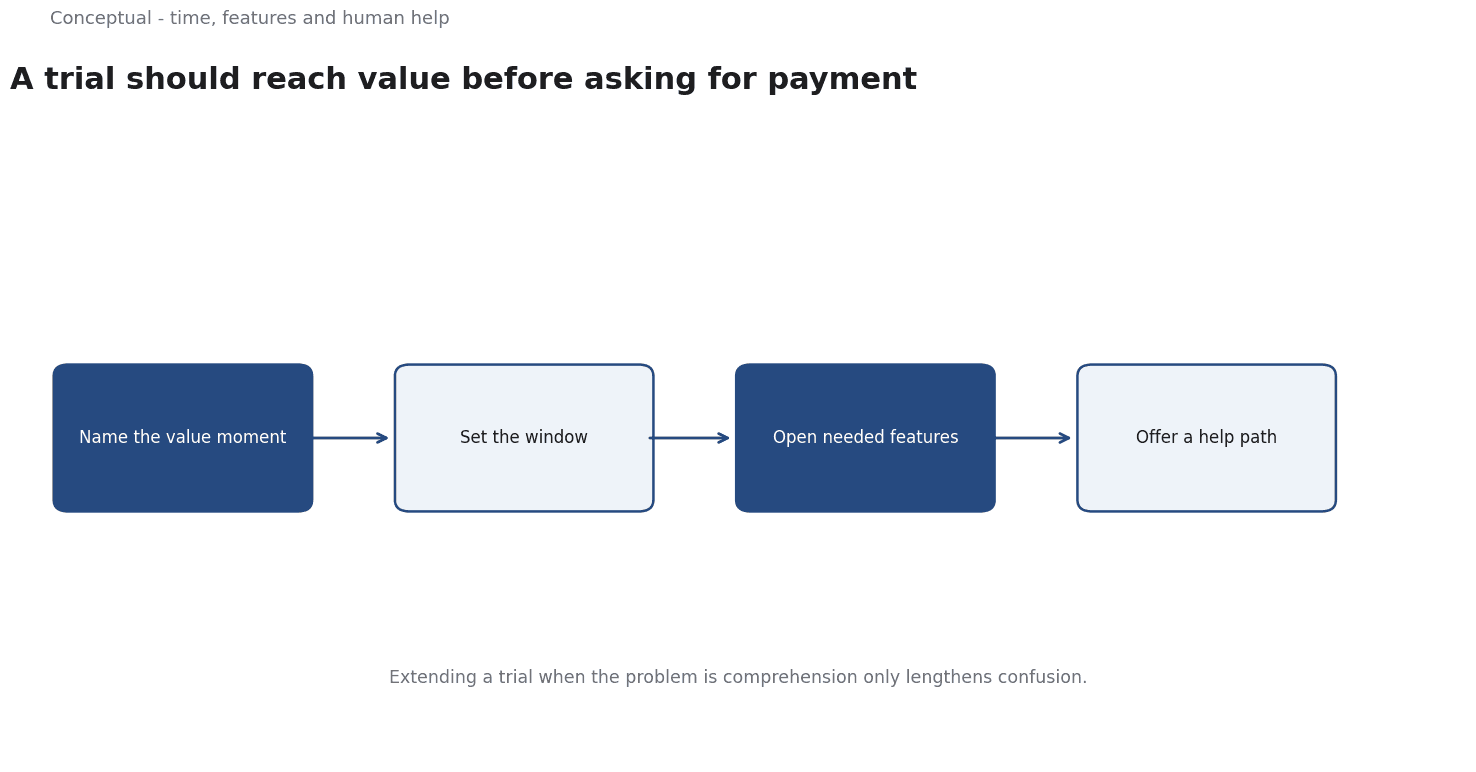
Three levers
Time. Long enough to complete a meaningful task, short enough to maintain urgency. A 14-day trial that needs 30 days of setup is misaligned, as the activation article measures time to first value.
Features. Access to what the user needs to succeed. Restricting the very capability that produces value protects the demo from costing money but prevents the trial from proving anything, as Freemium Conversion: Where the Free Boundary Should Sit argues for a genuine boundary.
Human help. A short onboarding conversation or a well-timed check-in can turn a stalled trial into a converted one, which the customer-success article treats as part of the health journey.
A worked example
The following is hypothetical and illustrative.
A B2B tool offers a 14-day trial with all features. Three checks:
- Time to value. Do users complete the first meaningful task within three days, as the funnel article measures activation? If the median is ten days, the trial window is spent waiting rather than evaluating.
- Help timing. Do users who receive a day-two check-in convert more than a matched group who do not, which the A/B testing article requires for a reliable result? A help offer at day one may be premature; at day twelve, too late.
- Qualified conversion. Do trials convert to customers who retain, as the retention article measures by cohort, or do they attract users who cancel after the first month?
Three conclusions follow:
- The trial is designed around value, not around a billing clock, as Freemium Conversion: Where the Free Boundary Should Sit argues for real boundaries.
- Help is timed, not constant, which the customer-success article recommends for health-based intervention.
- Conversion is checked against retention, as the cost estimator article treats a short-lived customer as a loss.
A trial also reveals whether the product is ready to be adopted without hand-holding. If most users need a conversation to reach value, that is useful information about the product, not just the trial design. It suggests the motion should be sales-assisted, as the founder-led-sales article describes, rather than self-serve. A trial that quietly fails without that interpretation is a missed signal about how the market wants to buy.
What the trial window is really measuring
A trial is both an evaluation experience and a measurement instrument. The behaviour inside it — which features are opened, where users stall, what they ask about — is a direct signal about how the product is understood. The product-analytics article argues for treating such signals as evidence about the question a user is trying to answer, and the funnel article explains how to read the transitions between stages. A trial that converts poorly may be telling you that the value moment is unclear, not that the price is wrong.
That distinction matters because the two problems call for opposite responses. If users reach value and decline to pay, the offer or the price is the issue, which the pricing-strategy article addresses. If users never reach value, the trial design or the product's first-run experience is the issue, which the activation guidance covers.
Human help is the most expensive lever and the most informative. A check-in that converts a stalled user pays for itself, as the customer-success article models for onboarding, but the pattern of who stalls also tells the product team where the interface fails. Treating that pattern as product evidence, rather than as a series of individual rescues, is what turns a trial programme into a learning system. The voice-of-customer article recommends grouping feedback by underlying cause for the same reason.
What trials cannot do
They cannot fix a product that does not deliver. A trial exposes the truth faster, which the reputation article warns about for claims experience contradicts.
They guarantee nothing. No structure guarantees a purchase, which the publication standard makes explicit for marketing claims.
They are not the same as a demo. A self-serve trial suits a product a user can adopt alone; a complex enterprise tool may need guided evaluation, as the founder-led-sales article describes.
The counterargument — that a longer trial is always better — is false.
A longer window without a value moment simply delays the decision, which the activation article explains for time-to-value.
A decision test
- Name the value moment the trial must produce, as the activation article recommends.
- Set the length to comfortably contain that moment, as the funnel article measures.
- Give access to the features needed for the value, as Freemium Conversion: Where the Free Boundary Should Sit advises for a genuine boundary.
- Time human help at the point of stalling, as Customer Success: Onboarding, Health Scores, and Expansion Revenue recommends.
- Measure qualified conversion against a baseline, as the A/B testing article requires.
- Check retention of converted users, as the retention article advises.
- Survey with AAPOR-style wording if asking why users did not convert, with a defined population.
For the upgrade path, see Freemium Conversion; for the early experience, see Customer Success.
References & Further Reading
- Wikipedia contributors, 2026. Demand generation - Wikipedia — An overview of demand generation as a marketing discipline distinct from lead generation; secondary reference used with the lead-generation entry.
- American Association for Public Opinion Research, 2026. AAPOR — The professional association for public opinion and survey research; its standards and resources underpin the survey-design discussion.