Venture Debt Best Practices
Venture debt extends runway without the dilution of a round. Read the mechanics, a worked example, and the obligations that come with it.
Venture debt is a loan to a venture-backed company, often structured with warrants and tied to an equity round. It is pitched as a way to extend runway without dilution, which is true at signing and incomplete as a description. Debt is an obligation with covenants and a maturity date, and those terms decide whether the extra runway is useful.
Direct answer: Use venture debt when a company has a clear use for the cash, a credible path to repayment or refinancing, and an understanding of the covenants. The venture-debt overview provides the instrument's context, and investor education treats debt as an obligation with risk. The boundary: debt cannot replace product-market fit, which the startup-validation article treats as the prior question, and a covenant breach can transfer control, as Debt Restructuring: Workouts and Covenants explains.
The mechanics
The facility. A loan amount, an interest rate, and a maturity date, often drawn in tranches tied to milestones, as the venture-debt overview describes. The terms are a negotiation, as the term-sheet article treats financing terms as the substance of a deal.
Warrants. Lenders may receive the right to buy shares, which adds a potential dilution component, as the cap-table article explains for instruments that affect ownership.
Covenants. Conditions such as minimum cash or a requirement to raise a new round, which the debt-restructuring article treats as a test that can be breached. The definitions matter more than the thresholds, as the EBITDA article explains for how a measured figure is constructed.
Three consequences follow. Debt changes the risk profile without changing the business, which the risk-assessment article treats as a decision about upside and downside. It interacts with equity rounds, as the financing sequence determines whether the company can repay or refinance, which the startup-valuation article considers. And it has a cost even when it is not drawn, as commitment fees are a real expense, which the cost estimator treats as certain.
A worked example
The following is hypothetical and illustrative. A company has 6 million in cash and a net burn of 500,000 a month, giving twelve months of runway, as the burn-rate article computes.
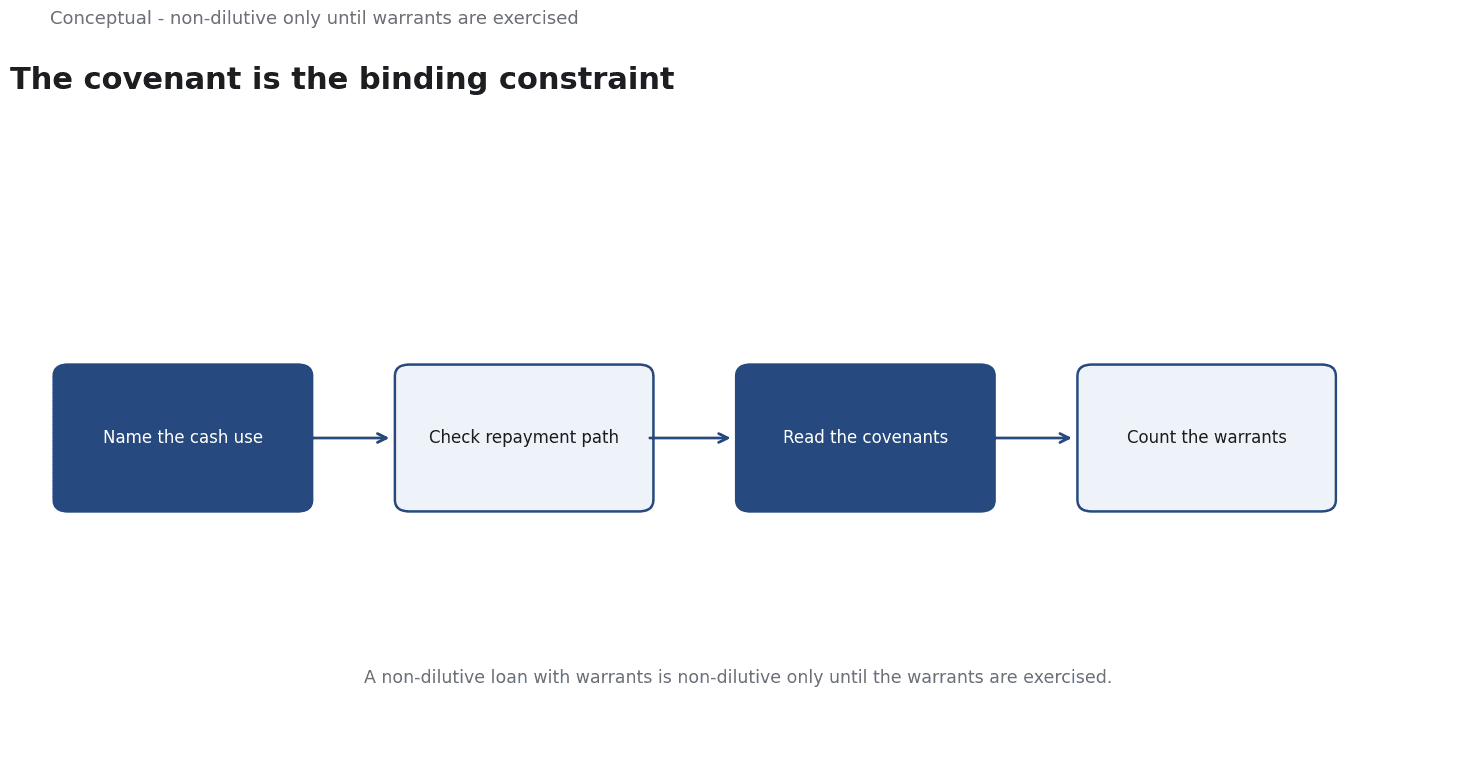
It raises 4 million of venture debt with a 30-month maturity, interest, and a covenant requiring a qualified equity round within 18 months. Three checks decide whether this is sensible. First, what is the use of funds, as the 13-week cash-flow article requires for a short-term view? If the cash funds a product with measurable milestones, the extension has a purpose. Second, can the company repay or refinance at maturity, which the debt-restructuring article treats as the central question? A round within 18 months is an assumption that should be evidenced, as the startup-valuation article advises. Third, do the covenants leave room for a slower round, as the covenant definitions in the debt article require?
Three conclusions follow. The runway extension is real but conditional, as the burn-rate article treats forward assumptions.
The covenant is the binding constraint, which the worked example reveals.
And the decision should be recorded with the repayment scenario, as the decision-memo article requires.
What venture debt cannot do
It cannot fix a business that does not convert cash into value, which the unit-economics article treats as the underlying question. It cannot remove dilution entirely if warrants are involved, as the cap-table article explains. And it cannot guarantee an equity round, which the startup-valuation article treats as a conditional estimate, not a promise.
The counterargument that debt is cheaper than equity is partly true in cash terms and misses the covenant risk, which the debt-restructuring article treats as a transfer of control.
A decision test
- State the use of funds and the milestones, as the cash-flow article requires.
- Check repayment and refinancing scenarios, as Debt Restructuring: Workouts and Covenants advises.
- Read the covenants and their definitions, as Debt Restructuring: Workouts and Covenants requires.
- Account for warrants in the ownership model, as the cap-table article explains.
- Price interest and fees, as the cost estimator requires.
- Compare with an equity round on dilution and control, as the term-sheet article advises.
- Record the decision and the repayment assumption, as the decision-memo article requires.
For the alternative, see SAFE Notes; for the risk, see Debt Restructuring.
References & Further Reading
- Wikipedia contributors, 2026. Venture debt - Wikipedia — An overview of venture debt as late-stage financing for startups.
- U.S. Securities and Exchange Commission (Investor.gov), 2026. Introduction to Investing — Primary regulator guidance on market mechanics and investor protection.