Visual Identity: a Decision Framework
A bounded decision framework for visual identity that maps the visible identity system to brand management choices, recognition risk, and a rebrand gate.
Visual identity projects often start as taste debates and end as expensive redesigns. The real problem is deciding which visible elements actually carry brand meaning and which choices deserve to be standardized. Without a framework, teams treat every logo tweak as strategy and miss the moments when identity genuinely shapes perception.
Direct answer: A visual identity decision framework treats the visible system - logo, color, type, and application rules - as one part of corporate identity, then tests each choice against the brand associations it must support. The source material presents visual identity as the visible expression of an organization's identity and brand management as the ongoing work of shaping brand perception. The practical move is to map each design choice to a specific brand association before approving it.
Delta: This article adds a decision framework beyond the sources: it maps visual identity elements to brand management choices and a rebrand gate, with claim status explicit.
The mechanism
The encyclopedia entry on corporate identity describes it as the way an organization presents itself to the public, built from a combination of visual, verbal, and behavioral elements. Visual identity is the visible layer of that system: the logo, palette, typography, imagery, and the rules that keep them consistent across applications. The practical consequence is that a visual decision is rarely just aesthetic. When a team changes a color or a mark, it changes the most visible signal of an identity that stakeholders already read as a whole.
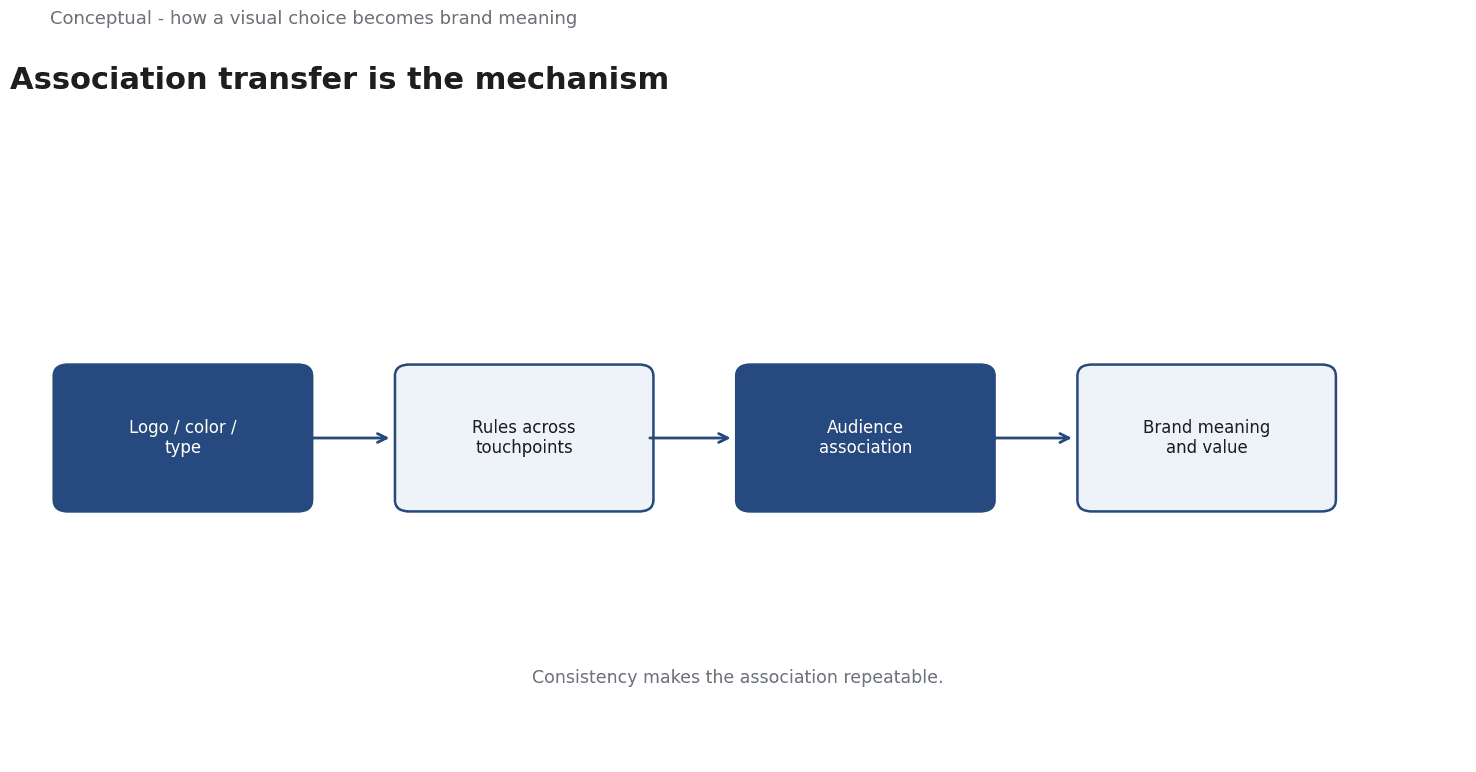
Brand management, in the second source, is the analysis and planning involved in shaping how a brand is perceived and in maintaining the associations that give it value. The mechanism connecting the two is association transfer: a visual element becomes useful to the brand when audiences reliably connect it to the intended meaning. A palette that signals reliability in one category can signal something else in another, so the same design object carries different brand value depending on context.
Consistency is not decoration; it is what makes an association repeatable.
That repeatability explains why identity systems specify rules rather than single assets. Guidelines for spacing, usage, and tone exist to reduce variation at every touchpoint, because each inconsistent application dilutes the association the brand is trying to build. The practical consequence for a decision maker is that the unit of analysis is the system, not the artifact. Approving one beautiful homepage matters less than knowing the rule will hold across product, packaging, support, and partner channels.
Between the two sources sits the decision gap. The sources define what identity and brand management are; they do not tell a team when a change is worth making. That judgment is local: it depends on which associations are currently weak, how recognizable the existing system is, and how costly inconsistency has become. A framework makes that judgment explicit by requiring each proposal to name the association it serves and the evidence that the current system fails it.
A worked example
The following is hypothetical and illustrative. A hypothetical regional services firm considers replacing its wordmark because a designer finds it dated. Three checks shape the decision. First, a recognition check asks customers what they associate with the current mark; most name reliability and local knowledge, the two associations the firm wants. Second, a consistency audit finds that the real problem is not the mark but inconsistent color and type across proposals and invoices. Third, a cost check shows a full rebrand would require updating every template and retraining partners. The outcome: the firm keeps the wordmark, standardizes the palette and type rules, and measures whether the association holds. The decision changed because the framework separated a taste complaint from a brand problem.
Evidence status
| Claim | Status | Source | Verified | Recheck when |
|---|---|---|---|---|
| Visual identity is the visible layer of corporate identity | source-reported | Corporate identity (Wikipedia) | 2026-11-18 | Identity terminology is revised |
| Brand management shapes and maintains brand perception | source-reported | Brand management (Wikipedia) | 2026-11-18 | Brand equity models change |
| Consistency makes a visual association repeatable | inferred | Derived from the sources | 2026-11-18 | New perception research appears |
The first two rows summarize definitions from the encyclopedia entries and are fairly stable, though terminology in identity and brand literature evolves. The third row is an inference from the idea that an association must be repeated to be learned. It is a working assumption for decisions, not a measured effect, and it should be revisited if perception research changes.
What it cannot do
No framework can tell a team whether a design is good, because aesthetic judgment and cultural meaning sit outside the sources. What it can do is force the team to state which association a change is meant to serve. That discipline narrows a debate, but it does not replace the judgment of people who understand the category and its audience.
A clearly stated association can still be the wrong one.
The hidden cost of a visual identity system is governance. Guidelines must be written, distributed, enforced, and updated as products and channels multiply. Each new partner or acquisition adds another place where the system can drift. A framework that treats identity as a single launch ignores the ongoing work of keeping it consistent, which is often where the real budget goes.
If customers are dissatisfied because service is slow or quality is inconsistent, a new mark will not change the association. The redesign may even draw attention to the underlying weakness. A decision test that skips the diagnosis step turns a visible symptom into an expensive cosmetic fix.
Recognition has boundaries. The same colors and forms can carry different meanings across markets and languages, and a mark that reads clearly in one context can fail in another. Trademark and accessibility constraints also bind the choices: a palette that fails contrast requirements or infringes an existing mark is not a viable option regardless of brand logic. The framework must include these checks rather than assume them.
Finally, associations drift. A system that fit the brand ten years ago may now signal something the firm has outgrown, and the decision must be revisited as the business changes. Periodic review against current customer perception is what keeps the framework from defending an identity for its own sake. A rebrand gate is useful only if it can be reopened.
Counterargument: the claim that visual identity is mostly intuition is fair for early creative exploration and incomplete for governance decisions, where a named association and a reviewable rule prevent drift.
A decision test
- Name the association the identity is supposed to carry.
- Check what audiences currently associate with the existing system.
- Diagnose whether the problem is the identity or the experience behind it.
- Audit consistency across the touchpoints that matter most.
- Test proposed changes against the named association, not against taste alone.
- Check legal, accessibility, and cross-market constraints.
- Set a rebrand gate with evidence thresholds and a fallback of standardization.
These steps order the decision correctly: diagnosis before redesign, evidence before approval, and constraints before commitment. The gate converts a feeling that the identity is tired into a testable claim about association and consistency. Revisit the test when the business or its audience changes, because an identity that once fit can quietly stop doing so.
For further reading, see Voice of customer: turning feedback into decisions.
References & Further Reading
- Wikipedia contributors, 2026. Corporate identity - Wikipedia — Visual elements that represent an organisation.
- Wikipedia contributors, 2026. Brand management - Wikipedia — The discipline of maintaining a brand across touchpoints; secondary reference used for channel consistency.