Volatility for Small Teams
Volatility is a property of the market, not a signal to trade. Read how to respond, a worked example, and why a small team has different constraints.
Volatility is often treated as a problem to eliminate, which ignores that it is a property of the market. The Wikipedia entry describes variation in prices over time, and Damodaran's framework insists on explicit assumptions. The response should follow the team's constraints.
Direct answer: Respond to volatility by restating the time horizon and the assumptions behind the position, then checking liquidity. The sources describe the concept; the response rule is a synthesis.
Delta: This article adds a claim-status table and a worked review, separating documented market behaviour from local judgements about risk.
The mechanism
The first point is that volatility describes variation, not direction. The Wikipedia entry defines it in terms of price changes over time, which means a volatile market can rise or fall.
Treating volatility itself as a signal is a category error, and it leads to activity that does not change the underlying decision.
The second point is the horizon. A small team with money needed soon has a different tolerance from one with a long horizon. The same price movement is a liquidity problem in one case and noise in the other. Establishing the horizon before reacting is the first practical step.
The third point is assumptions. Damodaran's framework treats assumptions as explicit inputs. Volatility tests them, and the useful question is which assumption has changed, not what the price did. A fall can be consistent with a thesis that remains intact, or it can reveal that the thesis was wrong.
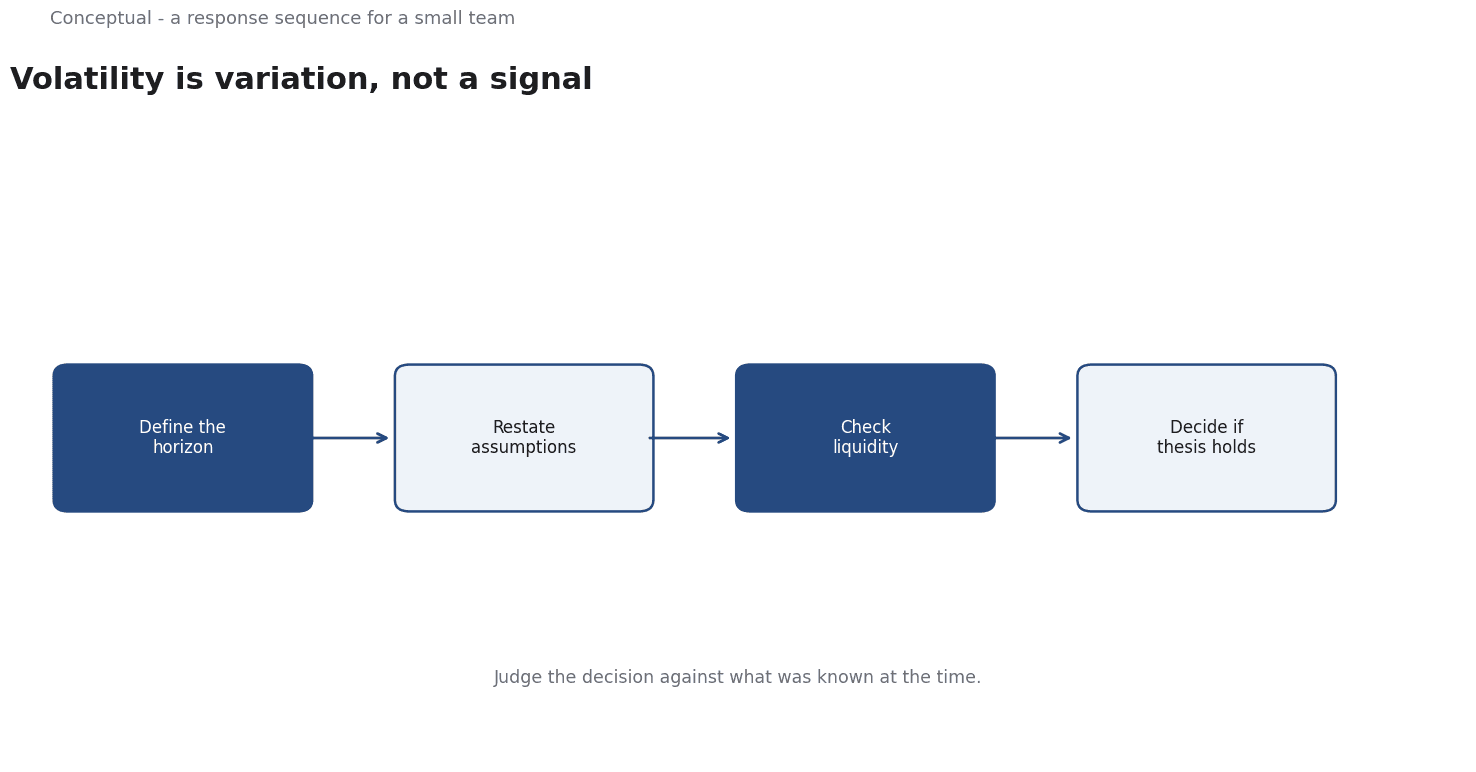
The sequence is: define the horizon, restate the assumptions, check liquidity, then decide whether the position still makes sense. The decision should be written with the reason, so a later review can tell a sound decision from a lucky outcome.
A worked review
Illustrative. A small team sees a sharp fall in a market where it holds a concentrated position.
Three checks decide. First, when is the money needed, and does the position match that horizon? Second, which assumption about the holding has changed, and which is merely being tested by price? Third, is there a liquidity need that forces a decision now?
The outcome is a written decision with a reversal condition. The scenario is hypothetical; the method is the contribution.
Evidence status
| Claim | Status | Source | Verified | Recheck when |
|---|---|---|---|---|
| Volatility describes variation in prices | source-reported | Wikipedia, Volatility | 2026-11-18 | Definition changes |
| Valuation requires explicit assumptions | source-reported | Damodaran Online | 2026-11-18 | Framework changes |
| Decide from horizon, assumptions and liquidity | inferred | Derived from the concept | 2026-11-18 | Needs change |
Why small teams are different
A small team often has less ability to absorb a long drawdown, both financially and emotionally. That is a constraint, not a weakness, and it should shape the position size before volatility arrives.
A final issue is that volatility can tempt a team into frequent decisions, and each decision has a cost in attention and possible error. A written rule for when a decision is warranted reduces the noise, because it separates a movement that deserves action from one that does not.
The team should also record what information was missing when a decision was made. A choice made under uncertainty can be judged fairly only against what was known at the time, which is the difference between a bad decision and a bad outcome.
The horizon should be written before a fall, because it is hard to choose one calmly during a fall.
A smaller position is often the most effective response to volatility, because it reduces the pressure to decide at the wrong moment.
The position size should reflect the team's ability to wait, which is a constraint set before the market moves.
A decision made during a fall should be judged against the information available at the time, not the outcome.
A longer horizon is only useful if the position can survive the wait.
What it cannot do
It cannot predict the next move. It does not remove risk. And it cannot guarantee that a long horizon will be rewarded.
The counterargument that volatility should be avoided entirely is fair for short horizons and incomplete when the goal requires exposure.
A decision test
- Define the horizon.
- Restate the assumptions.
- Check liquidity needs.
- Decide whether the thesis holds.
- Set a reversal condition.
- Record the decision and recheck date.
For the related question, see Bear Markets.
References & Further Reading
- Wikipedia contributors, 2026. Volatility (finance) - Wikipedia — The degree of variation in prices over time.
- Aswath Damodaran, 2026. Damodaran Online: Home Page for Aswath Damodaran — Publicly maintained datasets for industry averages, WACC, and valuation.