Waitlist and Launch Marketing: Building Demand Before Product
A waitlist is evidence of interest, not of demand. Read how to collect it, a worked conversion test, and what signups do not prove.
A large waitlist feels like validation, which is why launch plans often treat signup count as a forecast. It is a weaker signal than it appears: an email address costs nothing, and the people who give one are often the most curious rather than the most likely to buy. The value of a waitlist is in what you learn from it and how you convert it, not its size.
Direct answer: Use a waitlist to learn who has the problem, test messaging, and build a channel for the launch — not as proof of demand. Demand-generation principles explain the stage a waitlist serves, and AAPOR's standards apply when surveying signups about their needs. The boundary: a signup is a stated interest with no commitment, which the startup-validation article treats as weaker than evidence of willingness to pay.
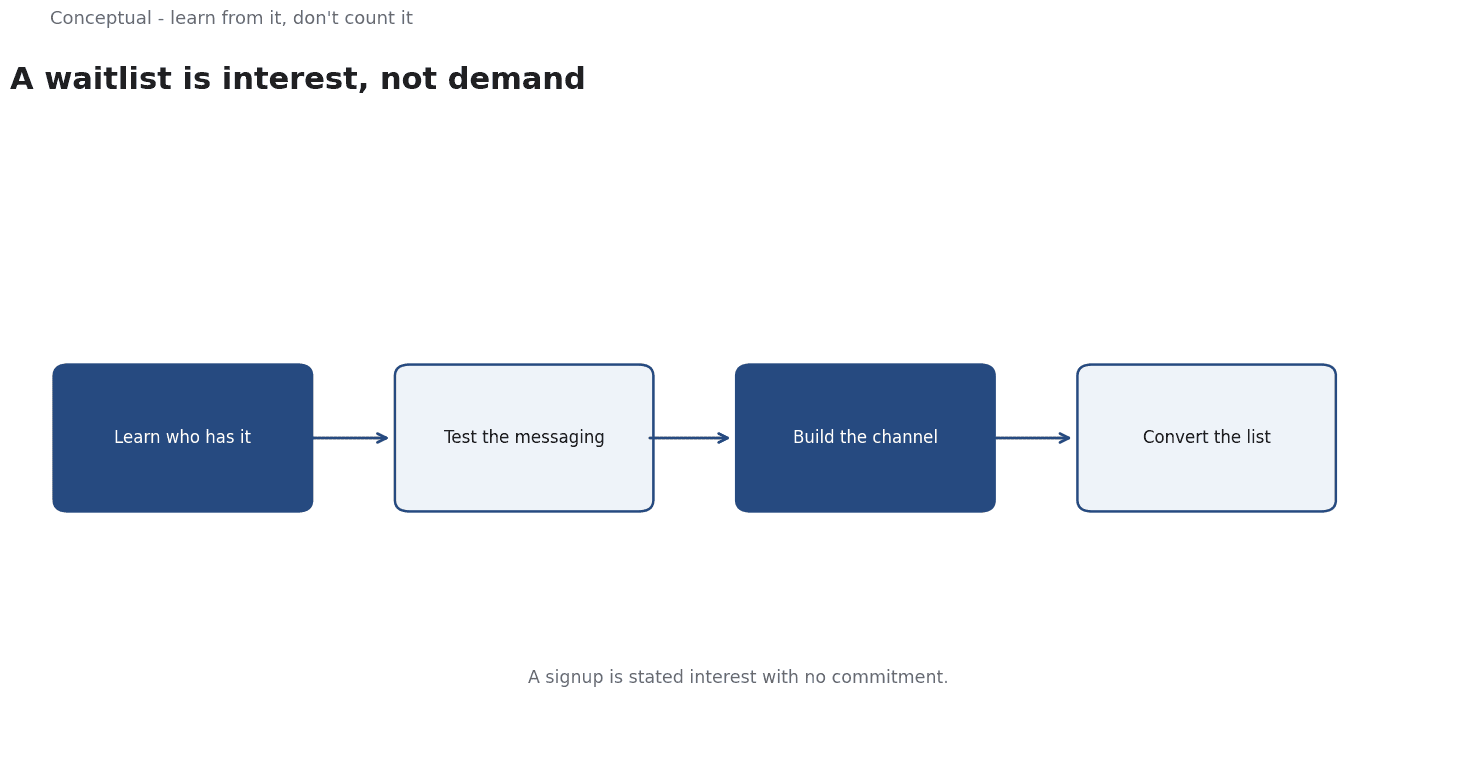
What a waitlist is good for
Learning. Ask signups about their situation and the problem they hope the product solves. The answers shape the product and the positioning, as the customer-journey article recommends for evidence tied to a decision.
Message testing. The signup page is a controlled place to test which promise resonates, using the A/B testing method — with conversion and downstream quality as the metrics, not just clicks.
Distribution. A waitlist is an owned channel for launch, which the newsletter article treats as valuable when it is engaged rather than large.
A worked conversion test
The following is hypothetical and illustrative.
A product collects 10,000 waitlist signups. At launch, three tests:
- Segment by stated need. Survey a sample with AAPOR-style wording — defined population, consistent question — and group signups by the problem they described.
- Test the offer. Send a paid-launch invitation to two matched segments with different value propositions and measure qualified conversion, not opens, as the email-metrics article recommends.
- Compare with a cold channel. Run the same offer to a matched set of non-signups to estimate how much of the response came from the waitlist versus the message, as the geo-experiment guidance recommends for incrementality.
Results might show that the waitlist converts at 8% while the cold channel converts at 3%, which is useful — but the absolute number of customers is 800, not the 10,000 a naive forecast assumed.
Three conclusions follow:
- The waitlist's value is the channel and the learning, not the forecast, which the startup-validation article argues.
- The conversion rate matters more than the size, as the funnel article explains for stage metrics.
- A holdout improves the estimate, which the marketing-attribution article covers for credit rules.
Keeping the list alive
A waitlist decays from the moment it is created. Three practices preserve its value:
Set expectations at signup. State what the product is, roughly when it will be available, and how often the subscriber will hear from you, which the newsletter article recommends for a clear promise.
Send useful content before launch. A short note on the problem the product solves or a decision the team made keeps the list warm, as the content-marketing article argues for value before asks. The email-metrics article covers the guardrails on volume and complaints.
Segment by the stated need. A list grouped by the problem each person described lets the launch message be relevant, which the customer-segmentation article treats as a real difference rather than a cosmetic one.
These practices are why a smaller engaged list often outperforms a large silent one, which the newsletter article argues for net growth over raw signups.
What a waitlist cannot do
It cannot prove willingness to pay. Signing up is free; paying is a different decision, which the startup-validation article treats as the stronger evidence.
It cannot validate a market single-handedly. A waitlist drawn from one channel reflects that channel, as the market-research article explains for sampling.
It stays warm only with attention.
The counterargument — that some famous products launched to a waitlist — is survivorship, which the competitive-intelligence article warns about for success stories.
The method is to measure conversion, not to assume it.
A decision test
- Ask a defined question at signup, with AAPOR-style wording.
- Test the promise with a controlled message test, as the A/B testing article recommends.
- Measure qualified conversion, not signup count or opens, as the email-metrics article advises.
- Compare with a cold channel to estimate incrementality, as the geo-experiment guidance suggests.
- Keep the list engaged with useful content, as How to Grow a Newsletter From Zero explains.
- Treat signups as interest, not commitment, which the startup-validation article argues.
- Record the assumptions in a decision memo, as the decision-memo article recommends.
For the validation frame, see How to Validate a Startup Idea; for the channel, see How to Grow a Newsletter.
References & Further Reading
- Wikipedia contributors, 2026. Demand generation - Wikipedia — An overview of demand generation as a marketing discipline distinct from lead generation; secondary reference used with the lead-generation entry.
- American Association for Public Opinion Research, 2026. AAPOR — The professional association for public opinion and survey research; its standards and resources underpin the survey-design discussion.