Waitlist Campaigns Costs Explained
A waitlist converts interest into a stock you can draw on. Read the real costs, a worked example, and why signups are not demand.
A waitlist looks cheap: a form, a landing page, and a promise. The costs appear elsewhere — in the attention spent acquiring names, in the trust spent if the product is late, and in the conversion work required to turn a name into a customer, as Waitlist and Launch Marketing: Building Demand Before Product treats interest as something built before product, as Referral Programs without the Hype treats incentives as a design with costs, as the unit-economics article requires for contribution.
Direct answer: Count the full cost of a waitlist — acquisition, follow-up, and the credibility risk of delay — and judge it by qualified conversion, not by signup count. The demand-generation overview explains where interest fits, and the viral-marketing entry describes referral-driven growth. The boundary: a large list does not prove demand, which the NPS article warns about stated intentions, as the publication standard forbids guaranteed outcomes, as the evaluation-rubric article requires for concrete measures.
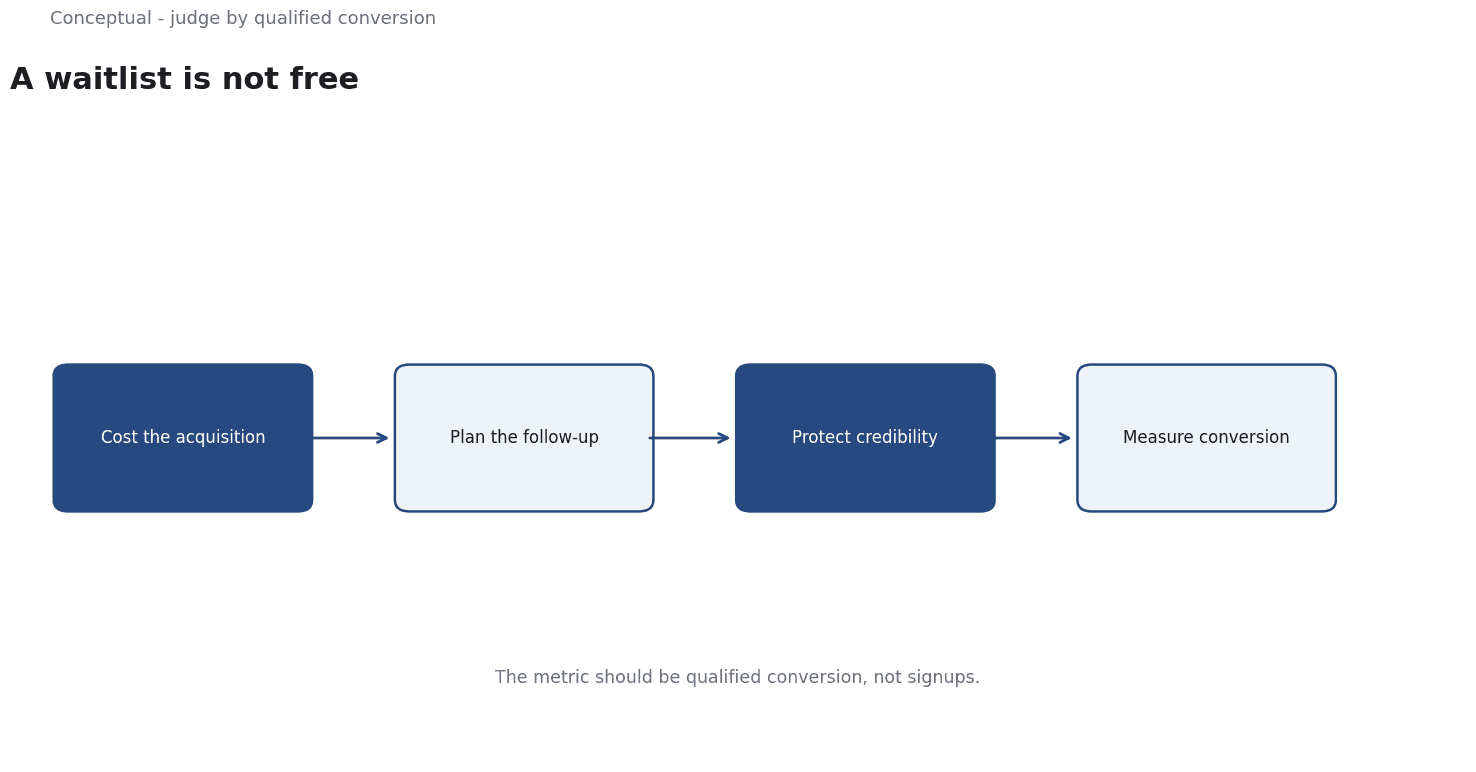
The costs
Acquisition cost. Every signup came from somewhere — ads, content, or word of mouth — and each source has a cost, which the unit-economics article requires, as the marketing-budget article treats allocation, as the cost estimator requires for any spend.
Follow-up cost. A name on a list needs a sequence of messages, which the activation-email article treats as a cost centre, as the email-metrics article warns about activity measures, as the dashboard article argues for metrics tied to decisions.
Credibility cost. A waitlist is a promise to deliver, and delay spends trust, which the crisis-management article treats as reputation recovery, as the value-proposition article argues for claims that hold, as the monitoring article advises for review after change.
Opportunity cost. Attention spent on a list is attention not spent on product or sales, which the small-team time article treats as a shared constraint, as the engineering-management article advises on capacity, as the decision-memo article requires for a recorded judgement.
Three consequences follow.
The metric should be qualified conversion, not signups, as the evaluation-rubric article requires, as the NPS article warns about intentions.
The incentive should be checked for fraud, as Referral Programs without the Hype advises, as the discount article warns about incentives that distort behaviour. And the result should be reviewed, as the monitoring article treats as a trigger.
A worked example
The following is hypothetical and illustrative. A team builds a waitlist before a product launch and collects 5,000 signups.
Three checks decide whether the list is valuable. First, what did each signup cost, as the unit-economics and cost-estimator articles require, across the sources used, as the marketing-budget article advises? Second, how many signups convert when the product is available, as the funnel article advises for stage measures, rather than how many joined, as the NPS article warns about intentions? Third, did the delay before launch damage trust, as the crisis and value-proposition articles advise, with evidence from messages or support, as the voice-of-customer article treats feedback as a signal?
Three conclusions follow. Signup count is a stock, not demand, which the conversion check reveals. Follow-up and credibility are real costs, as the activation-email and crisis articles advise. And the decision should be recorded with the full accounting, as the decision-memo article requires.
What waitlist costs cannot do
They cannot prove demand, which the NPS article treats as a distinction between intention and action, as the evaluation-rubric article requires for concrete measures.
They do not guarantee a launch, which the publication standard forbids claiming, as the go-to-market article treats launch as a process. And they cannot remove the need for a product, which the value-proposition article treats as prior, as the product-marketing article advises for positioning before promotion.
A decision test
- Count acquisition cost by source, as the unit-economics article requires.
- Count follow-up cost, as the activation-email article advises.
- Measure qualified conversion, not signups, as the rubric article requires.
- Check incentives for fraud, as Referral Programs without the Hype advises.
- Track trust through delays, as the crisis article advises.
- Treat intention as intention, as the NPS article warns.
- Record the decision and review after launch, as the decision-memo article requires.
For the build-up, see Waitlist and Launch Marketing; for the incentive cost, see Referral Programs.
References & Further Reading
- Wikipedia contributors, 2026. Demand generation - Wikipedia — An overview of demand generation as a marketing discipline distinct from lead generation; secondary reference used with the lead-generation entry.
- Wikipedia contributors, 2026. Viral marketing - Wikipedia — Growth driven by word of mouth and referral loops.