Webinar and Event Marketing in a Hybrid World
Events create attention that decays fast. Read how to design for the decision, a worked measurement plan, and why attendance is not an outcome.
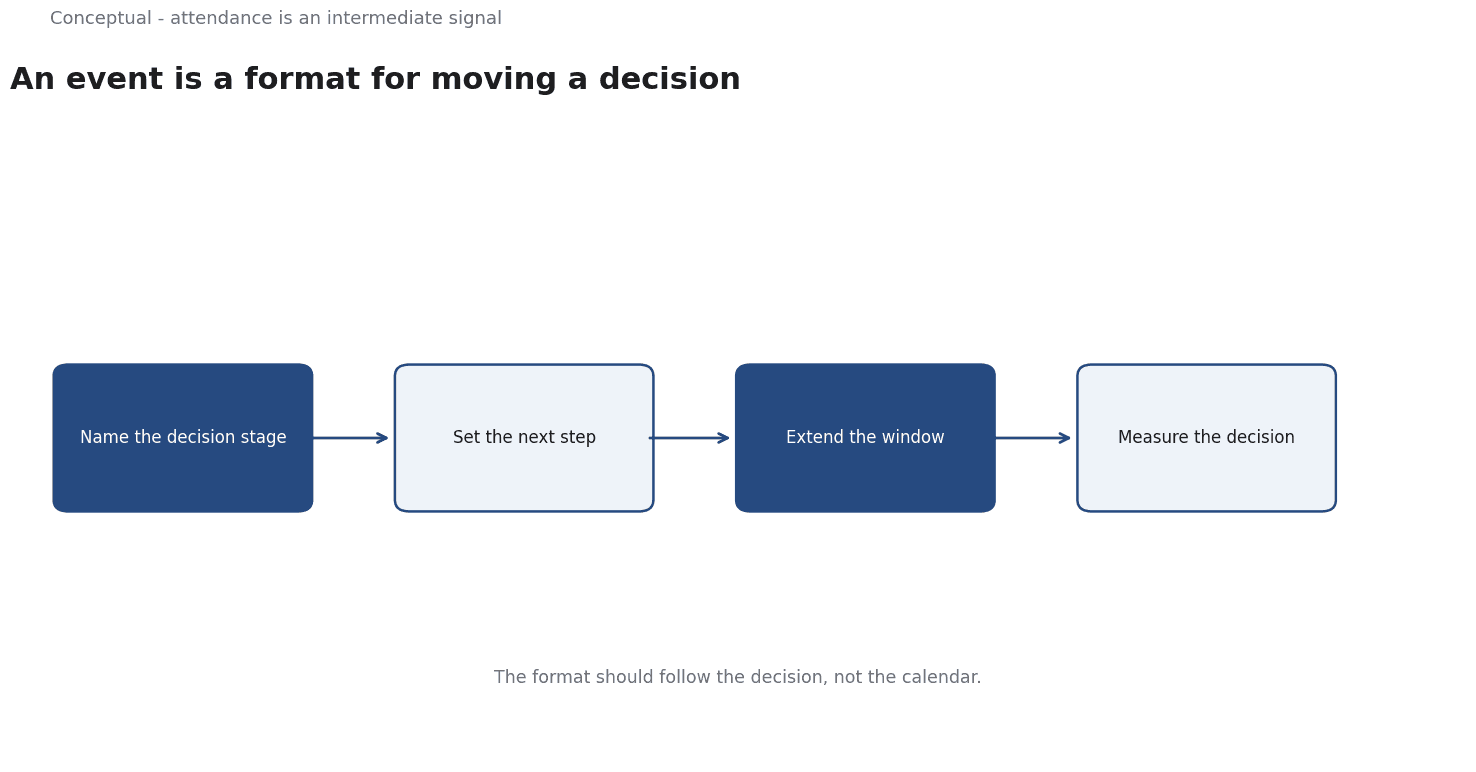
An event can generate a burst of attention that disappears from the calendar by Monday. The reason is usually that attendance was treated as the result. A webinar is a format for moving a decision forward, which means the decision and the follow-up should be designed before the invitation goes out.
Direct answer: Design events around a specific decision stage, with a defined next step and a measurement window that extends beyond the session. Demand-generation principles explain the stage an event serves, and AAPOR's standards apply if you survey attendees about their experience. The boundary: attendance and engagement are intermediate signals, not outcomes, which the email-metrics article argues for other channels, and no format guarantees conversion, as the publication standard states for marketing claims.
What events are good for
Preference building. A useful session teaches something the audience can apply, which the content-marketing article argues for value before asks.
Comparison. A demo or a panel lets a buyer evaluate an approach in context, which the landing-page article treats as a late-stage need.
Community. A gathering lets peers meet, which the community-led-growth article describes as a precondition for interaction.
Three consequences follow:
- The stage decides the content, as the funnel article recommends for stage-matched next steps.
- The next step must be defined — a guide, a trial, a conversation, which the demand-generation article frames as capture.
- The follow-up is part of the event, not an afterthought, as Lifecycle Email: Triggered Messages Across the Customer Journey treats triggered messages as a designed sequence.
A worked measurement plan
The following is hypothetical and illustrative.
A company hosts a webinar for 500 registrants; 200 attend live. Three measurements:
- Attendance quality. How many attendees fit the target segment and are at the intended decision stage, as the segmentation article recommends for real differences? A hundred of the two hundred qualify.
- Next-step rate. How many take the defined action within seven days — a guide download or a demo request, which the funnel article treats as a stage transition? Suppose 25 do.
- Incremental comparison. A matched group that received the content as a static page converted at 12%; the webinar group at 25% among qualifiers. The geo-experiment guidance supports using a comparison to separate effect from background, as the brand-lift article explains.
Three checks decide whether it worked:
- Was the follow-up triggered within a day, as Lifecycle Email: Triggered Messages Across the Customer Journey recommends?
- Did the 12% versus 25% difference hold in a second cohort, as the A/B testing article requires for a reliable result?
- Did attendees find it useful, measured with AAPOR-style wording and a defined population, as the survey standards require?
Three conclusions follow:
- The 200 attendees are not the result, which the email-metrics article argues for intermediate signals.
- The comparison matters, which the attribution article treats as the counterfactual problem.
- The stage decides the metric, as the funnel article explains.
Choosing an event format
The format should follow the decision, not the calendar.
Three matches:
Teaching session for an informational stage, where the value is a method the audience can use, as the content-marketing article recommends for value before asks.
Demo or comparison for a commercial stage, where the value is reducing uncertainty about an approach, which the landing-page article treats as a late-stage need.
Small gathering for a community stage, where the value is peer interaction, as the community-led-growth article describes for preconditions.
The hybrid label matters less than the question of what the audience gains by attending live. A webinar that is simply a lecture with a chat box offers little that a recording cannot, so attendance becomes a courtesy rather than a signal of intent. Teams that design an interaction — a question answered, a decision worked through, a peer exchange — give attendees a reason to show up, and the follow-up then has a natural next step to point back to.
What events cannot do
They cannot create demand from nothing. An event amplifies interest that exists, as the waitlist article treats signups as interest rather than commitment.
They cannot guarantee conversion. No structure guarantees a result, which the publication standard makes explicit for marketing claims.
They cannot replace the product. A good session around a poor experience accelerates disappointment, as the reputation article warns about claims experience contradicts.
The counterargument — that events are expensive and hard to measure — is fair.
The response is to define the decision and the next step before booking the venue, which the decision-memo article recommends for any consequential spend.
A decision test
- Name the decision stage the event serves, as the funnel article recommends.
- Define one next step with a time window, as Demand Generation vs Lead Generation: Where the Funnel Breaks requires.
- Design the follow-up as a triggered sequence, as Lifecycle Email: Triggered Messages Across the Customer Journey advises.
- Measure qualified attendance, not raw registrations, as the segmentation article argues.
- Use a comparison for any effect claim, as the brand-lift article recommends.
- Survey with AAPOR-style wording, with a defined population, for usefulness.
- Review within a defined window, as the monitoring article advises.
For the channel frame, see Demand Generation vs Lead Generation; for the follow-up, see Lifecycle Email.
References & Further Reading
- Wikipedia contributors, 2026. Demand generation - Wikipedia — An overview of demand generation as a marketing discipline distinct from lead generation; secondary reference used with the lead-generation entry.
- American Association for Public Opinion Research, 2026. AAPOR — The professional association for public opinion and survey research; its standards and resources underpin the survey-design discussion.