What Executive Communication Actually Measures
Executive communication is judged by the decisions it changes, not how it sounds. Read what it measures, a worked example, and where the signal fails.
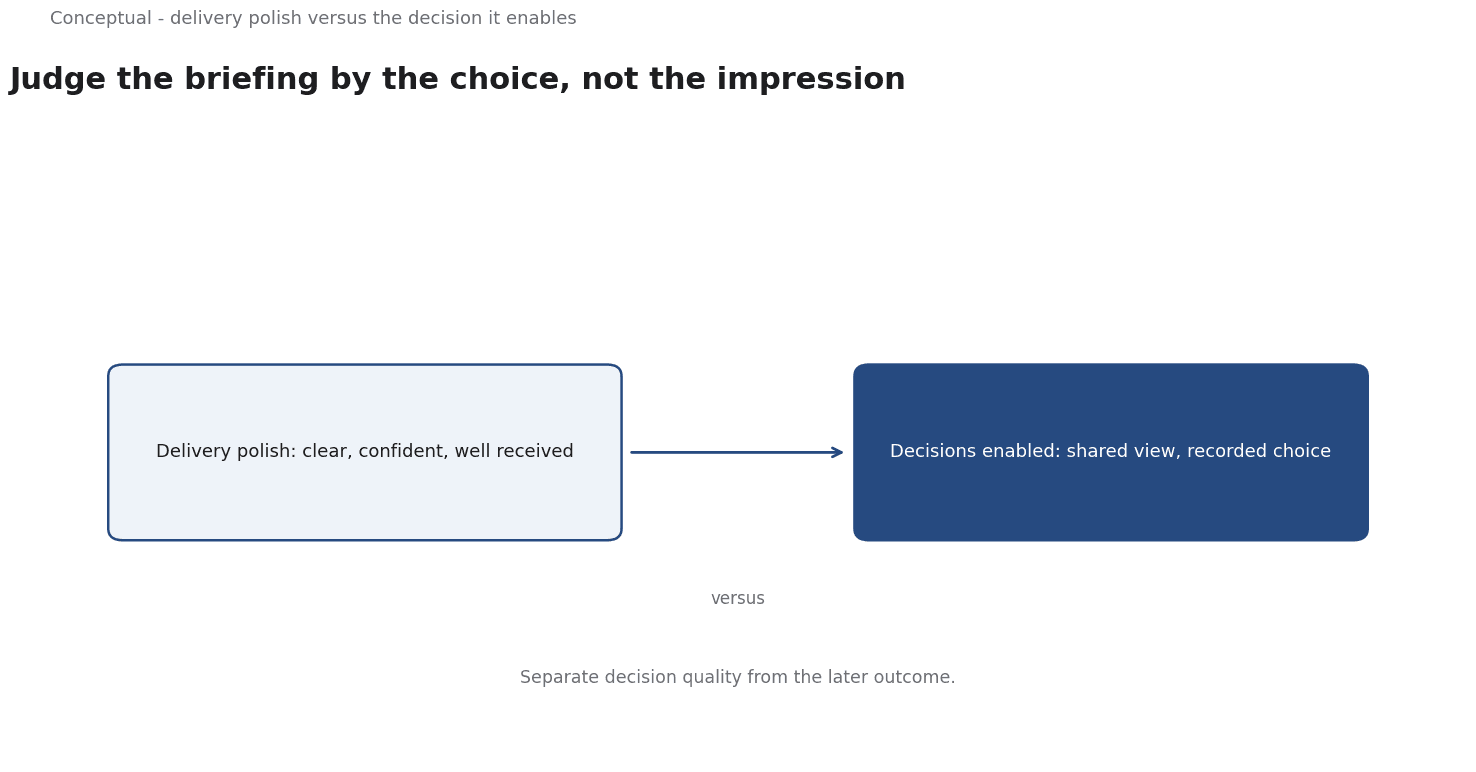
Executives are often judged on how a briefing lands: whether it was clear, confident, and well delivered. The real problem is that polish is easy to observe and hard to connect to anything the organization does afterward. A presentation can draw nods and still leave a room no closer to a decision, so the visible signals of good communication are not the ones that matter most.
Direct answer: Executive communication is best measured by the quality and speed of the decisions it enables, not by the impression it leaves. Wikipedia's public-speaking entry describes how a message is prepared and delivered to an audience, while its decision-making entry frames the selection of a course of action under limited information. The boundary: communication is an input to a decision, so it can be judged only alongside the choice, the evidence, and the context in which the audience acted.
Delta: This article adds a decision framing beyond the sources: it maps the structure of speaking and the nature of judgment to the specific question of what an executive message is accountable for, with claim status explicit.
The mechanism
The public-speaking entry describes speaking to an audience to inform or persuade, covering preparation, audience awareness, and the organization of a message. The mechanism is reduction of effort on the listener's side: a message is structured so that an audience with limited attention can follow it and retain the point. The practical consequence is that clarity is not decoration. A briefing that requires the listener to reorganize the facts before understanding them shifts work onto the person who must also make the decision, and that extra work shows up as delay, questions, or a choice made on partial understanding.
The decision-making entry describes selecting among alternatives when information and attention are limited. The mechanism is bounded judgment: people form a view from the information in front of them and fill the gaps with assumptions. The practical consequence is that an executive message does not simply transfer facts into a room; it shapes which alternatives are considered and which facts are treated as important. Framing a question as a choice between two options narrows the decision, while presenting the underlying constraint can open it back up. The communication is therefore part of the decision process, not a report delivered before it begins.
Together these suggest the proper unit of measurement. If a message is an input to a judgment under limited information, the useful question is what changed in that judgment. Did the audience understand the constraint the same way afterward? Did it identify the real trade-off? Did it commit to a course of action with a visible rationale?
A message that scores well on delivery but leaves these unchanged has not accomplished much, while a plain message that aligns a room around a difficult choice has done exactly what was needed.
The final element is feedback across time. A decision can be well made and still turn out badly, and a poor decision can be lucky. The mechanism is to separate the quality of the communication and the decision process from the quality of the outcome. The practical consequence is that an executive should look for evidence that the room shared a clear understanding at the moment of choice, rather than judging the briefing by what happened later. Without that separation, communication is rewarded or blamed for results it did not control.
A worked example
The following is hypothetical and illustrative. A leadership team is deciding whether to delay a product launch, and an executive prepares a short briefing on the trade-off. Three checks judge the communication. First, the understanding check: can each decision-maker restate the constraint and the two realistic options in the same terms after the briefing? Second, the evidence check: are the figures and assumptions visible, with the uncertainty attached, so the room can see which part of the judgment is fact and which is estimate? Third, the commitment check: does the meeting end with a recorded choice and a rationale, rather than a promise to revisit the matter? The outcome is a decision made quickly with a shared account of why, even if the discussion was plain and unpolished. The limitation is that a shared understanding at the time does not guarantee the decision was correct.
Evidence status
| Claim | Status | Source | Verified | Recheck when |
|---|---|---|---|---|
| Public speaking involves preparing and delivering a message to an audience | source-reported | Public speaking - Wikipedia | 2026-11-18 | when the entry's account of preparation or delivery changes |
| Decision making selects among alternatives under limited information | source-reported | Decision making - Wikipedia | 2026-11-18 | when the entry's model of judgment changes |
| Executive communication is best judged by the decisions it enables | inferred | Derived from the sources | 2026-11-18 | when communication or decision research reframes the link |
The first two rows report what the sources state and can be checked against them directly. The third is an inference: it follows from treating a message as an input to bounded judgment, but neither source offers it as a measure of executive performance. Recheck conditions point back to the sources or to new research, keeping the status of each row explicit rather than implied.
What it cannot do
Executive communication cannot substitute for a sound decision. A clear briefing can make a weak option look reasonable by stating it well, and a confused room can sometimes reach a good answer despite poor framing. The limit is that communication affects the conditions under which a choice is made, not the underlying merits of the choice. Judging a leader solely by how persuasive they were confuses the quality of the delivery with the quality of the conclusion.
A hidden cost is the time spent on presentation at the expense of analysis. Preparing a polished narrative takes effort, and that effort is finite. When it absorbs the time that would have gone into checking the numbers or testing an assumption, the communication improves while the decision it supports gets weaker. There is also a cost in simplification: a message shaped for an audience with limited attention leaves out nuance, and some of what is left out is exactly the exception that should change the decision. The craft of speaking and the duty of accuracy pull against each other.
Agreement, nods, and an easy discussion feel like success, but they can just as easily mean the message was comfortable and the hard trade-off was never surfaced. In a hierarchy, senior presence amplifies this: people may signal agreement because disagreement is costly, leaving an executive with a false reading of alignment. The briefing appears to work because nobody objected, while the real constraint went unexamined and the decision inherits an unspoken assumption.
The boundary is that these sources describe a practice and a process, not a performance standard. The public-speaking entry explains how a message is prepared and delivered; it does not rank communication styles or claim that any technique produces better choices. The decision-making entry describes how judgments form under limits; it does not evaluate executive behavior. Using them responsibly means treating speaking as a way to reduce a listener's burden and decision theory as a way to ask what changed in the room, without presenting the combination as a validated measure of leadership.
Because decisions and organizations change, the measure needs scheduled review. The questions an executive must frame shift with the business, and a briefing format that once produced clear choices can become a ritual that produces agreement only. The practical requirement is to revisit, after major decisions, whether the room genuinely shared an understanding at the point of choice and to record where communication helped or clouded it. Without that review, the measure collapses back into the impressions it was meant to replace.
The counterargument that communication is simply the art of persuasion is fair for settings where winning support is the goal and incomplete for settings where the goal is a shared, well-reasoned choice.
A decision test
- State the decision the message is meant to support.
- Identify what the audience must understand to decide well.
- Separate the facts from the estimates and label each.
- Present the trade-off rather than a preferred conclusion alone.
- Check that decision-makers can restate the constraint afterward.
- Record the choice with its rationale at the end of the discussion.
- Judge the briefing by the decision process, not the later outcome alone.
These steps make communication accountable to something observable. The mapping from audience-centered delivery and bounded judgment to the moment of choice is what turns a soft skill into a testable practice. A passed test leaves a record of what the room understood and why it chose as it did, rather than a memory of who spoke most convincingly.
For further reading, see Decision Memos That Survive Review.
References & Further Reading
- Wikipedia contributors, 2026. Public speaking - Wikipedia — Speaking to an audience and how it is prepared.
- Wikipedia contributors, 2026. Decision-making - Wikipedia — Overview of decision processes, trade-offs and the distinction between the decision and its outcome; secondary reference.