What Initial Public Offerings Actually Measures
An IPO price is a market clearing price, not a verdict on company quality. Read what the sources say it measures, a worked example, and where the interpretation breaks.
An initial public offering sets a price at which shares first trade, and that price is often read as a verdict on the company behind them. The two sources describe the offering process and the idea of valuation. The real problem is that readers treat the IPO price as a measure of intrinsic worth, when what it actually records is a market clearing price under a particular set of conditions.
Direct answer: An IPO measures the price at which a company's shares can be sold to public investors at that moment, which in turn reflects a valuation agreed between the issuer and the market. The sources define the offering and the valuation concept; the reading of that price as a bounded signal is a synthesis. It is not a direct measure of future performance or of the company's underlying quality.
Delta: This article adds a claim-status table and a price-to-decision reading test beyond the sources: it maps the IPO price to a valuation interpretation, with claim status explicit.
The mechanism
The Wikipedia entry on initial public offerings describes the process by which a private company offers shares to public investors. The offering is a financing event: the company raises capital, and ownership becomes tradable on a market. The practical consequence is that the event creates a publicly observed price where none existed before. Before the offering, the company's worth is a private estimate; after it, there is a number that anyone can see.
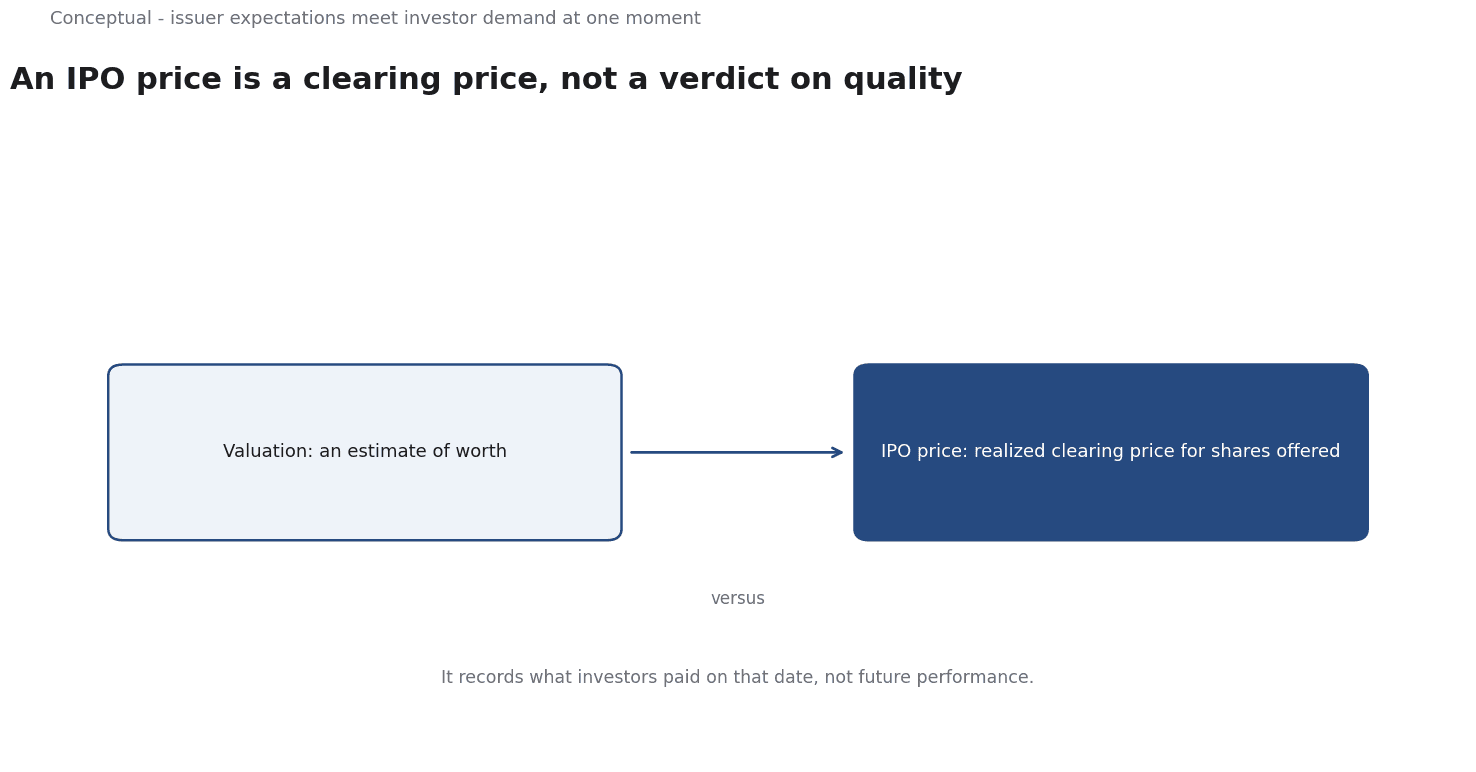
The valuation entry describes the process of determining the worth of a company or asset. Valuation methods produce an estimate, and different methods can produce different numbers depending on their assumptions. The IPO price is where the issuer's expectations and investor demand meet. The practical consequence is that a price is an outcome of an exchange under demand, not a calculation that the market is obliged to accept. A valuation can inform the asking price, but the final price depends on what buyers will pay.
The two concepts link but are not identical.
Valuation is an estimate of worth; the IPO price is the realized clearing price for the shares actually offered.
The gap between an internal valuation and the final price reflects information and sentiment that the sources do not model. They describe the mechanics separately, so the claim that a price is a bounded signal rather than a verdict is an inference about interpretation, not a definition either source states.
The output of a careful reading is a discipline: separate what the event mechanically establishes, namely a price, a float, and capital raised, from what it does not establish about long-term value. The sequence is to identify the event, name the valuation idea behind it, note the conditions of the offering, and then bound the interpretation. Neither source supplies a particular company, price, or date.
A worked example
The following is hypothetical and illustrative. A private software company prices its first public offering, and an analyst reviews what the number can support. Three checks decide the reading. First, is the price being treated as the realized clearing price for the shares offered rather than as a statement of intrinsic worth? Second, which valuation assumptions sit behind the issuer's expectations, and are they stated? Third, what conditions of demand at the time of the offering could change the price without changing the business? The review finds that the headline price supports a claim about what investors paid on that day, but not a claim about future performance. The outcome is a bounded interpretation, not a forecast. The figures are hypothetical; the verification method is the contribution.
Evidence status
| Claim | Status | Source | Verified | Recheck when |
|---|---|---|---|---|
| An IPO offers shares of a private company to public investors | source-reported | Wikipedia, IPO | 2026-11-18 | Offering process revised |
| Valuation is the process of estimating the worth of an asset | source-reported | Wikipedia, Valuation | 2026-11-18 | Definition revised |
| An IPO price is a bounded signal, not a verdict on quality | inferred | Derived from the sources | 2026-11-18 | Market conditions change |
The first two rows are factual claims drawn from the sources. The third is an inference about how to read a price, because neither source labels a market price as a verdict or otherwise. Recheck the definitions when the source entries change, and the inferred claim when market conditions shift enough to change how a clearing price forms.
What it cannot do
An IPO price does not measure the intrinsic quality of a company. It records what a set of investors paid for a set of shares at a point in time, under the demand and information conditions of that moment. The valuation entry describes estimates of worth, but a market price is the result of an exchange, not a direct reading of that worth. A reader who treats the price as a scorecard for management or for the business model is asking the number to carry a meaning the sources do not give it.
The hidden cost is that the price invites comparison where comparison is weak. Two offerings priced at different levels may reflect different floats, different market conditions, or different assumptions rather than a difference in company quality. Drawing a ranking from the numbers alone ignores what each price was conditioned on. That error is easy to make because the figure is single and public, while the conditions behind it are scattered and require work to assemble.
The price is set for the initial sale; once shares trade, the market determines new prices continuously. A first-day price says little about where the shares settle over years, yet the launch number is the one that gets remembered. The sources describe the offering and the idea of valuation, not the long-run behavior of a share price, so extending the launch figure into a forecast is an unsupported step.
There is a boundary around what these sources establish. The offering entry describes how private shares become public and tradable; the valuation entry describes how worth is estimated. Neither supplies a rule for predicting returns, a model of investor behavior, or a judgment about whether any particular offering is fairly priced. A reader expecting an investment thesis will not find one here, and should not treat the mechanisms as a substitute for one. The sources explain what the event is, not what to do with a specific ticker.
Because conditions change, the reading needs review whenever the market environment or the offering structure changes. Each interpretation should carry a recheck condition, and the distinction between the clearing price and the valuation estimate should be restated each time the number is cited. Without that record, a later reader can slide from a bounded claim about what was paid into an unbounded claim about what the company is worth.
The counterargument that an IPO price is fair as a snapshot of investor demand is incomplete when it is read as a verdict on the company's quality.
A decision test
- State what the event mechanically established, including the price and capital raised.
- Identify the valuation assumptions that informed the asking price.
- Note the demand conditions at the time of the offering.
- Separate the clearing price from the estimate of worth.
- Limit the claim to what investors paid on that date.
- Refuse to extend the price into a forecast of future returns.
- Record the interpretation with a recheck date tied to market conditions.
The test keeps the number tied to the event that produced it. By separating the clearing price from the valuation estimate, a reviewer can cite what an offering observed without smuggling in a claim about quality or future performance. For further reading, see Decision Memos That Survive Review.
References & Further Reading
- Wikipedia contributors, 2026. Initial public offering - Wikipedia — First sale of a company shares to public investors.
- Wikipedia contributors, 2026. Valuation (finance) - Wikipedia — Overview of absolute and relative valuation approaches; secondary reference.