What Liquidity Ratios Actually Measures
Liquidity ratios compare current assets to short-term obligations, but working capital timing matters. See what the ratios measure, a worked example, and their limits.
Liquidity ratios are often read as a simple verdict on whether a company can pay its bills. The liquidity-ratio entry describes ratios that measure the ability to meet short-term obligations, and the working-capital entry defines current assets minus current liabilities. The real problem is that a ratio compares balances at a point in time, while the cash needed to pay obligations arrives and leaves continuously.
Direct answer: Liquidity ratios compare current assets with current liabilities to indicate whether short-term obligations can be met. The sources define the ratios and working capital but do not prescribe a threshold or a timing rule. A ratio is therefore a snapshot, and its meaning depends on the quality and timing of the balances behind it.
Delta: This article adds a claim-status table and a cash-timing test beyond the sources: it maps each ratio component to the payment decision it supports, with claim status explicit.
The mechanism
The liquidity-ratio source describes ratios that measure a company's ability to meet its short-term obligations. The current ratio, for example, relates current assets to current liabilities. The practical consequence is that the ratio compresses many balances into a single comparison, which makes it easy to track over time and across companies. Compression is also its weakness: the ratio treats all current assets as equally available and all current liabilities as equally urgent. Two companies with the same ratio can have very different abilities to pay, because the composition behind the number differs.
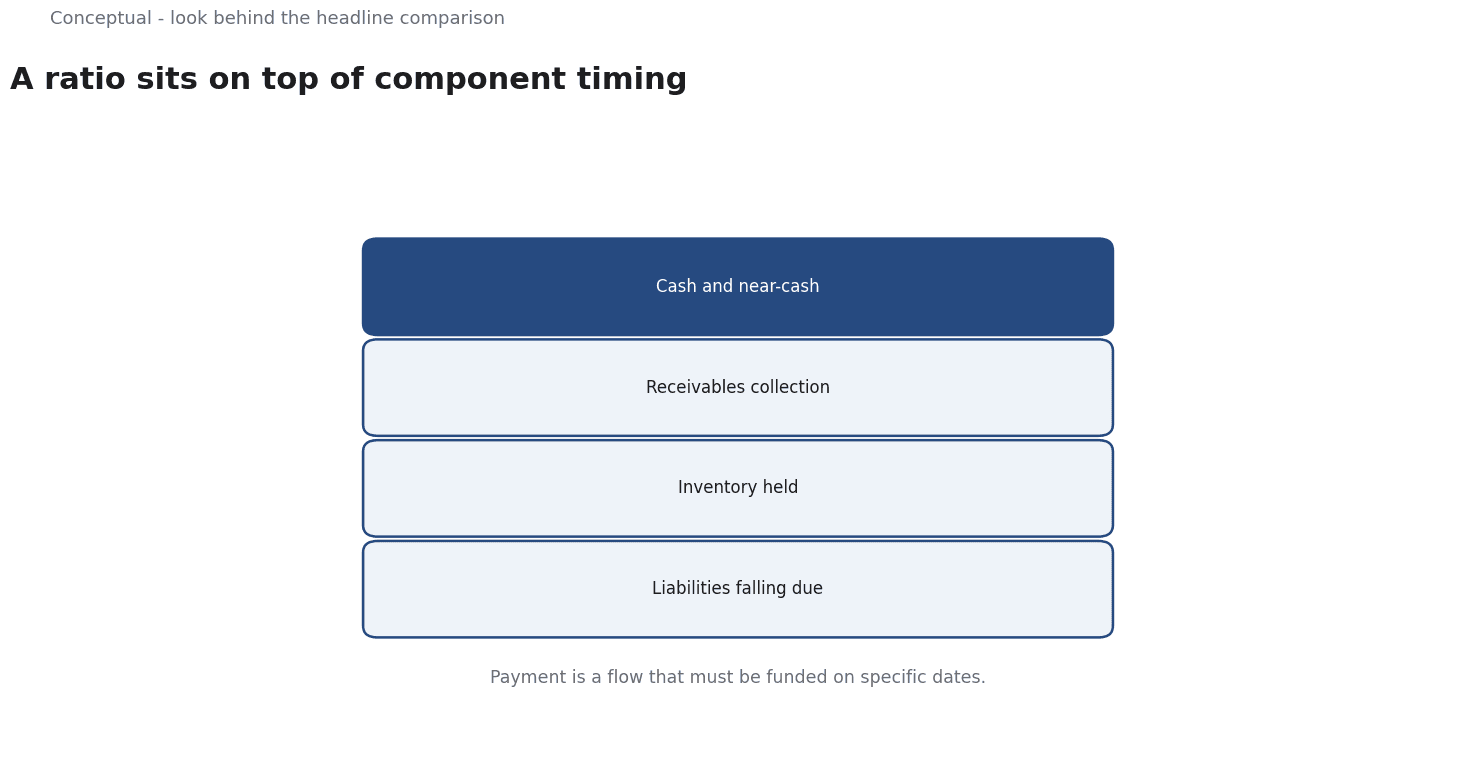
The working-capital source defines working capital as current assets minus current liabilities and notes that a growing business can be cash-constrained. The practical consequence is that growth can consume cash even while the ratio looks healthy. If receivables and inventory expand faster than cash, the balance sheet can show adequate current assets while the bank balance is low.
The ratio measures a stock at a point in time, but payment is a flow that must be funded on specific dates.
Neither source sets a universal target or says which ratio to use for a given decision. That choice is inferred, not source-reported. A useful discipline is to look behind the ratio at the components: how quickly receivables convert to cash, how long inventory sits, and when liabilities come due. A decision about whether to extend payment terms or arrange a credit line depends on that timing, not on the ratio alone. Starting from the payment decision prevents a manager from treating the ratio as a verdict rather than an input.
The consequence for practice is that liquidity should be assessed as a combination of a ratio and a cash timeline. The ratio gives a broad indication of cushion, while the timeline shows whether cash arrives before obligations fall due. Each component should have a definition and an owner so trends can be read consistently. A ratio with no understanding of the underlying timing is a number that can be stable right up to a payment problem. The same logic applies to peers: comparison is useful only when the components are defined the same way.
A worked example
The following is hypothetical and illustrative. A small distributor reviews a current ratio that looks comfortable and asks whether to delay a supplier payment. Three checks decide the review. First, what share of current assets is cash or near-cash, rather than slow inventory? Second, when do the largest liabilities actually fall due relative to when receivables are collected? Third, would delaying the payment improve the timeline or merely shift the problem to another date? The review finds that most current assets are inventory and that a large liability falls due before the receivables arrive. The company arranges a short credit line instead of delaying payment. The figures are hypothetical; the verification method is the contribution.
Evidence status
| Claim | Status | Source | Verified | Recheck when |
|---|---|---|---|---|
| Liquidity ratios measure ability to meet short-term obligations | source-reported | Wikipedia, Liquidity ratio | 2026-11-18 | Definition revised |
| Working capital equals current assets minus current liabilities | source-reported | Wikipedia, Working capital | 2026-11-18 | Definition revised |
| Payment decisions depend on cash timing behind the ratio | inferred | Derived from the sources | 2026-11-18 | Payment cycle changes |
The first two rows restate definitions from the sources. The third row is a synthesis, since neither source provides a threshold or a timing rule. Recheck when the source definitions change, or when the company's payment cycle, receivables, or inventory mix shifts.
What it cannot do
A liquidity ratio cannot tell you whether a specific payment will be made on time. It compares balances, not dates. The liquidity-ratio source describes measurement of short-term ability to pay, not a schedule of cash inflows and outflows. A company can show a healthy ratio and still miss a payment if its cash is tied up in inventory that will not sell before the due date. The ratio is an indicator, not a forecast, and using it as one mistakes a balance-sheet comparison for a cash plan.
The hidden cost lies in the quality of the components. Current assets include inventory, which may be slow or obsolete, and receivables, which may never be collected. Counting them at face value flatters the ratio. The working-capital source notes that a growing business can be cash-constrained, which is exactly the gap a ratio can hide. Investigating component quality takes work that the ratio itself does not require, and a team that stops at the headline number saves that effort at the cost of accuracy.
Two firms may classify the same item differently, or change a classification between quarters, and the ratio will move even when the underlying position has not. A manager who reads that movement as improvement can make a confident but wrong decision. Because the sources define the ratios but do not discuss comparability, this risk is an inference from the gap between definition and use.
There is a boundary around what liquidity ratios cover. They reflect recorded balances at a reporting date, not off-balance-sheet commitments, unused credit lines, or the willingness of a lender to renew. They also say nothing about profitability: a company can be liquid while losing money, or profitable while short of cash. Seasonal businesses can look weak at one date and strong at another. A ratio that ignores these factors is a partial view, and the sources do not claim otherwise.
Because balances and payment cycles change, a liquidity ratio needs periodic review. Each component should be checked against its quality and timing, and the ratio should be read alongside a short cash timeline. Definitions and recheck dates should be recorded with the figure, so a reviewer can see what was included and when it was last questioned. Without that record, a stable ratio can conceal a deteriorating cash position until a missed payment makes it visible.
The counterargument that a single ratio is fair for quick screening is incomplete when it is used to time an actual payment.
A decision test
- Name the payment or financing decision the ratio is meant to inform.
- Recompute the ratio from the current reported balances.
- Break current assets into cash, receivables, and inventory.
- Check when the largest liabilities fall due.
- Compare due dates with expected cash collections.
- Decide whether to pay, delay, or arrange credit based on the timeline.
- Record definitions, owners, and recheck dates with the ratio.
A liquidity ratio is a starting point, not a verdict. The test ties the number to a payment decision and makes the component timing visible, so a reviewer can see when the ratio is reassuring and when cash will actually be needed. For further reading, see Cash Flow Forecasting: A 13-Week Operating Model.
References & Further Reading
- Wikipedia contributors, 2026. Liquidity ratio - Wikipedia — Ratios measuring ability to meet short-term obligations.
- Wikipedia contributors, 2026. Working capital - Wikipedia — Current assets minus current liabilities, and why a growing business can be cash-constrained; secondary reference.