What Local SEO Actually Measures
Local SEO measures visibility in location-based search, not a universal rank. Learn the source definitions, a worked example, and where the metrics break.
Local search results are shaped by where the searcher is, which makes a single ranking number a poor description of performance. The Google SEO starter guide sets out the basics of how search works, and the Wikipedia local search entry describes results tied to a location. The real problem is that local SEO dashboards often report position as if it were universal, when visibility depends on place and intent.
Direct answer: Local SEO measures how visible a business is in searches with geographic intent. The sources describe search basics and the nature of location-based results. The bounded answer is that it is a visibility measure built on relevance and prominence in a place, not a single rank that applies everywhere.
Delta: This article adds a claim-status table and a visibility decision test beyond the sources: it maps each local signal to a business decision, with claim status explicit.
The mechanism
The Google SEO starter guide explains that search engines crawl, index, and rank pages, and that useful, relevant content helps a page perform. Those basics apply to every search, including ones with local intent. The guide emphasizes that there is no single trick: relevance, user experience, and accessibility all matter. The practical consequence is that a local business still needs a site that can be crawled and that answers the query clearly before any local factor is considered.
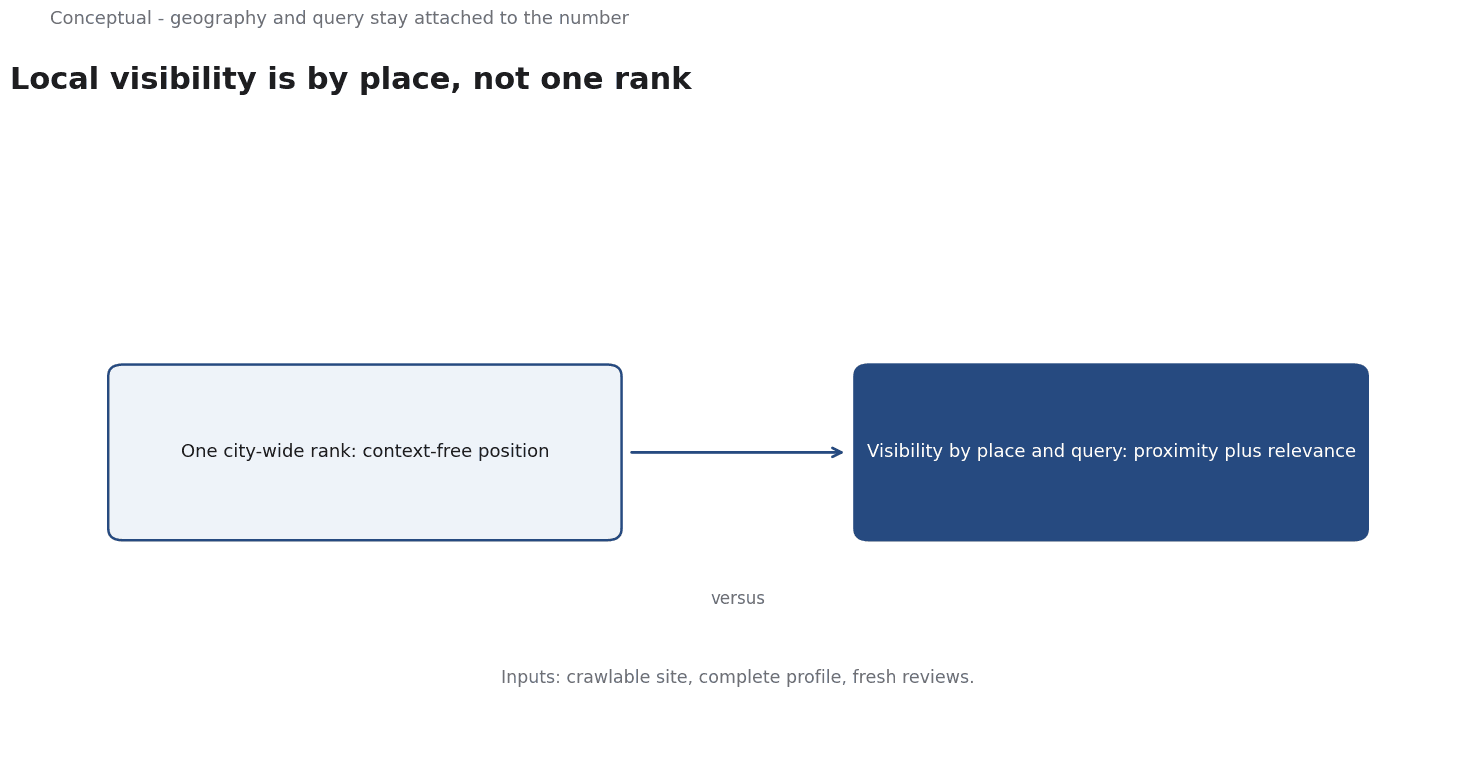
The Wikipedia entry on local search describes results that depend on the searcher's location. A query for a service near a city returns businesses in that area, often with a map or a list of nearby results. The defining feature is proximity: the same query from two places can return different businesses. Prominence and relevance then decide which of the nearby businesses appear. The practical consequence is that a rank measured in one location says little about visibility in another.
A dashboard that collapses this into one number misleads. A business can rank well for a broad term while being invisible in the neighborhood that supplies most of its customers. The mechanism that makes local SEO measurable is to separate the inputs: a crawlable and relevant site from the basics, a complete and accurate business profile, and fresh reviews that signal activity. Each input maps to a different decision and a different owner.
The output is a view of visibility by place and query, not a universal score.
The sources describe how search works and what local search is; they do not prescribe a particular tracking tool or a target position. Those are local choices. The discipline is to keep the geography and the query attached to every measurement, so a reviewer can tell what a number actually describes.
A worked example
The following is hypothetical and illustrative. A hypothetical neighborhood cafe sees its dashboard report a steady rank for a city-wide dining term. Three checks frame the review. First, is the business profile complete, with current hours, address, and category? Second, are recent reviews present and answered, rather than a cluster of old ones? Third, does the site have a page that clearly names the neighborhood and the service? The review finds good city-wide rank but weak visibility within a two-mile radius. The team rewrites the local page and completes the profile. The outcome is a relevance fix, not a rank chase. The numbers are hypothetical; the verification method is the contribution.
Evidence status
| Claim | Status | Source | Verified | Recheck when |
|---|---|---|---|---|
| Search engines crawl, index and rank pages by relevance | source-reported | Google, SEO Starter Guide | 2026-11-18 | Guide updated |
| Local search results depend on the searcher's location | source-reported | Wikipedia, Local search | 2026-11-18 | Definition revised |
| A single universal rank does not predict visits to a specific place | inferred | Derived from the sources | 2026-11-18 | Tracking method changes |
The first two rows report what the sources say: the basics of search and the location dependence of local results. The third is an inference about the limits of a single rank, because neither source addresses measurement dashboards. Recheck the first claim when Google revises the guide and the inferred claim when tracking methods or the local results format changes.
What it cannot do
Local SEO measurement does not predict revenue. The sources describe how search works and what local search is; they do not connect a position to a sale or a store visit. A business can be visible and still fail to convert, because price, hours, and reputation sit outside the measurement. Treating visibility as a proxy for customers is a category error. The honest output is a description of where a business appears in a place, not a forecast of traffic.
The hidden cost is upkeep. A profile needs current hours, a correct category, and photos; reviews need a response; the site needs content that names the place and the service. Each of these is recurring work, and neglect shows up quietly as fading visibility. Teams often budget for a one-time optimization and are surprised when results drift. The cost is paid in ongoing attention to details that never finish.
A business can improve a city-wide position while remaining invisible to the nearby customers who actually visit. A related failure is fake review activity, which can draw penalties and erase the trust the profile depends on. Both problems come from treating the number as the goal rather than as one signal among several. The measurement must stay tied to a place and a query to remain meaningful.
There is a boundary around the method. It covers published search visibility for the queries and places that are tracked. It does not capture word of mouth, paid placement, or the effect of a closed street on foot traffic. Multi-location businesses add complexity, because each location has its own profile and its own local result set. A single aggregate view can hide the weakest location, so the unit of analysis must be the individual place.
Because results and profiles change, the measurement needs a regular review. A competitor can add reviews, a category can be reclassified, and the format of local results can shift. Each signal should carry a recheck condition, and the set of tracked queries should be revisited when the business changes what it offers or where it serves. Without that habit, a dashboard becomes a record of the past rather than a guide to the present.
The counterargument that local rank is fair for comparing nearby competitors is incomplete when the comparison ignores proximity and review recency.
A decision test
- Define the place and the query that matter to the business.
- Check that the site can be crawled and answers the query clearly.
- Verify the business profile is complete and accurate.
- Check review freshness and whether reviews receive a response.
- Measure visibility for the chosen place, not a city-wide term.
- Compare against nearby competitors in the same place.
- Record each signal with a recheck condition tied to a review or profile change.
Local SEO is useful when the place stays attached to the number. The test turns a vague rank into a set of reviewable visibility checks, so a reviewer can see which place and which signal a claim describes. For further reading, see What AI Search Actually Measures.
References & Further Reading
- Google, 2026. SEO Starter Guide: The Basics — The search engine's own description of what it needs from a site.
- Wikipedia contributors, 2026. Local search (Internet) - Wikipedia — Search results tied to a geographic location.