What Mental Models Actually Measures
A mental model earns its keep by predicting something. Read what it measures, a worked example, and why a good explanation can still be useless.
Mental models are often valued for how well they explain the past, which is easy to do after the fact. The Wikipedia entry describes models as representations used in reasoning, and the decision-making entry covers structure and evidence. The measure is whether a model predicts and changes a decision.
Direct answer: Judge a mental model by its predictions on cases not used to build it and by whether anyone acted differently because of it. The sources describe reasoning; the test is a synthesis.
Delta: This article adds a claim-status table and a worked example, separating documented concepts from the local test of usefulness.
The mechanism
The first point is that many models fit any single event. The mental-model entry describes representations, and a representation that explains everything after the fact may predict nothing beforehand. The test is what it would have said before the outcome was known.
The second point is decision relevance. The decision-making entry describes owners and evidence. A model that changes how evidence is interpreted is useful; a model that only provides vocabulary is not, however elegant it feels.
The third point is domain limits. Most models are local to a domain, and applying one outside it produces confident errors. Knowing where a model stops working is part of knowing the model, and that boundary is learned by testing where its prediction fails.
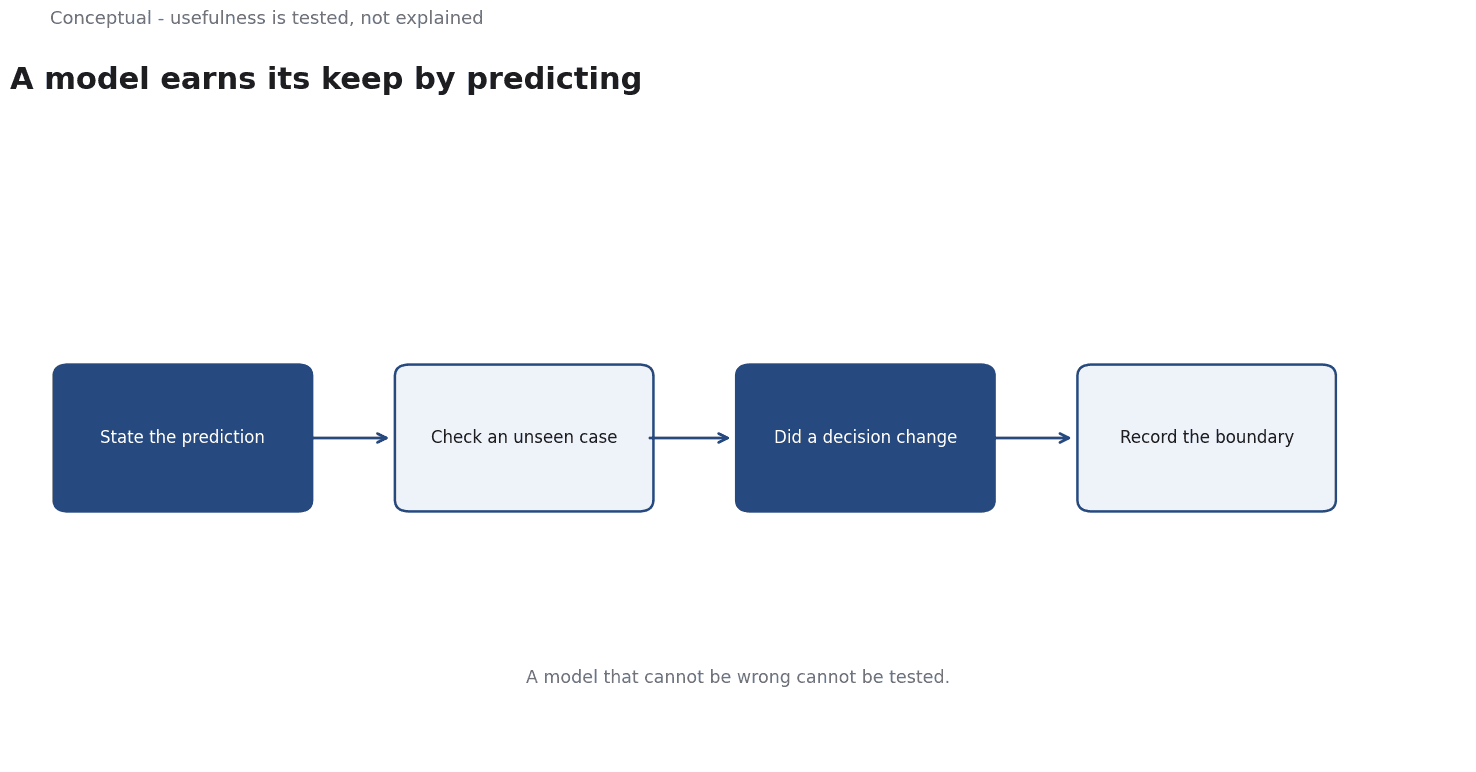
The sequence is: state the prediction, check it on an unseen case, observe whether a decision changed, then record the boundary.
The testing is local work, so the conclusions are inferred; the concepts are source-reported.
A worked example
Illustrative. A team uses the model of incentives to explain a drop in contributions.
Three checks decide. First, what would the model have predicted before the drop, specifically enough to be wrong? Second, did anyone change a decision because of that prediction? Third, in which other situations would the same reasoning mislead, and were those cases considered?
The outcome is a test of the model, not an appreciation of it. The scenario is hypothetical; the method is the contribution.
Evidence status
| Claim | Status | Source | Verified | Recheck when |
|---|---|---|---|---|
| Mental models are representations in reasoning | source-reported | Wikipedia, Mental model | 2026-11-18 | Definition changes |
| Decisions have owners and evidence | source-reported | Wikipedia, Decision making | 2026-11-18 | Source revised |
| Test prediction and decision effect | inferred | Derived from the concepts | 2026-11-18 | Context changes |
Why an explanation can be useless
The useful test is whether it would have led to a different action before the result, which is the only point at which a model can change anything.
A further issue is that models can conflict. Two useful representations may suggest opposite actions in the same situation, and choosing between them requires knowledge of which assumptions hold. That choice is not supplied by either model, which is why a record of the reasoning matters more than the name of the model used.
The test also has a cost. Checking every model on every decision is impractical, so a team must choose which models are worth evaluating. That choice should follow the decisions that matter most, not the ones that are most familiar. A short list of tested models is more useful than a large collection of untested ones.
Finally, a model that has been tested once can fail after conditions change. The boundary it was validated within may no longer describe the situation, which is why the result should carry a date. Revisiting the test after a material change is part of keeping the model useful.
A model should be kept only while it continues to predict, which is a reason to revisit it rather than defend it.
A prediction recorded before the outcome is the cheapest way to make the test honest.
A model that cannot be wrong in principle cannot be tested, which is a reason to be suspicious of it.
What it cannot do
It cannot guarantee a correct decision. It does not replace data. And it cannot make a model universal.
The counterargument that more models always help is fair for breadth and incomplete when none are tested.
A decision test
- State the model's prediction.
- Check it on an unseen case.
- Observe whether a decision changed.
- Note where it fails.
- Record the test and result.
For the related questions, see Mental Models Metrics.
References & Further Reading
- Wikipedia contributors, 2026. Mental model - Wikipedia — How people represent and reason about the world.
- Wikipedia contributors, 2026. Decision-making - Wikipedia — Overview of decision processes, trade-offs and the distinction between the decision and its outcome; secondary reference.