What Personal Branding Actually Measures
Personal branding measures accumulated professional signals, not reputation itself. Learn what the sources define, a claim-status table, and what analytics cannot establish.
Personal branding is often discussed as if a profile or a follower count were the brand itself. The sources describe self-marketing and web measurement in general terms. The real problem is separating what can be observed online from the professional reputation people actually form.
Direct answer: Personal branding is the practice of shaping how others perceive a person's professional value, and web analytics records the online traces that result. The sources define these two ideas but do not equate visibility with reputation.
Observable signals are evidence about reach, not proof of how a person is regarded.
Delta: This article adds a claim-status table and a signal-to-decision mapping beyond the sources: it maps observable brand signals to career choices, with claim status explicit.
The mechanism
The personal branding entry describes the practice of presenting oneself as a brand, usually with the aim of shaping how others perceive one's work and value. It is an intentional activity: a person chooses what to emphasize, where to appear, and which work to make visible. The emphasis on perception matters, because a brand exists in the minds of other people rather than in the profile itself. A profile is an artifact; the brand is the association that others form after encountering it.
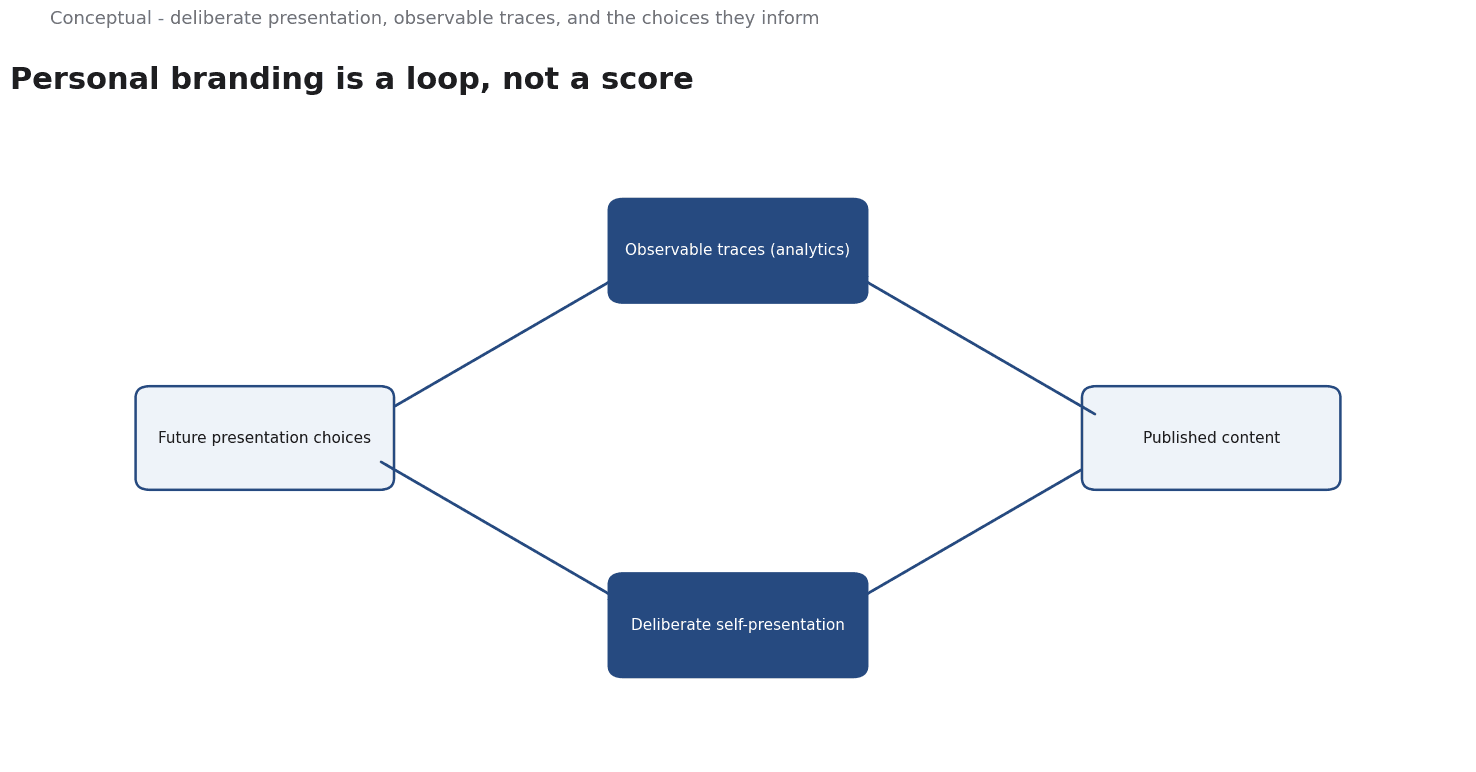
Web analytics provides the measurement side of the picture. As the source describes it, analytics collects, reports, and analyzes web data such as visits, page views, and referrals. Applied to a personal site or portfolio, these tools can show how many people arrived, which pages they read, and where they came from. That is genuinely useful information about reach. The practical consequence is that a person can observe which work attracts attention and adjust what they publish. The measurement is of events on pages, not of opinions held by people.
The gap between the two is where most confusion lives. A source can tell you that a post was read or that a page was visited; it cannot tell you that a reader formed a durable impression or changed a decision about you. Reputation is formed through experience, word of mouth, and repeated exposure, most of which leaves no trace in analytics. Because the sources describe branding and measurement separately, linking a metric to a reputation outcome is an inference, not a documented fact.
That inference has a practical discipline attached to it. A person should state which decision a signal is meant to inform before treating it as meaningful. Follower counts may inform where to spend time; referral sources may inform which topics to write about. Neither establishes that professional standing improved. The mechanism is therefore a chain: deliberate self-presentation produces content, content produces observable traces, and traces inform choices about future presentation. Each link is local and must be checked rather than assumed.
A worked example
The following is hypothetical and illustrative. A consultant considers a personal branding effort after seeing that a portfolio page gets steady analytics traffic. Three checks shape the decision. First, the consultant asks what decision the traffic is meant to inform, such as which topic to write about next. Second, the source of visits is examined to see whether readers arrive from searches, from social shares, or from direct links. Third, the consultant looks for signals beyond page views, such as inquiries or invitations, that might indicate a professional effect. The checks show that traffic is high but produces no inquiries, while a smaller page drives most referrals. The consultant shifts focus to that topic. The figures are hypothetical; the verification method is the contribution.
Evidence status
| Claim | Status | Source | Verified | Recheck when |
|---|---|---|---|---|
| Personal branding is the practice of shaping others' perception | source-reported | Personal branding - Wikipedia | 2026-11-18 | Definition revised |
| Web analytics collects and reports web data such as visits | source-reported | Web analytics - Wikipedia | 2026-11-18 | Definition or scope changed |
| Link an observable signal to a career decision before trusting it | inferred | Derived from the sources | 2026-11-18 | Goals or measurement setup changes |
The first two rows restate definitions from the source entries and can be checked directly. The third row is a synthesis, since neither source connects a metric to a career choice. Recheck the definition rows if the source entries change, and recheck the inferred row when the person's goals or measurement setup change.
What it cannot do
Personal branding signals cannot establish that a reputation changed. Analytics can show that a page was visited or a post was viewed, but the sources describe collection of web data, not the formation of opinion. A reader can visit without forming any lasting impression, and a strong impression can form through a conversation that never touches an instrumented page. Treating a traffic figure as proof of professional standing mistakes a trace of attention for a judgment about value. The signal is real; the interpretation is not.
The hidden cost is the time spent maintaining visibility instead of doing the work that the visibility is supposed to reflect. Personal branding rewards consistent output, and the effort spent producing and promoting content can displace the deeper practice that gives the content substance. There is also a cost to measuring what is easy: page views are simple to count, while trust and credibility are not. A person who optimizes the countable signal may drift toward topics that attract clicks rather than work that builds a career. The sources do not discuss this cost, so it is an inference.
A large following can coexist with a weak reputation among the people whose opinion matters, such as peers, clients, or hiring managers. Metrics treat all visitors alike, so a thousand casual readers and one meaningful introduction look different only if someone separates them. A related failure is over-interpreting small changes: a weekly swing in visits is usually noise, but it can trigger a rewrite of strategy. Without a stated decision, the numbers invite stories they cannot support.
There is a boundary around what online measurement covers. Much professional reputation is built in private settings, through work product, references, and conversations that leave no digital trace. The sources describe self-presentation and web data, so they cannot speak to those settings. Branding also operates over long periods, while analytics reports short windows; a monthly view can miss the slow accumulation that actually changes how a person is regarded. A signal from one period is a snapshot, not a verdict on a career.
Because both goals and platforms change, a personal branding effort needs periodic review. The topics that attract attention shift, and a signal that informed a decision last year may now be irrelevant. The measurement setup also drifts when platforms change how they report referrals or when tracking is altered. A short record of which signals informed which decisions, with a recheck date, keeps the effort honest. Without it, a person can keep producing content that looks successful in the dashboard while serving a goal they no longer have.
The counterargument that measurable signals are fair as a rough proxy for reach is reasonable for tracking output and incomplete for judging reputation, since attention does not equal regard.
A decision test
- State the career decision the branding effort is meant to inform.
- List the observable signals currently being tracked.
- Ask whether each signal would change that decision.
- Check the source of the signals, such as search, social, or direct.
- Look for non-digital signals like inquiries or introductions.
- Drop signals that inform no decision.
- Record definitions and a recheck date for the remaining signals.
Personal branding is best treated as deliberate self-presentation checked against observable signals, not as a score to maximize. The test ties each signal to a decision and keeps the limits visible, so reputation claims are not made from page views alone. For further reading, see Marketing Dashboards without the Hype.
References & Further Reading
- Wikipedia contributors, 2026. Personal branding - Wikipedia — How individuals build a professional reputation.
- Wikipedia contributors, 2026. Web analytics - Wikipedia — Collection and interpretation of website behaviour data.