Zero-Click Content: Value When Nobody Clicks
Many answers are consumed without a visit. Read how to measure value beyond clicks and what a zero-click presence can and cannot do.
A search engine or answer engine can satisfy a question directly, with no visit to your site. For years, that was treated as a lost opportunity because analytics counted clicks. The more useful view is that the impression itself can create value — recognition, trust, and a path to a later decision — provided you measure what can actually be observed.
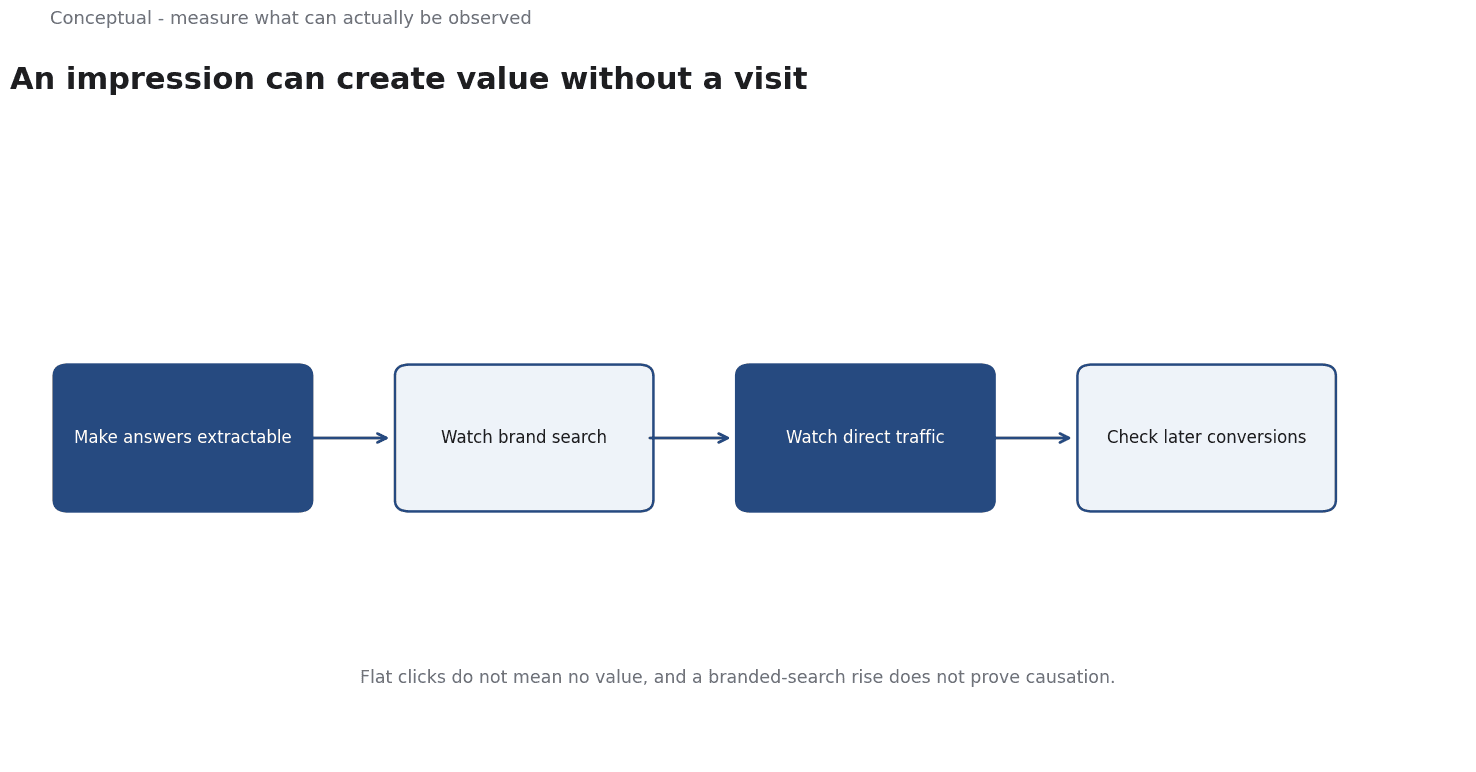
Direct answer: Zero-click content delivers value through an answer shown in the results, not through a visit, and should be evaluated with observable signals such as brand search, direct traffic, and later conversions rather than clicks alone. The measuring-GEO article covers what can and cannot be counted, and demand-generation principles explain the preference-building stage an answer serves. The boundary: no tactic guarantees inclusion or citation in an answer engine, and attribution is weak, which the publication standard makes explicit for GEO.
What value looks like
Recognition. A useful answer with your name attached can make a brand familiar, which the brand-awareness article measures through recall and branded search rather than clicks.
Trust. An answer that cites a source accurately can establish credibility before a visit, as the reduce-hallucinations article argues for grounded claims.
Path to a later decision. A reader who gets an answer today may search for your product when the need becomes real, which the funnel article treats as a stage transition, not an immediate conversion.
Three consequences follow:
- Clicks are a partial metric, which the email-metrics article argues for other channels as a lesson about intermediate signals.
- The content must be extractable — a direct answer with a clear scope, as the AI-search keyword article recommends.
- Attribution is weak, so a holdout or a trend is more honest than a precise claim, as the measuring-GEO article explains.
A worked measurement approach
The following is hypothetical and illustrative.
A company publishes answer-first content for ten common questions in its domain. After a quarter:
- Direct answers appear in results for eight of the ten questions, observed by manual checks.
- Branded search rose 15% against the prior quarter, with a matched category trend of 4%.
- Direct traffic rose 8%, while clicks from the content pages were flat.
Three checks decide what can be claimed:
- Observation, not assumption. The eight appearances were checked manually, as the measuring-GEO article recommends for observable signals, not inferred from a tool's estimate.
- Comparison. The 15% branded-search rise against a 4% category trend is the useful figure, which the geo-experiment guidance supports for separating effect from background, as the brand-lift article explains.
- Honesty about attribution.
Three conclusions follow:
- The evidence is directional, which the measuring-GEO article treats as the honest standard for AI-search visibility.
- A longer horizon is needed, as the brand-awareness article distinguishes short spikes from lasting preference.
- The content is useful independent of inclusion, because it serves real questions, which the content-marketing article argues for value before distribution.
Designing for extraction and recall
Content that may be consumed without a visit needs two qualities: it must be easy to extract and easy to remember. Three practices help:
Answer first. Put the direct answer at the start of the relevant section, with the scope stated, which the AI-search keyword article recommends for answer engines.
Make claims attributable. Include a source, a date, and a denominator with any number, as the data-governance article requires for relied-upon figures.
Repeat the identity, not the pitch. A consistent name and a clear statement of what the company does help recognition, which the brand-consistency article treats as the meaning that must travel intact.
These practices help whether or not a click follows, which is the point of measuring a zero-click presence with brand signals rather than visits.
What zero-click content cannot do
It cannot guarantee a citation. No structure guarantees inclusion in an AI answer, which the publication standard states explicitly for GEO.
It cannot replace a product page. An answer builds familiarity; the decision still needs a destination, which the landing-page article explains for B2B buyers.
It cannot be measured precisely with current tools. The measuring-GEO article is explicit about what cannot be counted, which the keyword-research article reinforces by refusing to invent volume figures.
The counterargument — that no click means no value — assumes a single attribution model.
The funnel and brand-awareness articles explain how preference created earlier shows up in a later decision, which a click-only view misses.
A decision test
- Write a direct, scoped answer to a real question, as the AI-search keyword article recommends.
- Observe appearances manually rather than trusting estimates, as the measuring-GEO article advises.
- Track branded search and direct traffic with a comparison, as the brand-lift article explains.
- Use a longer horizon than a single quarter, which the brand-awareness article recommends.
- Keep a destination for the later decision, as the landing-page article argues.
- Label attribution as weak, which the marketing-attribution article requires.
- Do not promise inclusion, which the publication standard forbids for GEO tactics.
For the measurement limits, see Measuring GEO; for the content method, see Keyword Research for AI Search Answers.
References & Further Reading
- Wikipedia contributors, 2026. Demand generation - Wikipedia — An overview of demand generation as a marketing discipline distinct from lead generation; secondary reference used with the lead-generation entry.
- American Association for Public Opinion Research, 2026. AAPOR — The professional association for public opinion and survey research; its standards and resources underpin the survey-design discussion.