Cloud Cost Optimization: FinOps, Right-sizing, and Reserved Instances
Cloud cost is a continuous engineering discipline, not a quarterly finance exercise. Read the mechanism behind right-sizing, commitments, and showback.
Cloud cost has a reputation for being mysterious, and much of that mystery is self-inflicted. The bills are detailed, the pricing models are published, and the reason teams cannot explain their spend is usually that nobody owns the connection between what engineers build and what finance pays. FinOps exists to close that gap.
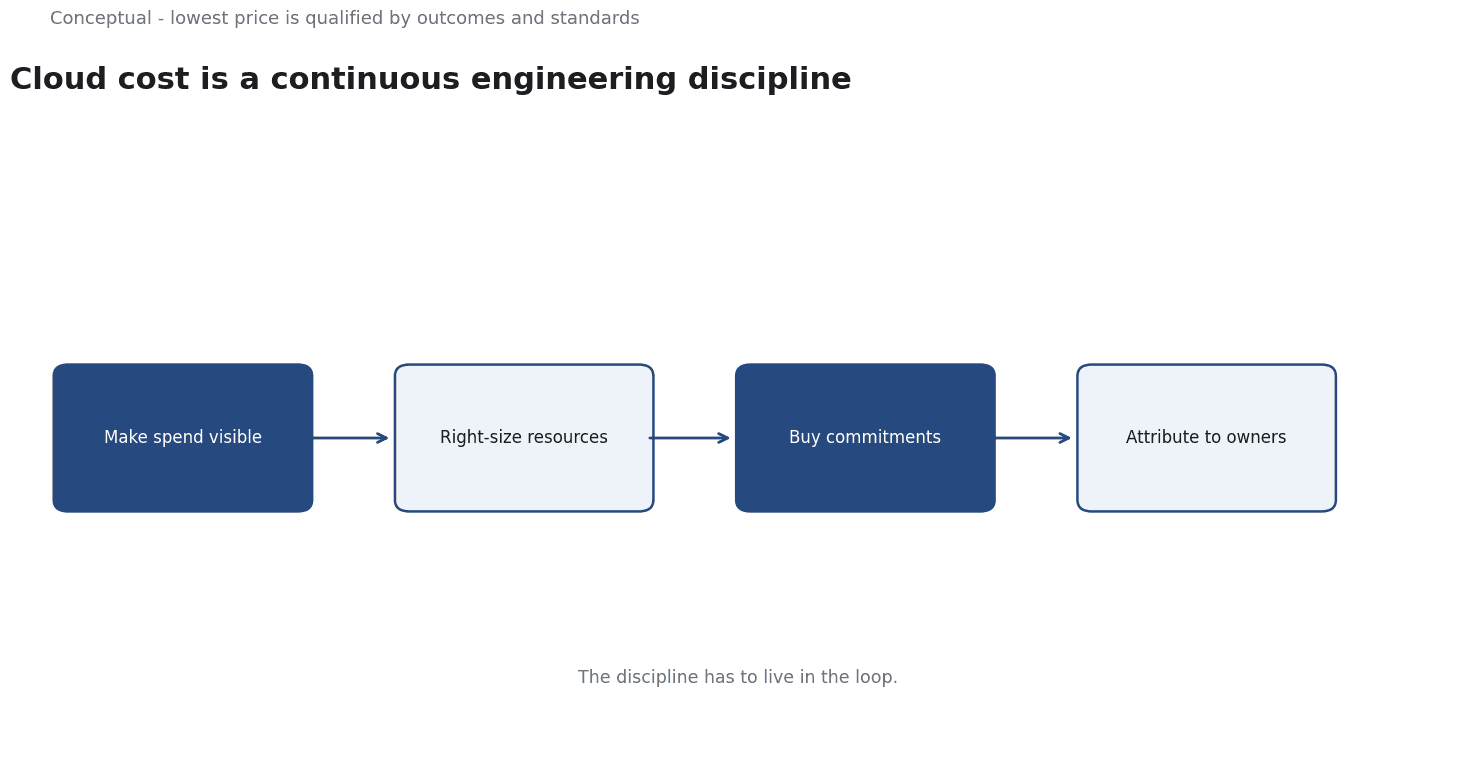
Direct answer: FinOps is the practice of managing cloud cost as a shared engineering and financial responsibility. The AWS Well-Architected Framework describes a cost-optimised workload as one that "delivers business outcomes at the lowest appropriate price point while meeting its functional requirements and your performance, reliability, security, and sustainability standards" — note that "lowest" is qualified by outcomes and standards. Cloud cost optimisation "differs from traditional on-premises environments because it emphasizes continuous improvement, automation, and alignment between resource consumption and business outcomes, rather than capacity prediction and procurement". The practical tools are visibility, right-sizing, commitment-based discounts, and a cultural habit of treating spend as a property of the system.
Why the on-premises playbook fails
In a data centre, capacity is bought in advance and mostly fixed. The dominant question is whether you bought enough, and the cost is largely sunk by the time the workload runs.
In the cloud, capacity can be added in seconds and removed just as quickly, and the pricing reflects that flexibility. The consequence is that cost becomes a runtime property of the system, driven by decisions that engineers make every day: instance sizes, storage tiers, data transfer paths, retention periods, and whether an environment is switched off at night.
AWS's framing is explicit: the emphasis is on "continuous improvement, automation, and alignment between resource consumption and business outcomes". A quarterly review cannot manage something that changes hourly, which is why a one-off cost-cutting project always decays.
The discipline has to live in the loop.
The three levers
Right-sizing means matching resources to actual demand. Instances are frequently oversized because they were chosen conservatively at launch and never revisited, because a burst became permanent, or because a service's memory profile changed. The measurement is straightforward — CPU and memory utilisation over a representative window — and the obstacle is usually the perceived risk of changing something that works.
A useful caution: right-sizing to average utilisation can break a service whose load is spiky. The target is the workload's actual performance requirement, not a utilisation percentage. The AWS definition explicitly includes performance and reliability standards, which is the reminder that the cheapest instance is not the right one if it fails under load.
Commitment-based discounts — reserved instances and savings plans — trade flexibility for price. If a workload is stable and long-running, committing to a quantity of usage reduces cost substantially; if the workload is uncertain, the commitment becomes an obligation you pay whether or not you use it. The decision requires a forecast with a stated confidence level, and it should be revisited when the workload changes.
The term "reserved instances" in the article title is a reminder that the mechanism is a commercial contract, not a technology setting. A commitment made for a service that is later replaced is a real financial loss.
Visibility and attribution — FinOps calls this showback or chargeback — makes spend visible to the teams that create it. The FinOps Foundation describes its role as "advancing the people who manage the value of technology", which is a cultural claim: the point is not a dashboard but a shared understanding of what the spend buys.
A worked example of right-sizing
Suppose an environment runs ten instances at a size costing 200 a month each, so 2,000 a month total. Monitoring shows average CPU at 12% and peak at 30%, with memory comfortably below the limit. Moving to a size costing 100 a month would halve the compute bill to 1,000, provided the smaller size still meets the performance standard during peaks.
The decision is not automatic. Three questions decide it:
- Is the measurement window representative? A quiet month after a launch or before a campaign will understate demand.
- What happens at the peak? If the service degrades when CPU reaches 30%, the instance was not oversized; the application needs profiling.
- Does the smaller size change other costs? A change in instance family can affect network performance, storage throughput, or licensing, and the saving should be net of these.
If those checks pass, the 1,000 a month is a real saving. If the measurement window was unrepresentative, the saving is temporary and the incident that follows costs more.
The same arithmetic applies to idle resources: a development environment left running outside working hours can be sized correctly and still waste most of its spend. Scheduling shutdowns is often a faster win than changing instance types.
A worked year of commitment planning
The commitment decision becomes concrete with a small calculation. Suppose a service runs ten instances continuously at 200 a month each, so 2,000 a month or 24,000 a year of on-demand spend. A one-year reserved commitment for the same capacity might cost the equivalent of 130 a month per instance, or 15,600 a year — a saving of 8,400.
That saving is only real if the capacity is needed for the full year. Three scenarios change the answer:
- The service is retired in month six. The commitment still costs 15,600 while on-demand spend would have been 12,000. The commitment has lost 3,600.
- The workload doubles in month four. The original commitment covers half the need; the rest is bought at on-demand rates, and the total is higher than either a larger commitment or a flexible plan would have produced.
- Instance sizes change after a right-sizing exercise. The commitment is tied to a specific type and region, and moving to a smaller family makes part of it unusable.
The decision therefore depends on a forecast with an explicit confidence level and a review date. A sane policy commits to the stable floor of demand — the load that will certainly be there — and leaves the variable part on demand or under a flexible savings plan. Committing the peak is a bet that the peak persists, which is usually wrong.
A second term matters for the whole bill: data transfer. Right-sizing compute can be undone by moving data between regions or out to the internet at scale. AWS's definition of a cost-optimised workload includes the requirement to meet "functional requirements and your performance, reliability, security, and sustainability standards" — a reminder that the cheapest architecture is not the one with the smallest instance bill.
The organisational part is the hard part
The technical levers are well understood. The difficult work is making cost a property that engineers own, because the incentives usually point the other way: shipping features is visible, while avoiding spend is invisible unless something goes wrong.
Three habits make the cultural change concrete:
- Showback with context. Report spend by service, team, and environment, with the business outcome it supports. A number without context produces arguments about allocation rather than decisions about value.
- Cost in the design review. Ask about the ongoing cost of a new service at the same time as its reliability and performance. A design that is technically excellent and economically inappropriate is not finished.
- An owner for the total. Someone has to be accountable for the whole bill, including the resources nobody claims — which are usually where the largest waste sits.
The FinOps Foundation's emphasis on community and certification reflects this: the discipline is partly about tooling and largely about people who know how to use it.
What to measure
- Spend by service and environment, with the owner named.
- Utilisation against performance requirements, not against an arbitrary target.
- The share of spend under commitment, with the expiry dates and the workloads covered.
- Idle and orphaned resources — volumes with no attached instance, environments with no traffic.
- Cost per unit of business output, such as cost per transaction or per active customer, because absolute spend can rise for good reasons.
- The time from an anomaly to its detection, because a cost spike noticed in the quarterly bill has already been paid.
For the operational practice that makes this manageable, see DevOps; for the statistical idea of alerting on rate of change, see Site Reliability Engineering.
A counterargument
The article presents FinOps as neutral engineering hygiene, and a critic would question that framing. The AWS definition it quotes makes "lowest appropriate price point" conditional on performance, reliability, security, and sustainability standards - so deciding what is "appropriate" is a governance choice about which standard yields, not a measurement the dashboard can settle.
Calling the responsibility "shared" can obscure that someone still decides whose reliability margin is spent to hit the number.
The worked right-sizing example also assumes instance size is the unit of optimisation, but the cited Kubernetes autoscaling documentation points to a world where capacity follows demand automatically and the saving lives in architecture and scheduling, not in a smaller instance type. Finally, commitment discounts reward predictability, which quietly biases an organisation toward keeping stable workloads rather than replacing them - a commercial incentive against exactly the continuous improvement the discipline claims to promote.
References & Further Reading
- FinOps Foundation, 2026. The FinOps Foundation — The cross-industry framework for managing cloud cost as an engineering discipline.
- Amazon Web Services, 2026. Cost Optimization (AWS Well-Architected Framework) — Vendor primary documentation on right-sizing and commitment models.
- Amazon Web Services, 2026. Well-Architected Cost Optimization Pillar — Right-sizing, commitment discounts, and cost allocation in one framework.
- Kubernetes Documentation, 2026. Autoscaling — The scheduling primitives that make per-workload demand and cost visible.