Cold Start Problem in Recommender Systems: Strategies for New Users and Items
Collaborative filtering cannot recommend what it has never seen. Read the three cold starts and the strategies that actually address each.
Every recommender works by learning from past behaviour, and every system meets a moment when there is no past behaviour to learn from. A new user has no history; a new item has no interactions; a new platform has neither. The cold start is not an edge case in a catalogue that grows — it is the permanent condition at the boundary of the system.
Direct answer: There are three distinct cold starts — user, item, and system — and they require different responses. User cold start needs information about the person beyond their behaviour; item cold start needs information about the item beyond its interactions; system cold start needs a strategy that does not depend on personalisation at all. Content-based signals, side information, and a deliberate onboarding moment are the standard instruments, and each trades precision for coverage.
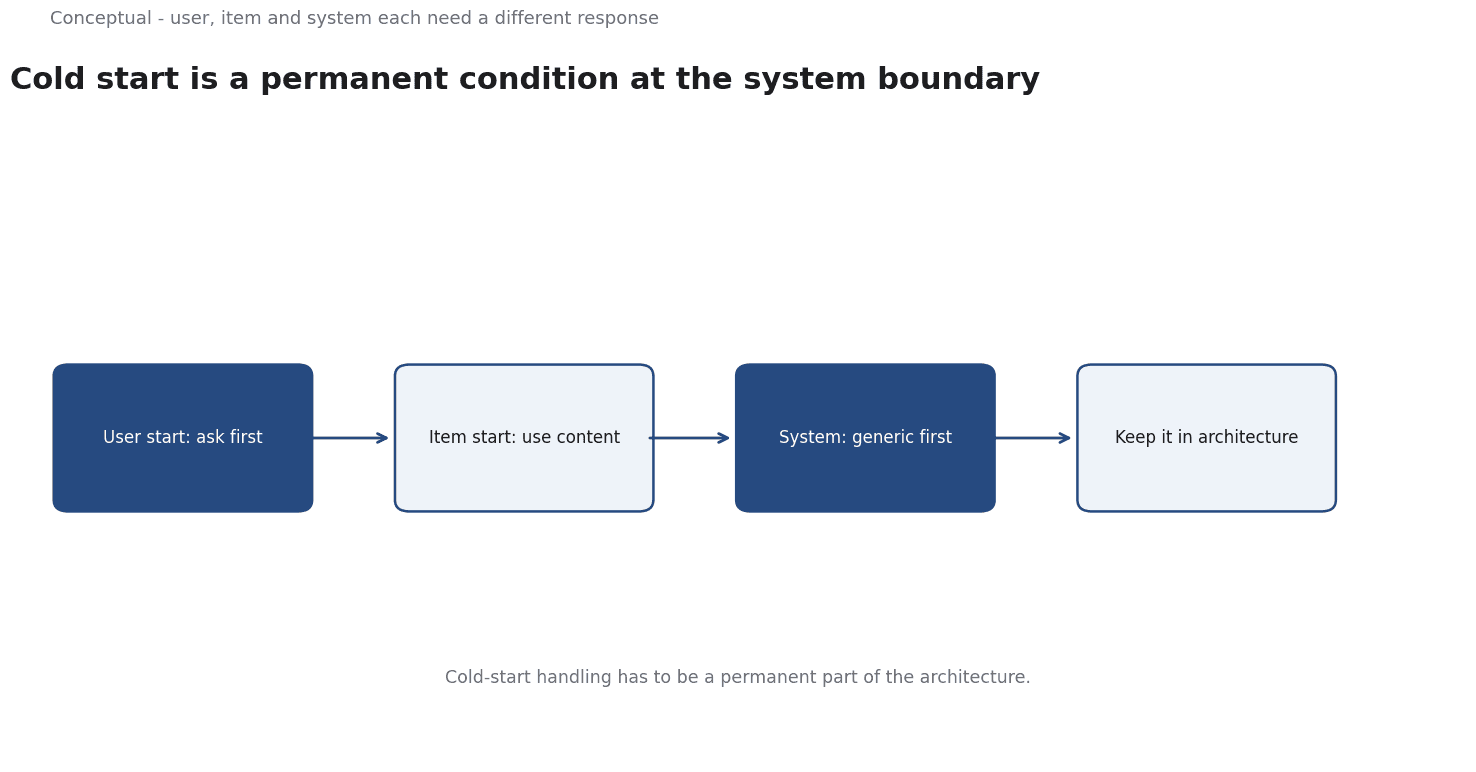
The three cases
New user. Collaborative filtering cannot place a user in the interaction structure because there are no interactions. The typical response is to ask for something — explicit preferences, a few selections, or an implicit signal from the first session — and to use demographic or contextual information where it is available and acceptable.
New item. A product with no interactions cannot appear in a collaborative recommendation, no matter how good it is. This is the quieter and often more damaging case, because it means a catalogue's newest additions are systematically invisible, and the system becomes biased toward its own past.
New system. A brand-new platform has neither users nor interactions, and no amount of clever modelling creates them. The answer is editorial curation, popularity, and human-designed defaults until enough behaviour exists.
Content is the bridge
The most general answer to both user and item cold start is side information — anything known about the entity that does not depend on interactions with it.
For items, that means the product description, category, price, image, text, or the structured attributes a catalogue already carries. A content-based model can recommend items similar to what the user liked even if nobody else has interacted with them, which is exactly what a collaborative model cannot do.
For users, it means the preferences they state, the context they arrive in, or a small set of choices they make at onboarding. The key is that the signal is collected before the system has to make a decision, which is why onboarding is a product decision rather than a formality.
The trade-off is that content-based methods are limited by the richness of the metadata. A sparse catalogue with generic descriptions produces generic recommendations, and they suffer from the "more of the same" problem — showing a user only variations of what they already consumed. Hybrid systems combine content and collaborative signals, and DeepFM's work on feature interactions is relevant to the ranking side: it is built to model "both low- and high-order feature interactions" from user behaviour and item attributes, which is one way of letting content signal into a ranking model.
Embeddings help when content is unstructured
When the side information is text or images, pretrained embeddings turn it into a representation a model can use. Sentence-BERT produces sentence embeddings that "can be compared using cosine-similarity", which is the basis for recommending items by the semantic similarity of their descriptions. Word2vec-style embeddings do the same for shorter text and for sequences of behaviour.
This is not a cure.
The embeddings are a bridge over the cold start, not a source of truth about the item.
Why the problem never goes away
A catalogue is a stream. New items arrive continuously, new users arrive continuously, and the system's cold-start population is therefore a steady-state property, not a phase it passes through.
Two consequences follow.
First, cold-start handling has to be a permanent part of the architecture rather than a launch-time workaround.
Second, the system needs a way to move entities out of the cold start — an exposure policy that gives new items a controlled chance to accumulate interactions, and a measurement of whether that exposure produced useful signal.
A catalogue that never exposes new items will converge on its past favourites, and the recommendation quality will appear excellent while the catalogue quietly becomes a museum. This is a distribution problem as much as a modelling one: without a deliberate route to exposure, new items have no chance to become recommendable.
A strategy for each case
- User cold start: collect a minimal, explicit signal at onboarding; use content-based recommendations until behaviour exists; measure how quickly a new user reaches useful recommendations.
- Item cold start: ensure the catalogue carries descriptive metadata; use content-based similarity; reserve a small, measured share of exposure for new items.
- System cold start: use editorial curation and popularity, and instrument the behaviour that will later feed the model.
- All three: build a hybrid ranker that can combine content and collaborative signals, and validate it on the segments where one signal is absent.
- Measure the transition: track how long it takes a new user or item to acquire enough signal to be served by the main model. That time is the real measure of your cold-start handling.
For the modelling side, see Recommender Systems; for the experimentation constraints, see A/B Testing Recommendation Systems.
A worked example
The following is hypothetical and illustrative. A new catalogue platform is launching with no interactions and expects its collaborative ranker to work from day one. Three checks follow the strategy for each case. First, user cold start: the onboarding flow must collect a minimal explicit signal before any recommendation is made, and content-based items fill the gap until behaviour exists; if users skip onboarding, the promised personalisation has no input. Second, item cold start: each new product must carry descriptive attributes, since a content-based model can only use metadata that exists, and a small, measured share of exposure must be reserved so new items can accumulate interactions rather than stay invisible. Third, system cold start: until behaviour arrives, editorial curation and popularity stand in, and the behaviour that will later feed a hybrid ranker, such as one using feature interactions, is instrumented from the start. The bounded outcome is a launch with curated defaults and a measured exposure slice; the team records how long new entities take to become recommendable, and does not claim personalisation before that transition.
A counterargument
A reasonable critic would question the confidence placed in side information as the bridge. The cited work is largely about representation: DeepFM models feature interactions and Sentence-BERT produces embeddings whose similarity is "comparable using cosine-similarity", and neither addresses what happens when the metadata itself is thin, noisy, or biased. The article concedes that pretrained embeddings import their training distribution and that content-based methods produce "more of the same", yet the strategy section still treats an explicit onboarding signal and content similarity as largely additive fixes.
If users skip onboarding or the catalogue's attributes are generic, the recommended instruments reproduce the invisibility they are meant to solve.
The exposure question, which the article itself calls a distribution problem, is exactly where the cited modelling literature is silent.
References & Further Reading
- Steffen Rendle et al., 2012. Neural Graph Collaborative Filtering — Graph collaborative filtering that propagates over the user-item graph.
- Ruibin Gai et al., 2017. DeepFM: A Factorization-Machine based Neural Network for CTR Prediction — Feature interactions in click-through-rate models, the shared core of search and recommendation ranking.
- Nils Reimers and Iryna Gurevych, 2019. Sentence-BERT: Sentence Embeddings using Siamese BERT-Networks — The bi-encoder recipe behind modern semantic search and RAG retrieval.