Community-Led Growth: When It Works and When It Does Not
Community is not a channel you switch on. Read the conditions it needs, a worked example, and why forcing it often backfires.
Community-led growth is often prescribed as a universal strategy: build a community, and growth follows. In practice, community works in a narrow set of conditions and fails when it is treated as a marketing tactic. A forum with no genuine peer interaction is a support burden with a friendly name.
Direct answer: Community leads to growth when members get value from each other around a problem or identity the product serves, and when the product benefits from their interaction. Demand-generation principles explain the preference-building stage community can support, and AAPOR's standards apply if you survey members about their experience. The boundary: a community cannot be manufactured by invitation alone, and it should not be measured by member count, which the email-metrics article argues for engagement over vanity figures.
When it works
A shared problem or identity. Members need a reason to interact that is not the product's feature list — a craft, an industry, a common challenge, as the category-design article explains for shared frames.
Peer value.
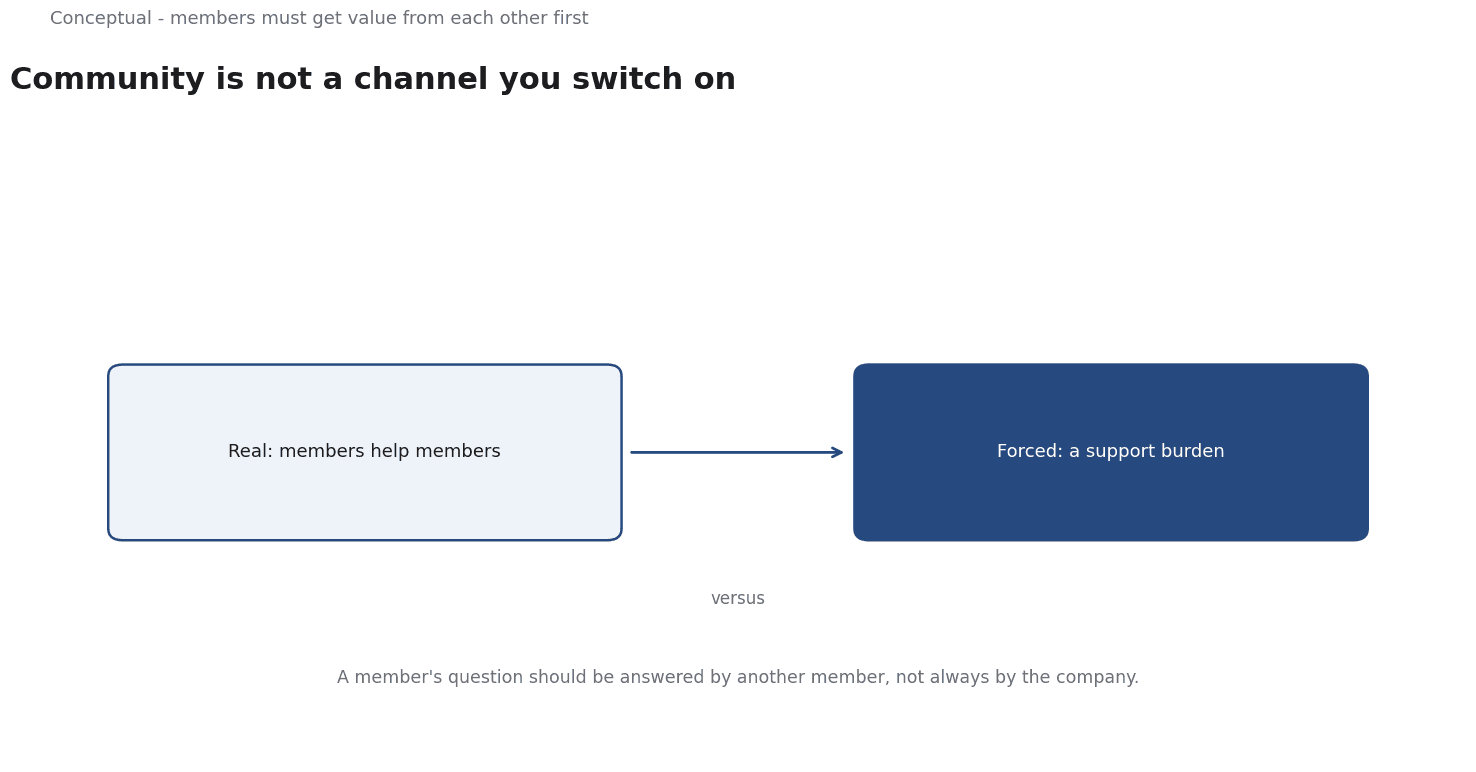
A member's question should be answered by another member, not always by the company.
The value comes from the network, which the network-effects article covers as a structural advantage.
A product connection. The community should make the product more useful — through templates, examples, or support — rather than sitting beside it as an unrelated social space, as the content-marketing article argues for value before asks.
When it fails
The company does all the talking.
No critical mass. A forum with few active members feels empty and repels the next member, which the waitlist article treats as an engagement problem rather than a signup problem.
It is used to deflect support. Sending customers to a community to reduce support cost, without anyone answering, damages trust, which the retention article identifies as a leading cause of churn.
A worked example
The following is hypothetical and illustrative.
A B2B software company considers a community. Three checks:
- Do members have a reason to talk? The product serves operations managers who face similar reporting problems — a plausible shared problem, as the customer-segmentation article recommends for defining a real segment.
- Will peers answer? The team identifies 50 power users who already answer questions in other channels. Seeding with them gives the community a chance of peer value, which the advocacy article covers as a source of credible voices.
- Does the product benefit? The community would host templates and workflow examples that make the product more useful, which the content-repurposing article treats as a value asset.
Measurement after launch should focus on three things: the share of questions answered by members rather than staff, repeat participation by members, and whether community members retain better than comparable non-members — with the attribution article's caution about selection, which the loyalty article also confronts.
Three conclusions follow:
- The preconditions were checked before the platform was chosen, which the AI-integration blueprint recommends for any new initiative.
- The metrics are interaction and retention, not member count, which the email-metrics article argues for vanity avoidance.
- The company's role is to enable, not to dominate, which the brand-voice article treats as a matter of restraint.
What community cannot do
It cannot fix a weak product. Members will not build a community around something that does not solve a real problem, which the value-proposition article argues.
It cannot be outsourced to a platform. The tool does not create the peer value, just as an email platform does not create a good newsletter, which the newsletter article explains.
It cannot be measured by size. A large quiet community is worth less than a small active one, which the brand-awareness article distinguishes from meaningful engagement.
The counterargument — that every product needs a community — is a fashion, not a finding.
Many successful products have none, and the decision should follow the three preconditions, not a wish to be seen as community-led.
A decision test
- Name the shared problem or identity that would bring members together.
- Check for peer value — will members answer each other, as the advocacy article describes?
- Check the product connection — does interaction make the product more useful?
- Seed with credible members before launching, as the advocacy article recommends.
- Measure peer answers and repeat participation, not member count.
- Compare retention with a comparable non-member group, accounting for selection, as the attribution article warns.
- Keep the company in an enabling role, which the brand-voice article advises.
For the growth frame, see Demand Generation vs Lead Generation; for the retention angle, see Customer Retention Strategies.
References & Further Reading
- Wikipedia contributors, 2026. Demand generation - Wikipedia — An overview of demand generation as a marketing discipline distinct from lead generation; secondary reference used with the lead-generation entry.
- American Association for Public Opinion Research, 2026. AAPOR — The professional association for public opinion and survey research; its standards and resources underpin the survey-design discussion.