Customer Segmentation Metrics that Matter
A segment is useful only if it predicts behaviour and changes a decision. Read the metrics that test it, a worked example, and why size is not value.
Segmentation decks often stop at a set of named groups and a count of customers in each. That is a description, not a test. A segment earns its place when it predicts different behaviour and leads to a different action, which is a measurable claim rather than a naming exercise.
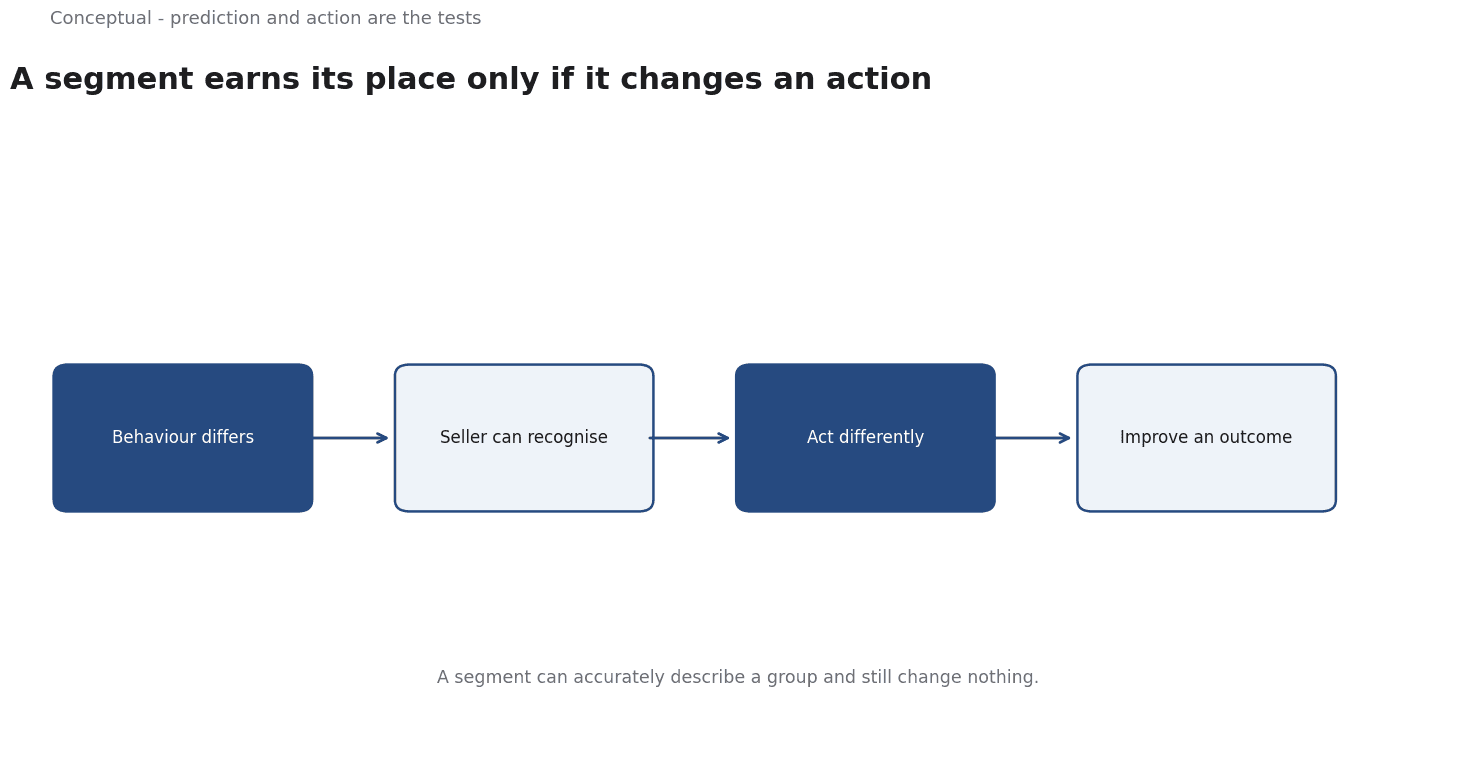
Direct answer: Test segments on three things — whether the groups differ in a behaviour that matters, whether a seller can recognise them, and whether acting differently on them improves an outcome. AAPOR's standards govern any survey used to define the segments, and demand-generation principles explain which decision a segment should change. The boundary: a segment is a model of a group, not a fact about an individual, as the personas article warns about treating a summary as a script.
Three metrics
Behavioural separation. Do the segments differ in conversion, retention, or order value, which the funnel article treats as stage metrics? A segment defined by attitude that predicts nothing is a label, as the market-research article argues for evidence tied to a decision.
Recognisability. Can a seller or a system place a customer in the segment from signals available at the point of contact, which the lead-scoring article covers for qualification signals? A segment that requires a survey to identify is not operational in a sales conversation.
Action lift. When the business treats the segments differently, does the outcome improve against a baseline, as the A/B testing article requires? A segment that predicts behaviour but cannot be acted on is interesting rather than useful, as the marketing-budget article treats spend allocation.
A worked example
The following is hypothetical and illustrative. A company segments customers into compliance-driven, efficiency-driven, and exploring, based on a question at signup, which the segmentation article recommends for observable signals.
Three checks decide whether the segments matter. First, conversion: compliance-driven customers convert at 25%, efficiency-driven at 12%, and exploring at 3% over six months, which the funnel article treats as a stage measure. Second, recognisability: a seller can assign a prospect from the signup answer or a short call, as the lead-scoring article advises for signals. Third, action lift: sending a dated implementation path to the compliance group and a worked example to the efficiency group improves conversion by four points against the previous single-message approach, as the A/B testing article requires for a reliable result.
Three conclusions follow. The segments predict behaviour, which the first metric confirms. They are operational, which the second confirms. And acting on them produced a measurable improvement, which the third confirms. A segment that passed only the first check would still be a hypothesis, as the evaluation-rubric article argues for multiple dimensions.
Why a segment can be true and useless
A segment can accurately describe a group and still change nothing.
The segmentation article argues for a difference that survives contact with sales, which is a test of the organisation as much as of the analysis. A segment that requires a new operating decision should be adopted only when someone is willing to make it, as the decision-memo article requires for a recorded choice.
The metrics also need a time window. A segment that predicts conversion in a thirty-day trial may not predict retention over a year, which the retention article treats as a cohort question. Stating the window is part of the definition, as AAPOR's standards require for any measurement claim, and a segment without one is a snapshot that can be misapplied to a decision it was never tested against.
Finally, segments should be reviewed as evidence accumulates. A scheme that separated groups well last year may collapse when a competitor changes the market or the product changes its audience, which the monitoring article treats as a change trigger. The review should be deliberate and recorded, as the decision-memo article recommends, rather than a quiet redefinition of what the labels mean.
What segment metrics cannot do
They cannot prove causation if the groups were self-selected, which the attribution article treats as a counterfactual problem, as the loyalty article applies to members. They cannot validate a survey with a poor population, which AAPOR's standards require you to state. And they do not stay valid: needs change with the market, which the monitoring article treats as a review trigger.
The counterargument that simple demographics are good enough is fair when the buying reason is genuinely the same, which the segmentation article argues for real differences in situation rather than cosmetic ones.
A decision test
- State the behaviour the segment should predict, as the funnel article advises.
- Check separation on conversion, retention, or value, as the metrics above require.
- Verify recognisability at the point of contact, as the lead-scoring article recommends.
- Test action lift against a baseline, as the A/B testing article requires.
- State the survey population and wording, as AAPOR's standards require.
- Avoid treating segments as individuals, as the personas article warns.
- Review on market change, as the monitoring article advises.
For the segmentation design, see Customer Segmentation; for the measurement, see A/B Testing.
References & Further Reading
- American Association for Public Opinion Research, 2026. AAPOR — The professional association for public opinion and survey research; its standards and resources underpin the survey-design discussion.
- Wikipedia contributors, 2026. Demand generation - Wikipedia — An overview of demand generation as a marketing discipline distinct from lead generation; secondary reference used with the lead-generation entry.