Email Deliverability: What Actually Affects Inbox Placement
Authentication proves who you are; reputation decides whether you get delivered. Read the three standards, the worked setup, and why opens mislead.
A sender can pass every authentication check and still land in spam. The checks answer "are you who you claim to be?"; the mailbox provider then asks a different question — "do recipients want this?" Confusing the two produces teams that configure DKIM correctly, see no improvement, and conclude that deliverability is a mystery.
Direct answer: SPF, DKIM and DMARC are the three authentication standards — SPF authorises sending hosts for a domain, DKIM signs messages cryptographically, and DMARC ties both to the visible From address and publishes a handling policy. Gmail's sender guidelines add the reputation layer: authentication is required, but recipient engagement and list quality affect placement. The boundary: authentication is necessary and verifiable; reputation is probabilistic and controlled by the receiving provider.
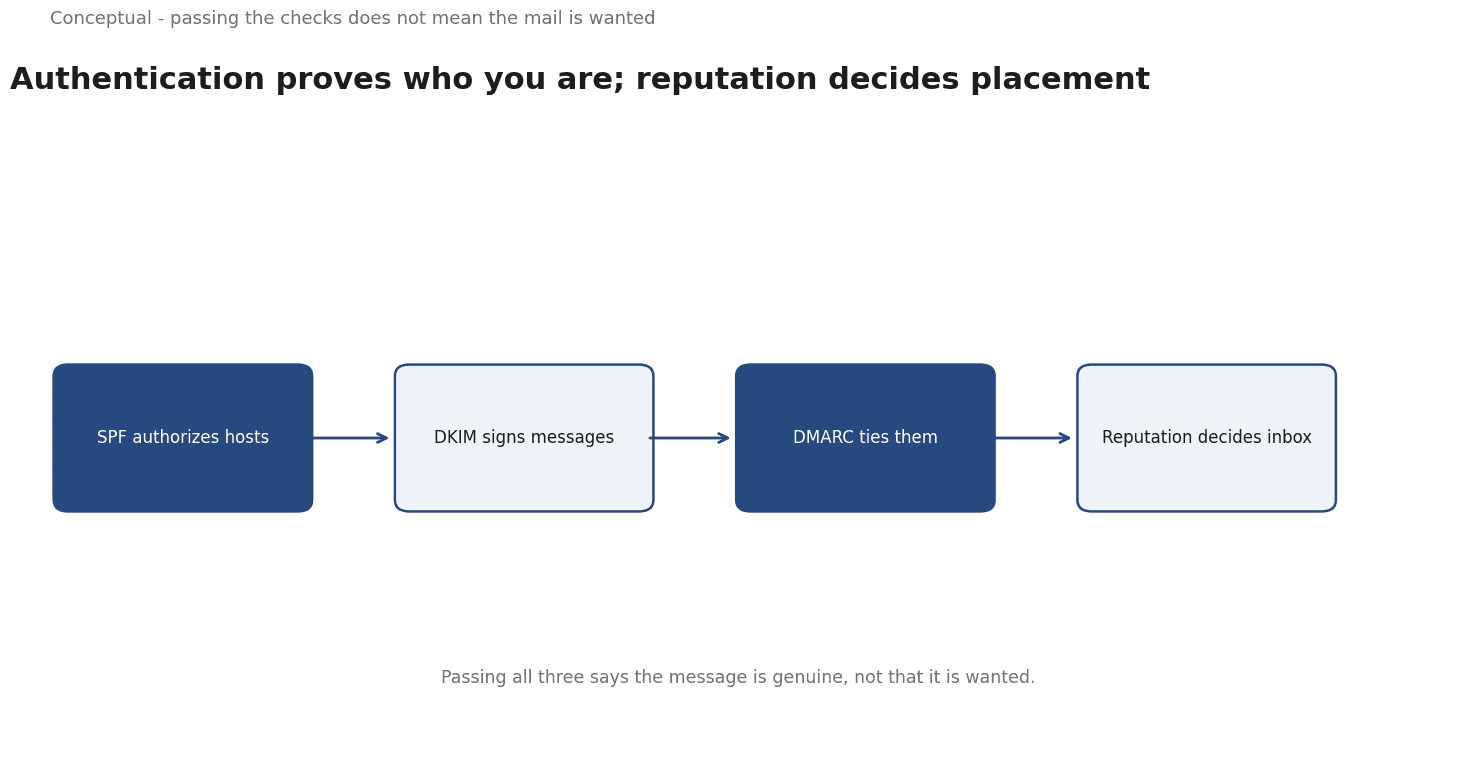
The three standards do different jobs
SPF (RFC 7208) lets a domain owner publish which hosts are authorised to send mail for that domain. A receiving server checks the sending host against the published record. It answers a narrow question about the envelope, not about the From address a human sees.
DKIM (RFC 6376) adds a cryptographic signature. The signing domain publishes a public key; the receiver verifies the signature and can confirm that the message was signed by that domain and that specified parts were not altered in transit.
DMARC (RFC 7489) connects the two to the visible From domain — the one the recipient reads — and lets the owner publish a policy for messages that fail. It also provides reporting, which is how a sender learns that mail claiming to be from its domain is being sent from elsewhere.
Three properties follow:
- SPF and DKIM can both pass while DMARC fails if the authenticated domains do not align with the visible From domain. This is the most common configuration surprise.
- DMARC is a policy, not a delivery guarantee. A
p=nonerecord requests reports without asking receivers to reject anything; moving toquarantineorrejectchanges handling, and should follow a period of reading the reports. - Authentication identifies, it does not persuade.
Passing all three says the message is genuine, not that it is wanted.
The reputation layer
Gmail's sender guidelines illustrate what providers ask beyond authentication: send wanted mail, avoid spam traps, make it easy to unsubscribe, and keep complaint rates low. Bulk senders face additional requirements, because the volume makes abuse more damaging.
Three practical implications:
- List hygiene is a deliverability control. Sending to addresses that no longer exist or that never opted in generates bounces and complaints, which damage reputation. A smaller, engaged list outperforms a large stale one.
- Engagement is feedback. Opens and clicks are signals providers can observe. A message nobody interacts with teaches the provider that the sender's mail is not wanted.
- Complaints are expensive. A single spam complaint from a recipient can outweigh many successful deliveries, which is why unsubscribe friction is counterproductive.
A worked example of a DMARC rollout
The following is a hypothetical sequence and timeline, not a measured result.
A company sends 500,000 emails a month from three systems: a marketing platform, a transactional service, and a CRM used by sales.
Step 1 — inventory. List every host that sends as the company's domain. The inventory finds the three known systems and one forgotten script sending invoices from a subdomain.
Step 2 — SPF and DKIM. Publish an SPF record authorising the known hosts and enable DKIM signing on each system. The forgotten script is now a source of SPF failures — which is the point of the inventory.
Step 3 — DMARC at p=none. Publish a DMARC record with reporting. After two weeks, the reports show that 98% of messages align, and that the remaining 2% come from the forgotten script plus an unauthorised source using the domain in the From field.
Step 4 — fix and escalate. Move the script to an authorised host, investigate the unauthorised source, then change the policy to quarantine and later reject once alignment is consistently above the team's threshold.
Three lessons follow:
- The rollout starts with observation. Moving straight to
rejectwould have blocked the legitimate script along with the spoofed mail. - The reports are the deliverable. They reveal both misconfiguration and abuse; without reading them, DMARC is just a DNS record.
- Authentication and reputation remain separate. After alignment reaches 100%, a campaign sent to a stale list can still go to spam. The work is not finished at
reject.
The setup order that avoids outages
A deliverability project changes DNS records that affect every message the domain sends. The order matters:
Inventory first. Find every system that sends as your domain, including subdomains and old scripts. A record that authorises only the known systems will break the unknown ones.
Monitor before enforcing. A DMARC record at p=none gives reports without changing handling. This is the observation phase; treat the reports as the output of the project.
Fix the sources the reports reveal. Align the authenticated domains with the visible From address, and move or retire unauthorised senders. At this stage, a spike in failures is a success — it means the report is doing its job.
Tighten policy gradually. Move to quarantine, watch complaint and bounce rates, then move to reject when alignment is stable.
Keep subdomain policy in mind. DMARC allows a separate policy for subdomains. A domain that is protected while its subdomains are not leaves an obvious path for impersonation.
This sequence is unglamorous, and it is the difference between a project that improves placement and one that interrupts invoices.
Metrics that mislead
Open rates are noisy. Privacy features in mail clients pre-fetch images, which can register as opens without a human reading. Treat open rate as a directional signal, not a measurement.
Delivery is not inbox placement. "Delivered" typically means the receiving server accepted the message; it may have been filed in spam or promotions. The distinction matters when diagnosing a deliverability drop.
A single seed test is weak. Checking whether a test message reached your own inbox tells you about one recipient with one history. Use seed lists across providers and monitor complaint and bounce rates over time.
The counterargument — that deliverability is opaque because providers do not publish their rules — is partly fair. The standards and published guidelines are public, and they remove the failures a sender can control.
What remains is a reputation system you influence through list quality and recipient behaviour rather than configure directly.
A decision test
- Inventory every sending host before changing DNS records.
- Publish SPF and enable DKIM, checking alignment with the visible From domain.
- Start DMARC at
p=noneand read the reports before tightening policy. - Treat a stale list as a deliverability risk, not just a marketing-quality issue.
- Make unsubscribing easy to limit complaints.
- Measure bounces, complaints and inbox placement rather than trusting opens.
- Test across providers and re-check after any sending-system change.
For the retention context, see Customer Retention; for the measurement caveat, see Marketing Attribution.
References & Further Reading
- IETF, 2014. RFC 7208: Sender Policy Framework (SPF) for Authorizing Use of Domains in Email, Version 1 — The SPF standard for authorising which hosts may send mail for a domain.
- IETF, 2011. RFC 6376: DomainKeys Identified Mail (DKIM) Signatures — The DKIM standard for cryptographically signing messages so a receiver can verify the signing domain.
- IETF, 2015. RFC 7489: Domain-based Message Authentication, Reporting, and Conformance (DMARC) — The DMARC standard for tying SPF and DKIM to the visible From domain and publishing a handling policy.
- Google, 2026. Email sender guidelines - Gmail Help — A major mailbox provider's published sender requirements and bulk-sender recommendations.