How to Analyze a Company Before Investing
Company analysis is a set of questions about how value is made and captured. Read a sequence, a worked example, and the limits of a checklist.
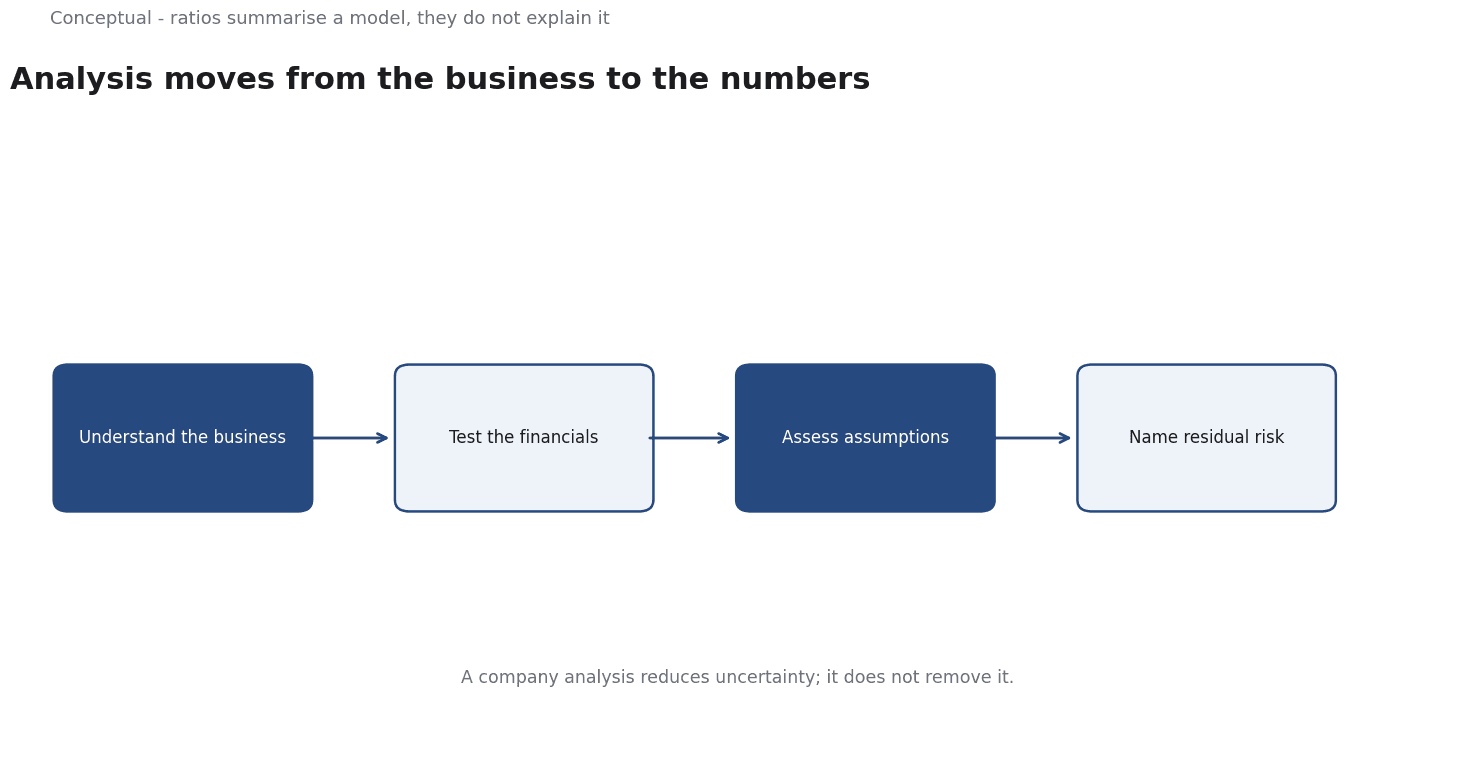
A company analysis that begins with a ratio screen starts in the wrong place. Ratios summarise the result of a business model; they do not explain whether that model can persist. A defensible analysis moves from how the company makes money to what the numbers show and, finally, to what could break.
Direct answer: Analyze in three passes — understand the business, test the financials, and assess the risks and assumptions. Investor.gov's basic guidance and the financial-statement overview provide the primary context; Damodaran's valuation discipline insists that assumptions be stated. The boundary: this is educational analysis, not personalised advice, and a well-researched view can still be wrong.
Pass one: understand the business
Four questions come before the numbers:
How does it make money? What is sold, to whom, and what does a unit contribute after its direct costs?
Why do customers choose it? Is there a real advantage — switching cost, brand, network, cost structure — or a temporary gap?
What is the competitive set? The alternatives a customer would actually choose, including doing nothing.
What could stop working? A dependency on a supplier, a channel, a regulation, or a technology assumption.
Written answers to these questions make the financial numbers interpretable. Without them, a rising margin is just a number with no explanation.
Pass two: test the financials
Four checks cover most of the ground:
Profitability and its quality. Compare margin over time and against peers, then ask whether the margin is supported by the business story. Check for adjustments that flatter it, as the EBITDA article explains.
Cash conversion. Compare profit with operating cash flow. A persistent gap deserves an explanation — growth, collection problems, or capital intensity. The free-cash-flow article works through the mechanics.
Balance sheet strength. Liquidity, leverage, and the maturity of debt.
Capital efficiency. How much capital is required to grow? Two businesses with the same profit but different capital needs are not equivalent.
A worked example of a first-pass check
The following numbers are hypothetical and illustrative.
A company reports revenue growth of 20% over three years, a gross margin of 55%, and an operating margin that rose from 8% to 12%.
Three questions follow:
- Is the margin rise operating or accounting? If depreciation policy changed or a cost was reclassified, the improvement may not be real. The notes answer this.
- Is growth converting to cash? If receivables grew 35% while revenue grew 20%, the company is financing more of its sales. Ask whether this is a temporary timing effect or a weakening position with customers.
- What is funding the growth? If capital expenditure and working capital absorbed more cash than operations produced, the company must be drawing down cash or borrowing. Check the debt maturity schedule.
Three conclusions are possible:
- If margins are clean, cash conversion is sound, and debt is manageable, the business deserves a deeper valuation.
- If the margin rise is an accounting effect, stop and re-read the notes before going further.
- If cash conversion is deteriorating, the growth may be destroying value even while the income statement improves.
The point is not that one metric decides. It is that each check either supports or challenges the business story from pass one.
Pass three: risks and assumptions
Write down the assumptions that would most change the conclusion — customer retention, pricing power, input costs, or the duration of an advantage. Then ask which are observable and which are guesses. An analysis whose conclusion flips on a single unobservable assumption is a hypothesis, not a finding.
Investor.gov's material is a reminder that all investments involve risk and that returns are not guaranteed.
A company analysis reduces uncertainty; it does not remove it.
What the sequence cannot do
It cannot produce a price. A valuation is a separate calculation with its own assumptions, as the valuation article explains.
It cannot eliminate surprises. Fraud, regulation, and technological change arrive from outside the checklist.
It cannot replace temperament. A correct analysis held with the wrong time horizon or position size can still produce a poor outcome. That is a portfolio question, not a company question.
The counterargument — that analysis is too slow for a fast market — is fair for short-term trading and irrelevant to investing based on business performance.
The method's horizon should match the reason for holding.
A decision test
- Write the business story before opening the accounts.
- Check margin quality against the notes and peers.
- Compare profit with cash generation.
- Review the balance sheet for liquidity and debt maturity.
- Measure capital intensity alongside profit.
- List the assumptions that would change your conclusion.
- Label the output as analysis, not advice or certainty.
For the valuation step, see How to Value a Public Company; for the statement basics, see Reading Financial Statements.
References & Further Reading
- U.S. Securities and Exchange Commission (Investor.gov), 2026. Introduction to Investing — Primary regulator guidance on market mechanics and investor protection.
- Wikipedia contributors, 2026. Financial statement - Wikipedia — An overview of the four financial statements and the purpose of each; a secondary reference used here with primary documents where available.