Getting Started with Account-Based Marketing
ABM focuses on named accounts instead of broad funnels. Read when it fits, a worked pilot, and why headcount alone does not make it work.
Account-based marketing treats a small set of named companies as markets of one. It sounds like a tactic for large enterprises with big budgets, which is partly true, but the underlying logic — focus effort where the value is highest — applies to any B2B team with a clear ideal customer. The mistake is adopting the label without the focus.
Direct answer:
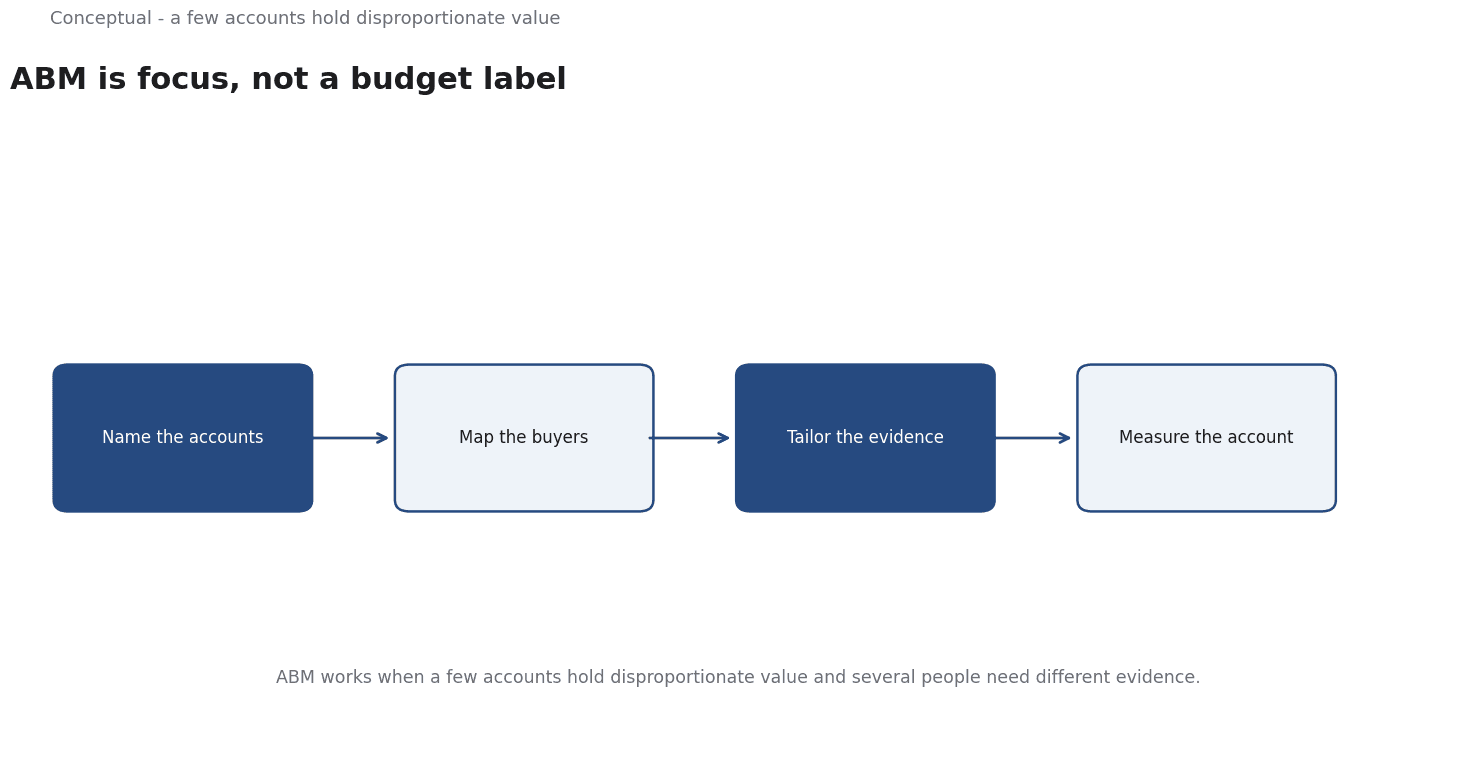
ABM works when a small number of accounts represent disproportionate value and the buying decision involves several people who need different evidence.
The account-based-marketing overview provides the channel context, and O*NET's task descriptions help define which roles are involved in the decision. The boundary: ABM is not a technology purchase or a headcount decision, and it cannot fix a weak offer, which the value-proposition article argues for stating what changes for the buyer.
When it fits
Concentrated value. If a hundred accounts make up most of the potential revenue, broad lead generation wastes effort, which the unit-economics article explains for acquisition cost and contribution. The segmentation article argues for real differences in value, which is the basis of the account list.
Multiple stakeholders. A complex purchase involves users, finance, and security, each needing different evidence, as the landing-page article recommends for B2B clarity. ABM lets a team address those roles with tailored material rather than one generic pitch, which the content-repurposing article treats as adapting a claim to a channel.
A defined buying process. If you cannot describe the stages a named account moves through, you cannot target them, which the funnel article treats as a prerequisite for stage-matched next steps.
A worked pilot
The following is hypothetical and illustrative. A company selects twenty accounts based on fit signals — size, use case, and a trigger event such as a new regulatory requirement.
For each account, the team maps the buying roles using role descriptions, as O*NET supports, and prepares three pieces: a problem article for the user, a cost framework for finance, and a security summary for the reviewer. Outreach is coordinated across sales and marketing rather than run as separate campaigns, which the marketing-communications article treats as coordination.
Three checks decide whether the pilot worked. First, did the named accounts engage across more than one role, which the funnel article treats as a stage signal? Second, did the tailored material change the conversation, as the evaluation-rubric article recommends for measuring a specific effect? Third, did the cost per qualified opportunity beat the broad funnel, which the marketing-budget article treats as an allocation question? A pilot that produces activity without these changes is a rebranding of existing outreach, as the demand-generation article warns about confusing capture with preference.
The discipline of focus
The hardest part of ABM is not the research or the tailored material — it is saying no to accounts that do not fit.
The account list should be short enough that the team can know each account's situation, which the founder-led-sales article describes as the advantage of a small, well-understood set.
Focus also changes the economics of content. When you know the twenty accounts you serve, each piece of material can address a real problem with a specific example, which the value-proposition article argues for concrete claims. A broad funnel must appeal to everyone and therefore says little to any one buyer, as the brand-positioning article warns about positioning that tries to serve all segments. The concentration of effort is the point, and it is why ABM can work for a small team with careful research, as the founder-led-sales article suggests for early-stage GTM.
Finally, focus makes measurement possible. With a small, named set, you can ask whether each account progressed through the buying stages and which material was used, which the funnel article treats as stage metrics. A broad campaign offers only aggregate numbers, as the marketing-attribution article explains for credit rules that cannot show what changed an individual decision.
What ABM cannot do
It cannot create demand in an account that has no problem, which the jobs-to-be-done article treats as the precondition. It cannot fix a weak value proposition, which the value-proposition article argues is the thing the buyer evaluates. And it is not cheap: tailored research and material take time, as the content-operations article covers for roles and review loops.
The counterargument that ABM is only for large companies is fair about the tooling and wrong about the logic.
A small team can run a ten-account version with a spreadsheet and careful research, which the founder-led-sales article describes for early-stage GTM.
A decision test
- Check whether value is concentrated in a small account set, as the segmentation article advises.
- Map the buying roles with O*NET-style task descriptions.
- Prepare distinct evidence for each role, as the landing-page article recommends.
- Coordinate sales and marketing around the account, as the communications article requires.
- Measure engagement across roles, not just contacts.
- Compare cost per qualified opportunity with the broad funnel, as Marketing Budget Template and Allocation Rules requires.
- Review the pilot before expanding, as the decision-memo article advises.
For the channel context, see B2B Marketing; for the cost frame, see Marketing Budget Template.
References & Further Reading
- Wikipedia contributors, 2026. Account-based marketing - Wikipedia — An overview of account-based marketing as a B2B strategy focused on named accounts.
- U.S. Department of Labor, 2026. O*NET OnLine — The standard occupational taxonomy used to compare roles across industries.