Growth Loops Pitfalls
A growth loop compounds, which is why a flaw in it compounds too. Read the failure modes, a worked example, and the metrics that catch them.
A growth loop is a mechanism where the output of one cycle feeds the next — a user invites others, whose use creates more value, which drives more invitations. The idea is powerful because compounding can produce rapid growth. It is also dangerous for the same reason: a small flaw in the loop is amplified each cycle.
Direct answer:
A loop works when each stage creates genuine value and the feedback is real rather than assumed.
Demand-generation principles explain the preference stage a loop can serve, and AAPOR's standards apply if you survey participants about why they shared. The boundary: a loop that rewards spam or relies on an unverified assumption grows noise, which the fraud controls in the referral article address, and no structure guarantees growth, as the publication standard states for marketing claims.
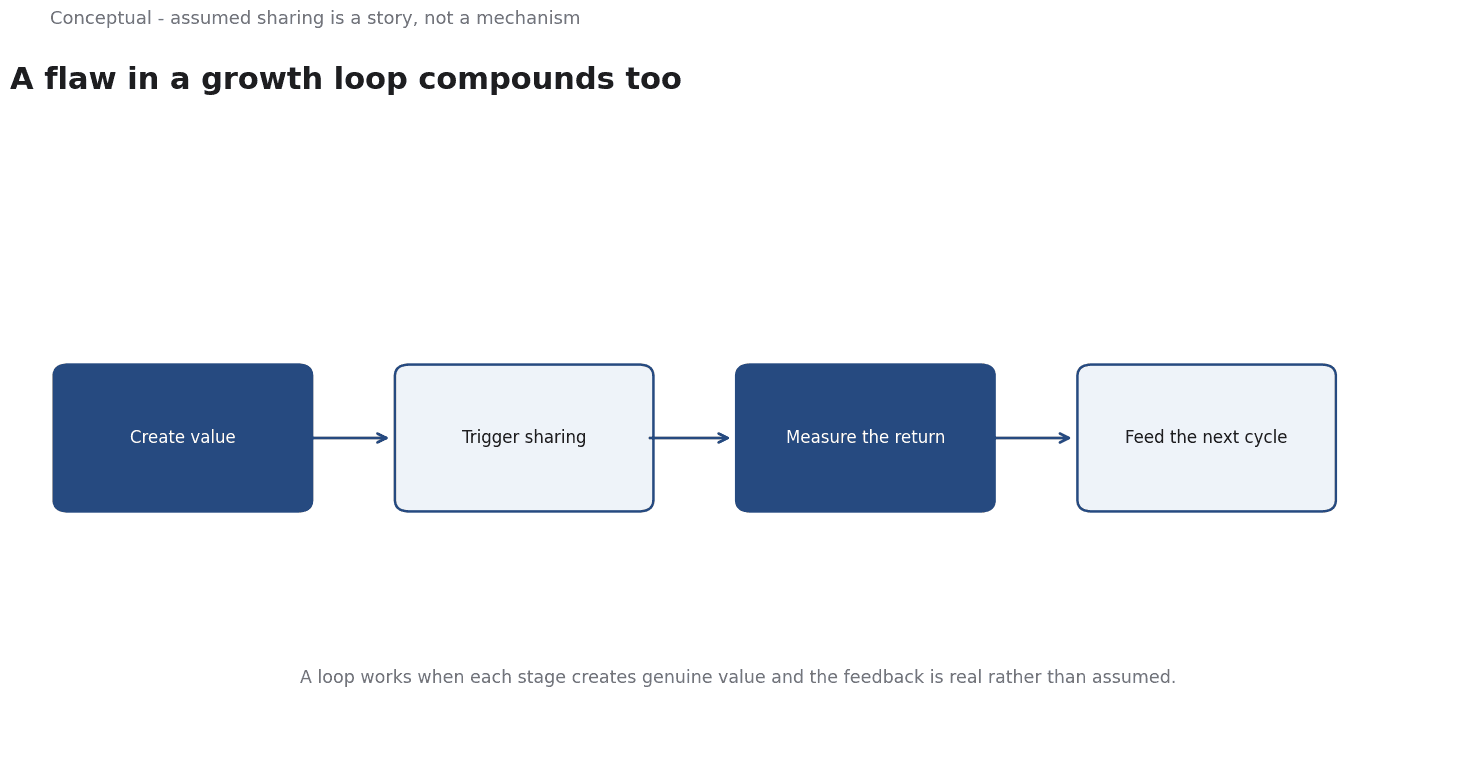
The failure modes
A broken feedback step. The loop assumes that use leads to sharing, but if users do not actually invite others, the mechanism stops, as Customer Advocacy and User-Generated Content treats genuine behaviour as the precondition.
Incentive distortion. A reward for inviting can produce low-quality invites, just as a loyalty points programme can reward people who would have stayed anyway, as the loyalty article explains for measured behaviour. The fraud controls in the referral article are the defence.
Value dilution. If each new cohort gets less value from the product than the last, the loop decays even while signups rise, which the retention article treats as a cohort problem. The network-effects article explains when adding users improves the product and when it degrades it.
Metric confusion. A loop can generate activity that looks like growth — signups, clicks, invites — without producing retained customers, which the funnel article distinguishes from stage transitions, as the email-metrics article warns about intermediate signals.
A worked example
The following is hypothetical and illustrative. A product has a loop: users complete a project, receive a shareable report, and invite colleagues, who then create projects.
Three checks decide whether the loop works. First, what fraction of completed projects are actually shared, and what fraction of invites convert, which the funnel article treats as stage metrics? If sharing is 5%, the loop is weak regardless of how good the report looks. Second, do invited users retain at the same rate as organic ones, which the retention article measures by cohort? A lower rate signals value dilution, as the network-effects article explains. Third, are invites genuine, which the fraud controls in the referral article address? A spike in invites from a few accounts is a warning, as the anomaly-detection article treats such patterns.
Three conclusions follow. The loop's weakest stage determines its speed, which the funnel metrics reveal. A reward should not be added to fix a weak sharing stage until the value of the report is tested, as the discount article warns about incentives that mask weak value. And the result should be recorded with the stage metrics, as the decision-memo article requires.
What growth loops cannot do
They cannot fix a product that does not deliver value; they amplify the truth about it, as the value-proposition article argues. They cannot be measured by invites alone, which the email-metrics article treats as an intermediate signal. And they are not self-sustaining if the input audience is finite, as the waitlist article treats interest as a stock that depletes.
The counterargument that loops are more efficient than paid acquisition is sometimes true and depends on the quality of the loop, which the worked example tests rather than assumes.
A decision test
- Map each stage of the loop and the metric for it.
- Measure sharing and invite conversion, as the funnel article requires.
- Check retention of invited cohorts, as the retention article advises.
- Detect abusive invite patterns, as the fraud article recommends.
- Avoid adding incentives before testing value, as the discount article advises.
- Watch for value dilution as the audience grows, as the network-effects article explains.
- Record the loop's weakest stage and review it, as the decision-memo article requires.
For the channel frame, see Demand Generation vs Lead Generation; for the advocacy stage, see Customer Advocacy.
References & Further Reading
- Wikipedia contributors, 2026. Demand generation - Wikipedia — An overview of demand generation as a marketing discipline distinct from lead generation; secondary reference used with the lead-generation entry.
- American Association for Public Opinion Research, 2026. AAPOR — The professional association for public opinion and survey research; its standards and resources underpin the survey-design discussion.