How Cloud Computing Changed the Modern Economy
Cloud computing shifted infrastructure from capital expense to operating expense, changing how companies start, scale, and fail. Learn the economic mechanics and what they do not
Cloud computing is usually described as a technical convenience: rent servers instead of buying them. The deeper change is economic. By turning infrastructure from a capital expense into an operating expense, cloud altered who can start a technology company, how fast they can scale, and how failure is priced.
Direct answer: Cloud computing converted IT infrastructure from a large upfront capital investment into a metered, pay-as-you-go operating cost. This lowered the cost of starting a software business, accelerated experimentation, and shifted risk from balance sheets to income statements.
But it did not eliminate infrastructure costs—it recurringized them—and the long-term economics depend on usage patterns, vendor lock-in, and whether variable costs scale faster than revenue.
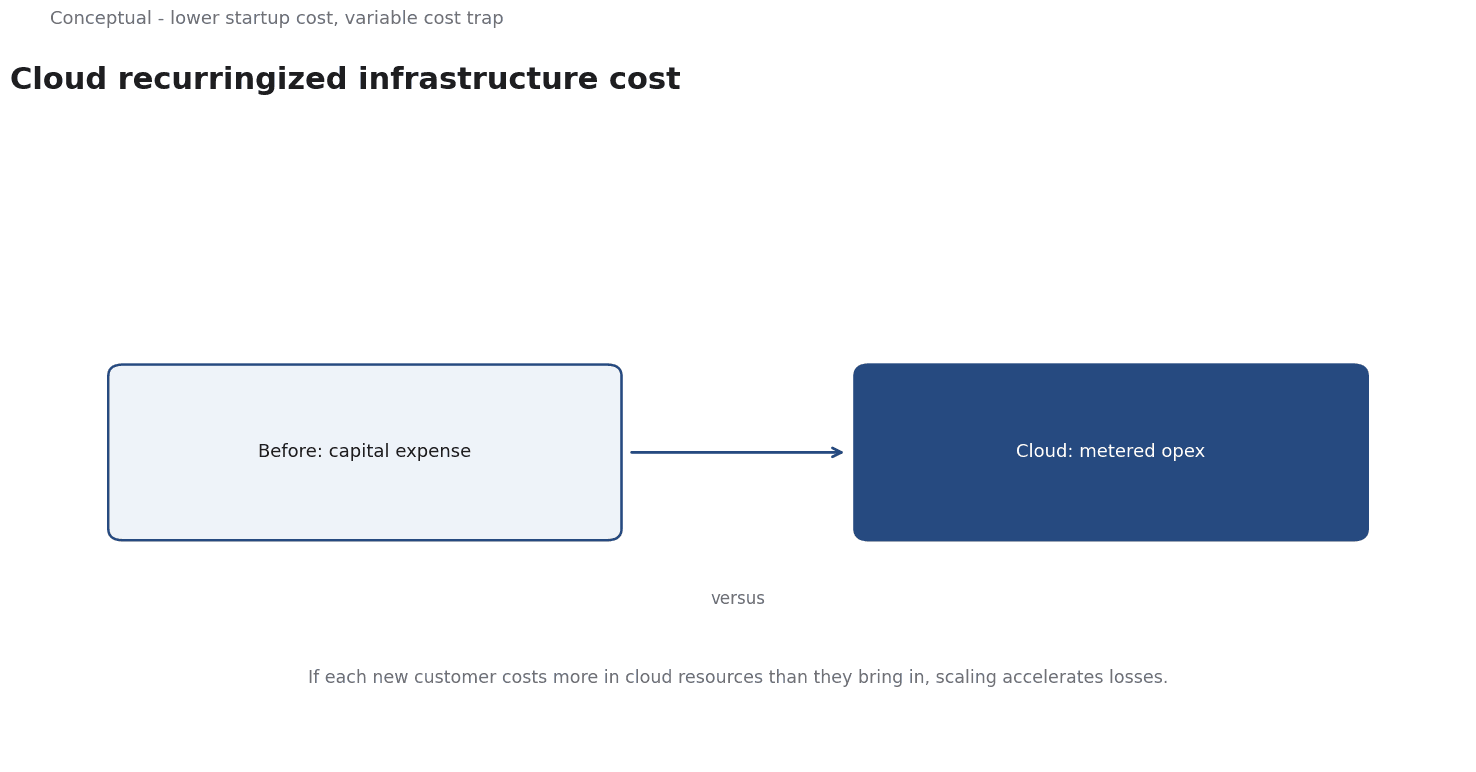
From capex to opex
Before cloud, launching an internet service meant buying servers, leasing data center space, hiring network engineers, and provisioning for peak load months in advance. The investment was large, irreversible, and due before the first customer arrived. A failed product left idle hardware; a successful one faced capacity shortages before new hardware could be ordered.
Cloud providers pooled physical hardware and sold it in small, hourly increments. A startup could begin with a few dollars of compute per day and scale to thousands of servers without negotiating with a hardware vendor. The balance sheet no longer needed a server line item; the income statement carried a growing cloud bill.
This changed the math of starting a company. The capital required to reach a minimum viable product fell from tens or hundreds of thousands of dollars to a few hundred. More experiments could be run, and more failed experiments could be abandoned without sunk hardware costs.
The variable-cost trap
The shift from capex to opex is not purely beneficial. Capital expenses are depreciated over years; operating expenses recur monthly. A server purchased for $10,000 and used for five years costs $2,000 per year in depreciation, plus power and staff. The equivalent cloud instance might cost $300 per month—$3,600 per year—before data transfer, storage, and support.
At low usage, cloud is cheaper because there is no idle capacity. At high and steady usage, owned hardware often wins. The crossover point depends on the workload: spiky or unpredictable traffic favors cloud; predictable, constant load can favor owned or colocation infrastructure.
The variable-cost model also means costs scale with success. A product that suddenly becomes popular sees its cloud bill rise in direct proportion to usage. That is better than turning customers away, but it means growth does not automatically improve unit economics.
Lock-in and the cost of leaving
Cloud economics are easy to enter and hard to exit. Data transfer fees, proprietary APIs, managed services with no open equivalent, and architectural habits formed around one provider create switching costs. The more a system uses provider-specific features—serverless functions, managed databases, autoscaling groups—the harder it is to move.
This matters because the cloud bill is not a fixed cost that can be predicted at signing. It is a function of usage, provider pricing changes, and architectural decisions. A vendor that raises prices or changes terms can force a migration that costs more than staying.
For most companies, cloud is still the right default. The alternative—buying and managing hardware—requires operational expertise that many software businesses do not have. But cloud should be treated as a recurring operational decision, not a one-time infrastructure purchase. Review reserved instances, right-size instances, data transfer patterns, and managed-service premiums regularly.
What cloud does not change
Cloud makes infrastructure easier to obtain, but it does not make product-market fit easier to achieve. A company can scale to millions of users on cloud and still fail if those users do not pay enough to cover the cloud bill and everything else. Cloud removes one barrier to entry; it does not remove the need for a sustainable business model.
For the related question of how unit economics interact with infrastructure costs, see Understanding Unit Economics: CAC, LTV, Churn, and Contribution Margin. For how technical choices affect operational cost, see CDN Caching and Googlebot: Avoid Origin Overload.
A worked example
The following is hypothetical and illustrative. Consider a small software business whose traffic arrives in unpredictable bursts. It starts with metered compute, pays for what it uses, and avoids the idle capacity that a purchased server would represent. That is the capex-to-opex trade in its simplest form: no large purchase before the first customer, and an abandoned experiment costs only the hours actually consumed.
Now suppose the product becomes stable and heavily used. The same metered bill grows every month, and the team re-examines the crossover point. It reviews right-sizing and commitment models, the practices described in AWS's cost optimization guidance, and compares its workload against open, comparable performance measurements of the kind MLCommons publishes rather than vendor claims. Data transfer and managed-service premiums are checked separately, because they are easy to overlook in a per-instance comparison. If the workload is steady enough, owned hardware may win; if it remains spiky, the flexibility is worth the premium.
Where the reasoning breaks down
The model breaks where usage and pricing refuse to stay still. A cloud bill is not a fixed monthly cost but a function of traffic, architecture, and provider terms. A price change can turn a previously sound decision into an expensive one, and the switching cost created by proprietary services can leave migration more costly than staying. The variable-cost trap is the sharpest version: if each new customer consumes more in cloud resources than they pay, growth accelerates losses rather than diluting them.
Benchmarks help only when they are comparable; that is why open measurements matter more than a single vendor's numbers. Even then, they describe hardware and software performance, not the economics of a particular contract.
A decision test
Treat infrastructure as a recurring decision. Ask whether the workload is spiky or steady, because that determines where the crossover point sits. Ask whether costs are measured per customer and connected to retained value, which is the discipline FinOps describes. Ask what leaving would cost: data transfer, rewrites around managed services, and the habits built around one provider.
If the answers change from quarter to quarter, the right response is a scheduled review rather than a one-time architecture choice. Cloud lowered the cost of starting; it did not remove the obligation to keep deciding.
A counterargument
A fair objection is that the headline claim rests on an accounting reclassification rather than on the sources cited. AWS cost-optimization guidance, FinOps, and MLCommons benchmarks are prescriptive or technical: they explain how to manage a cloud bill or compare hardware, not whether cloud lowered the cost of starting a company. The worked example is explicitly hypothetical, so the capex-to-opex crossover is asserted, not measured. The article's later sections concede as much: at high steady usage owned hardware often wins, costs scale with success, and lock-in makes the bill hard to predict. Those qualifications sit uneasily with the opening claim that cloud altered who can start a technology company.
The more careful conclusion appears later - that cloud is a default requiring continuous re-decision - which makes the sweeping framing more rhetorical than evidentiary.
References & Further Reading
- Amazon Web Services, 2026. Cost Optimization (AWS Well-Architected Framework) — Vendor primary documentation on right-sizing and commitment models.
- MLCommons, 2026. Benchmark work | Benchmarks - MLCommons — Open, comparable hardware and software performance measurements.
- FinOps Foundation, 2026. The FinOps Foundation — The cross-industry framework for managing cloud cost as an engineering discipline.