How to Brief a Designer for Brand Work
A brief is a set of decisions made before design starts. Read the seven sections, a worked example, and how to avoid designing by committee.
A vague brief produces a vague result. "Make it look more premium" sends a designer into a guessing game, and the eventual review becomes a debate about taste rather than a check against decisions. A good brief resolves the questions design cannot answer on its own.
Direct answer: A brief should state the audience, the decision the work must support, the constraints, the evidence available, the success criteria, the approval process, and what is explicitly out of scope. Brand-management principles treat this as part of maintaining a consistent identity, and marketing-communications research covers coordination across channels. The boundary: a brief defines the problem, not the solution — specifying the exact layout in the brief removes the designer's expertise.
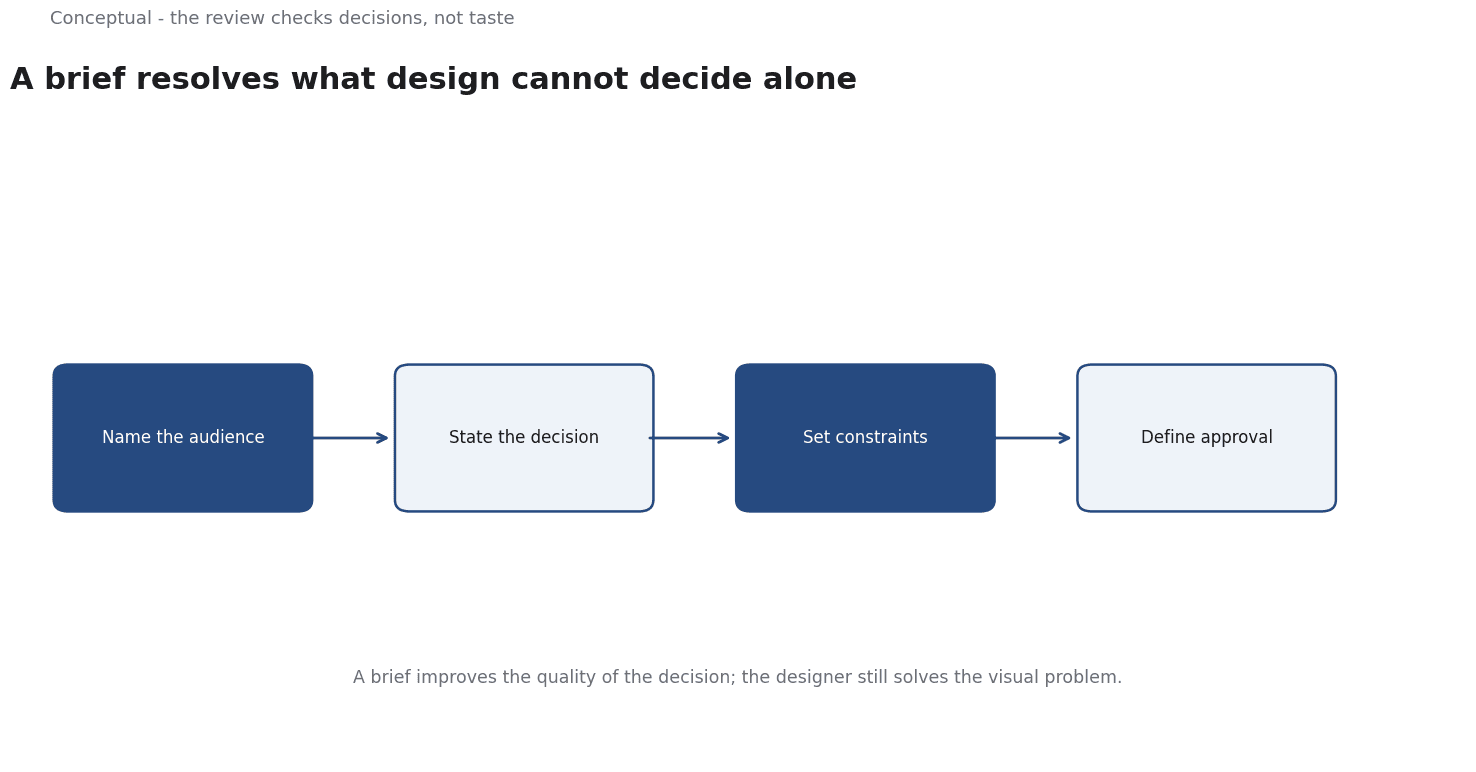
Seven sections
1. Audience and context. Who sees this, where, and under what circumstances? A logo used on an app icon and a billboard has different constraints.
2. The decision it supports. What should the reader think, feel, or do? "Recognise us as a credible alternative" is a decision; "look modern" is a style preference.
3. Constraints. Budget, timeline, formats, accessibility requirements, and existing elements that must remain. Constraints narrow the search and make the result evaluateable.
4. Evidence. Research, brand guidelines, customer language, and examples of work you want to avoid as well as emulate. Evidence replaces opinion with reference points.
5. Success criteria. How will the result be judged — recognition in a test, consistency with an existing system, or performance in a channel? State the metric before the work begins.
6. Approval process. Who reviews, in what order, and how many rounds.
7. Out of scope. What this project is not — a full rebrand, a new tone of voice, a website redesign. Stating exclusions prevents scope creep.
A worked example of a brief
The following is hypothetical and illustrative.
A company asks a designer to create a set of social templates. The brief states:
- Audience: operations managers at mid-sized logistics firms, encountered in a crowded feed.
- Decision: recognise the brand across three post types and stop scrolling on the ones that address a problem they have.
- Constraints: must work with the existing logo and colour palette; square and 4:5 formats; accessible contrast; delivered in two weeks.
- Evidence: the current brand guideline, three posts that performed well, two that did not, and five customer quotes describing the problem in their own words.
- Success: a recognition test with ten target readers; consistent application across the three formats.
- Approval: one review with the marketing lead, one with the product lead, then sign-off.
- Out of scope: no new logo, no change to the voice guide, no paid campaign assets.
Three properties make this useful:
- The decision is stated before the style. A designer can make choices that serve recognition without being told which font to use.
- The evidence includes failures. Knowing what did not work is as useful as knowing what did.
- The approval process is finite. Two named reviewers and a sign-off end the loop.
Three cautions apply: the recognition test needs a defined method, the constraints must be real, and the success criteria should be agreed before the first draft.
Reviewing the result without guessing
A brief gives the review a standard, which changes how feedback should be given. Three practices help:
Refer to the decision, not to taste. "This does not make the reader recognise us in a feed" is feedback a designer can act on. "I don't like the blue" is a preference that may have no connection to the brief's goal.
Separate requirements from suggestions. If something is required by the constraints — accessibility, format, existing logo — say so clearly. If it is a preference, label it and let the designer propose alternatives. Mixing the two produces work that satisfies nobody.
Test the outcome where possible. A recognition check with a few target readers gives evidence about the decision the brief named. It is not a substitute for design judgement, but it turns "does this look right?" into a question with a method, which is the point of the success criteria section.
A review conducted this way usually needs fewer rounds, because the designer can see which decision failed instead of guessing which element the reviewer disliked.
What a brief cannot do
It cannot replace a brand strategy. If nobody has decided what the brand stands for, the brief will inherit that ambiguity. The positioning work has to happen earlier.
It cannot guarantee a good result.
A brief improves the quality of the decision; the designer still has to solve the visual problem.
Specifying the solution in the brief transfers a task to the person least equipped for it.
It stays valid only until the context changes. A product launch or a new audience changes the decision the work supports. Revisit the brief rather than designing around a stale one.
The counterargument — that a long brief slows work down — is fair for small tasks. The test is whether the questions in it would otherwise be asked during review.
If the brief prevents three rounds of "I don't like it", it saved time.
A decision test
- Name the audience and the context of use.
- State the decision the work must support.
- List real constraints with formats and accessibility.
- Attach evidence, including examples to avoid.
- Define success with a method, before work starts.
- Fix the approval process and the number of rounds.
- State what is out of scope.
For the consistency context, see Brand Consistency Across Channels; for the strategic layer, see Brand Positioning.
References & Further Reading
- Wikipedia contributors, 2026. Brand management - Wikipedia — The discipline of maintaining a brand across touchpoints; secondary reference used for channel consistency.
- Wikipedia contributors, 2026. Marketing communications - Wikipedia — The coordination of messages across channels and the distinction between consistent and identical communication.