Internal Communications as a Strategy Tool
Internal communication is not announcements. Read how it changes decisions, a worked example, and why consistency matters inside a company too.
Most internal communication is treated as broadcasting: a newsletter, an all-hands, a memo. That framing misses its strategic function. Communication inside an organisation determines whether people understand the same priority, make decisions that fit it, and surface problems early. When it fails, teams work at cross purposes while each believing they are aligned.
Direct answer: Use internal communication to make decisions and trade-offs legible, not merely to announce outcomes. Marketing-communications principles apply inside a company as much as outside, and the decision-memo article provides the structure for a record that changes behaviour. The boundary: communication cannot fix a strategy nobody has chosen, which the positioning article argues, and it cannot substitute for management action, as Engineering Management: Hiring, Culture, Metrics, and Career Ladders treats culture as something built by decisions.
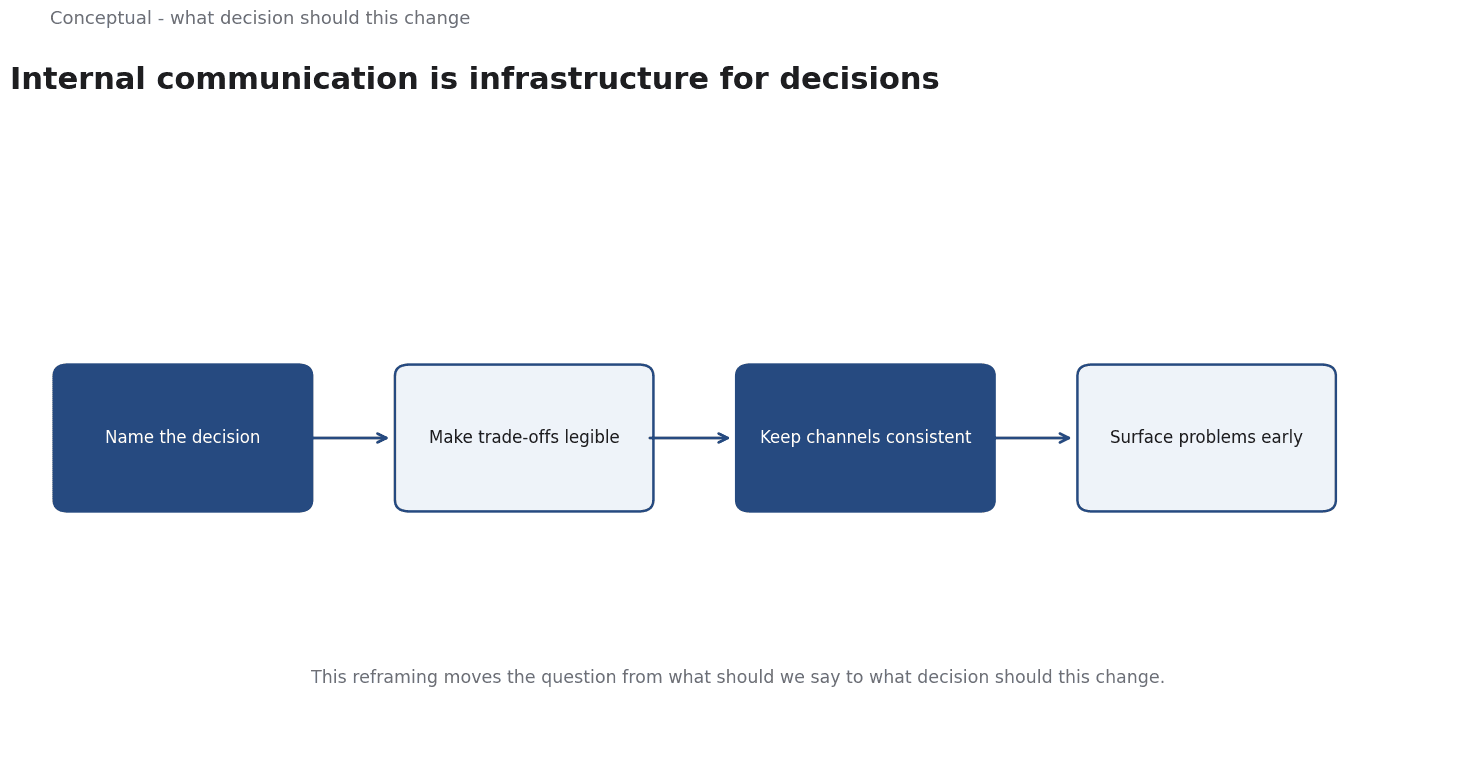
Communication as infrastructure
It helps to treat internal communication as infrastructure rather than messaging. Infrastructure is judged by whether work flows through it, which is why the test is not how many people read an update but whether decisions changed. The observability article makes the same point about alerts: a signal that does not lead to action is noise, and a channel nobody acts on is a cost.
This reframing moves the question from what should we say to what decision should this change.
The most consequential decisions often fail to travel because they are recorded in artefacts nobody consults. A strategy that lives only in a slide deck will be reinterpreted by each team, as the brand-consistency article explains for meaning that must survive across contexts. Putting the decision where work happens — in the roadmap, the review criteria, the escalation rules — is more effective than repeating it in a newsletter, which the engineering-management article treats as the substance of culture.
A final property of good internal communication is that it carries bad news.
The way an organisation responds to the first contrary signal determines whether the next one arrives in time, which is the real measure of whether communication is working.
What it has to do
Explain the decision, not just the result. People can act on a choice when they know what alternatives were considered and why one won. The decision-memo article makes this explicit for any consequential decision, and the governance checklist requires a recorded owner and review date.
Repeat the priorities. A strategy stated once is forgotten by the next quarter. Repetition is not redundancy; it is how a shared frame survives competing daily pressures, which the brand-consistency article treats as continuity of meaning.
Make it easy to surface problems. A channel that only carries good news is a measurement failure, as the voice-of-customer article argues for evidence that includes criticism. psychological safety is built by what happens after someone speaks, which the human-in-the-loop design implies for escalation.
A worked example
The following is hypothetical and illustrative. A company decides to prioritise reliability over feature speed for a quarter.
One all-hands announces the decision. Two weeks later, the roadmap still shows the old feature commitments, and support still escalates speed complaints as urgent. The communication failed because it changed nothing in the systems that drive decisions.
A working approach has three parts. First, a short decision record — the trade-off, the owner, and the review date — which the decision-memo article recommends. Second, a visible change to the artefacts teams use daily: the roadmap, the escalation rules, and the review criteria, which the engineering-management article treats as the real expression of culture. Third, a recurring note that reports what changed because of the priority, which the monitoring article recommends for any standard tied to changing work.
Three checks decide whether it worked. First, can employees explain the priority in the same terms, which the brand-awareness article measures for external audiences and applies here? Second, do decisions across teams reflect it — a review of shipped work, not a survey of stated agreement, as the product-analytics article argues for observed behaviour. Third, do contrary signals reach decision-makers, which the incident-response article treats as a property of a healthy system.
What internal communication cannot do
It cannot create clarity about a strategy that does not exist; that is leadership work, as the strategy article argues. It cannot replace incentives: a team rewarded for speed will hear a reliability message and continue optimising for speed, which the unit-economics article treats as a question of what gets measured. And it cannot be one-way: a channel with no response path is a broadcast, as the community article explains for the conditions of genuine interaction.
The counterargument that people should read the strategy document is unrealistic in an organisation where attention is scarce.
The practical response is to put the decision where work happens, which the observability article argues for alerts at the point of decision.
A decision test
- Write the decision, the trade-off, and the owner.
- Change the artefacts teams use daily to reflect it.
- Repeat the frame at a predictable cadence.
- Provide a visible path for contrary signals.
- Check comprehension with AAPOR-style wording if you survey.
- Measure observed decisions, not stated agreement.
- Review after any material change, as the monitoring article advises.
For the record, see Decision Memos; for the management substance, see Engineering Management.
References & Further Reading
- Wikipedia contributors, 2026. Marketing communications - Wikipedia — The coordination of messages across channels and the distinction between consistent and identical communication.
- Wikipedia contributors, 2026. Organizational communication - Wikipedia — How information flow and structure shape decisions inside organisations.