Market Structures: Perfect Competition, Monopoly, and Oligopoly
Market structure is about constraints on pricing, not labels. Read how concentration, entry barriers, and interdependence change the decision.
Market structures are usually taught as a taxonomy to memorise — perfect competition, monopolistic competition, oligopoly, monopoly — and the labels sound like descriptions of industries. They are more useful as a set of questions about constraints: how many competitors matter, how hard is entry, and does your pricing decision change theirs?
Direct answer:
The structure of a market determines the freedom a firm has to set price above cost and how long that freedom can last.
Under perfect competition, individual firms are price-takers. A monopoly faces the market demand curve directly. An oligopoly sits between them, and the defining feature is interdependence: your pricing or capacity decision changes your rivals' optimal response, so you cannot decide in isolation. The practical task is to identify which structure you actually face in the part of the market where you compete, because the wrong label produces the wrong pricing strategy.
The textbook end points are scaffolding
CORE Econ's open-access microeconomics textbook presents these models as simplified accounts of how buyers and sellers respond to constraints, and that is the right way to use the taxonomy. No real market is perfectly competitive, and few are pure monopolies. The models are reference points that tell you which forces matter.
Perfect competition assumes many small sellers, an identical product, and free entry. The consequence is that an individual firm cannot raise price — buyers buy from someone else — so it produces until marginal cost equals the market price. The realistic analogue is a commodity with many interchangeable suppliers: the firm's decision is about cost and volume, not price.
Monopoly means a single seller facing the whole market's demand. The firm can set price above marginal cost, but not arbitrarily: the higher the price, the lower the quantity demanded, and the optimum is where marginal revenue equals marginal cost. The constraint is demand, not competition. In practice the interesting question is what protects the monopoly position — a patent, a network effect, a regulatory barrier — because that determines how long the freedom lasts.
Oligopoly is the case most managers actually live in. A handful of firms matter, each large enough that its decisions affect the others. The defining feature is interdependence, and it makes the analysis a game rather than an optimisation.
Interdependence changes the pricing question
In an oligopoly you cannot ask "what price maximises our profit?" in isolation. You have to ask "what will they do, and what is our best response to that?"
A capacity expansion may trigger a response that eliminates the advantage. A move into a segment may be tolerable or may provoke a price war, and which it is depends on how your rival is positioned — which is exactly Porter's point about trade-offs: "a strategic position is not sustainable unless there are trade-offs with other positions", and a rival's ability to respond is determined by the position they have chosen.
This is why the most useful piece of competitive intelligence in an oligopoly is not a feature comparison but a map of who can credibly respond to what. A competitor whose cost base is built for volume cannot easily match a premium niche without damaging its economics, and that incompatibility is your room to move.
Market definition comes before structure
The structure you think you are in depends on how you draw the boundary, and the boundary is contested. A company may be a monopoly in a narrowly defined category and one of many alternatives in a broader one.
This is not an academic point: it is the same problem antitrust authorities face in merger review. Yang's work on market definition describes it as "an important component in the premerger investigation", built around the Hypothetical Monopolist Test — whether a hypothetical monopolist could profit from a small but significant and non-transitory price increase. The test exists because structure is not observed directly; it is inferred from whether customers would switch.
The same discipline applies to a business pricing decision. Ask what customers would do if you raised price five percent — would they accept, switch to a direct substitute, or leave the category entirely? Their answer determines the market you are actually in and therefore the structure you face.
Barriers to entry determine how long it lasts
Any position that earns returns above the competitive level attracts entry, so the durability of an advantage depends on what makes entry hard.
The categories are familiar but their consequences differ: scale economies make a new entrant's unit cost higher until it reaches comparable volume; network effects make the incumbent more valuable as it grows; switching costs make customers reluctant to move even when a rival is cheaper; regulation and patents are legal prohibitions; and control of a scarce input blocks access to production.
What matters is which barrier you have and whether it is strengthening or eroding. A network effect strengthens with scale; a patent expires; a switching cost can be eliminated by a change in technology or a standard. A structure that was defensible last decade may be wide open now, and the financials will show it as a margin decline with no obvious cause.
The decision sequence
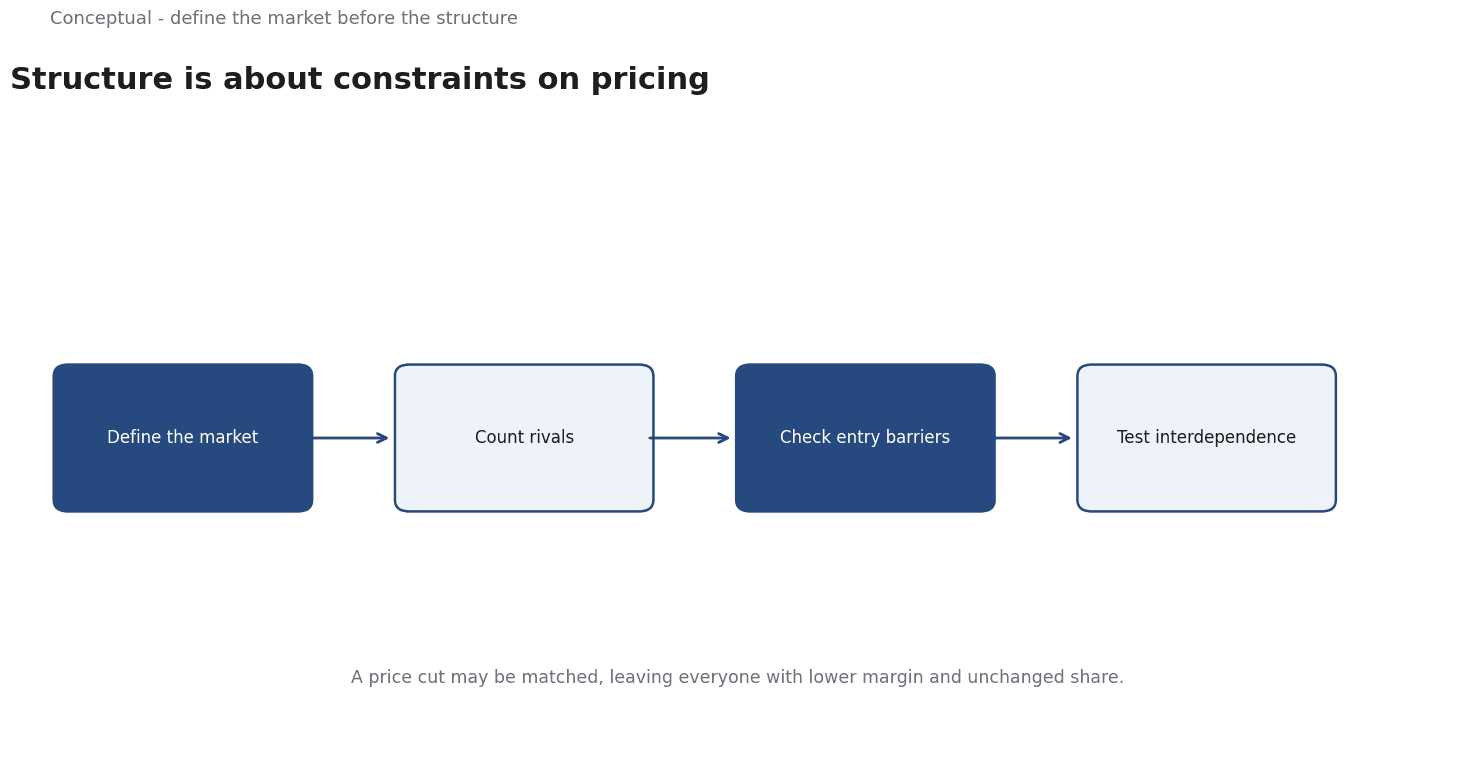
- Define the market from the buyer's substitution behaviour, not from your category name.
- Count the firms that genuinely matter in that market, including potential entrants.
- Identify the barrier protecting any above-normal return, and assess whether it is strengthening.
- For an oligopoly, map your rivals' feasible responses to each move you are considering, and their trade-offs.
- Check the elasticity of demand you face; structure sets the range, elasticity sets the optimum within it.
- Re-examine the boundary when technology or distribution changes. New substitutes redraw the structure before they show up in revenue.
For the competitive-position argument, see How Companies Build Competitive Advantages; for the elasticity tool, see Microeconomics for Decision Makers.
A counterargument
A fair objection is that the piece loosens the taxonomy so far it loses analytical bite: CORE Econ presents these as simplified models because the simplifications carry predictions, and the article keeps the language of constraints while dropping the machinery that tests them. Saying a monopoly optimises where marginal revenue equals marginal cost is doing work that "ask what protects the position" cannot replace. There is a source problem: the argument about rival responses rests on Porter's strategy work, whose point is about sustainable positioning and trade-offs, not market structure as such.
It imports a conclusion from competitive strategy and presents it as structural insight.
The practical sequence is useful, but calling the end points "scaffolding" may leave managers with questions and no model to answer them.
References & Further Reading
- Econlib, 2026. Core Econ: The Economy — A complete free economics textbook covering supply, demand, and elasticity.
- Michael E. Porter, 1996. What Is Strategy? — The differentiation-versus-cost argument behind competitive-advantage analysis.