Mergers and Acquisitions: When 1+1 Equals 3 (or Less)
The synergy number is the least verifiable part of a deal. Read what the merger review process actually examines and how to test a deal thesis.
Every acquisition presentation contains a page headed "synergies", and the number on that page is usually the least verifiable figure in the deal. It is a forecast about a future organisation that does not exist yet, produced by the party that wants the transaction to happen, and compared against a valuation built by the other party. It is worth understanding what is actually being checked when a deal is reviewed, because most of it is not about the synergy number.
Direct answer: A merger is a bet that two businesses are worth more combined than apart, and the test of that bet is not the synergy estimate but the price paid relative to what the combined entity can actually earn. Regulators examine something narrower and more concrete: whether the transaction would substantially lessen competition, which turns on how the market is defined. Buyers, meanwhile, are exposed to financing conditions and to the accounting of what they actually bought.
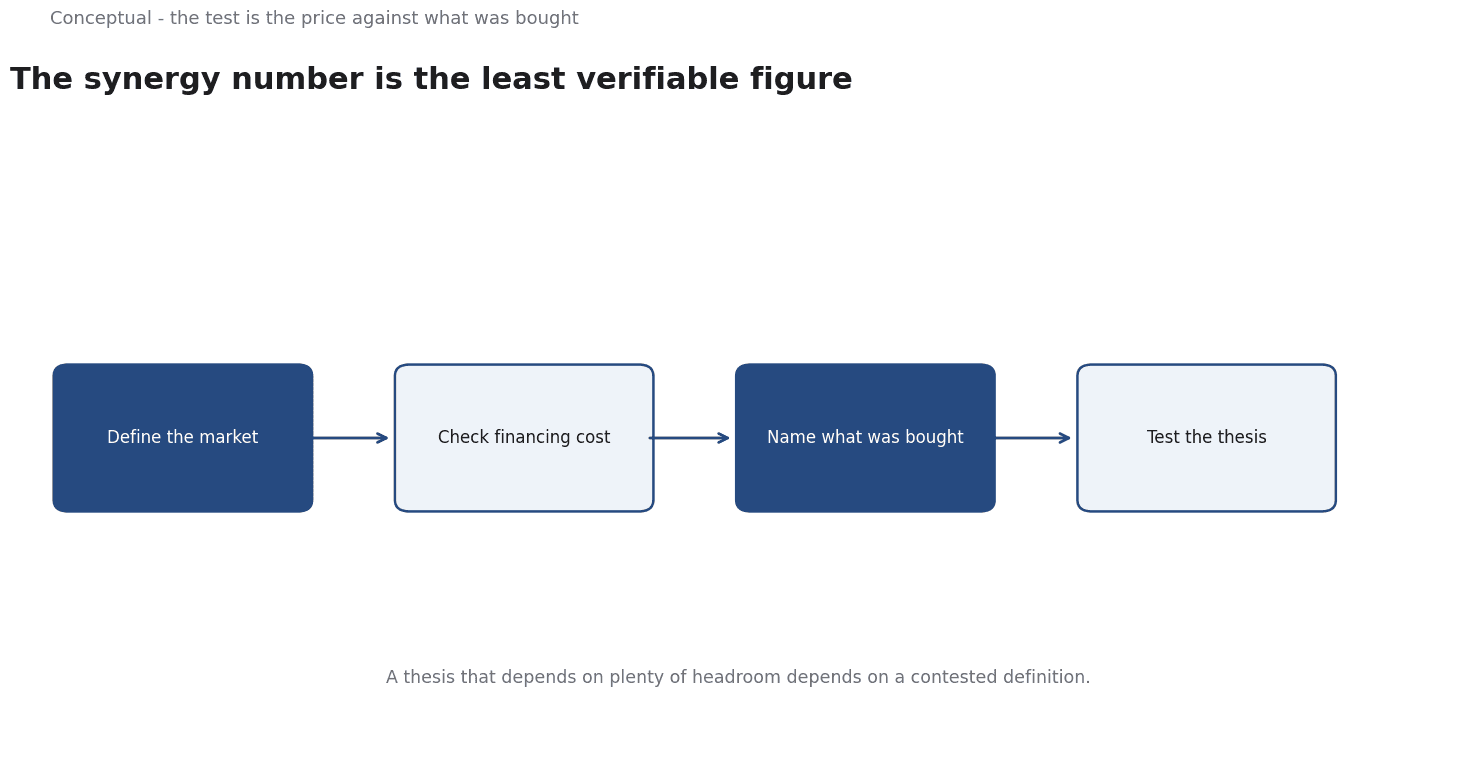
The three questions that decide a deal are therefore: what does the merged firm have the right to do that neither had before, what is the financing cost, and what was actually acquired for how much.
The regulatory question: market definition comes first
The single most consequential analytical step in a merger review is deciding what market the parties operate in, and it comes before any assessment of competitive effects. Yang states the stakes plainly: "Market definition is an important component in the premerger investigation", and the analytical machinery built on it — the Hypothetical Monopolist Test and the Critical Loss Analysis approach that preceded it — exists to "determine whether the hypothetical monopolist is going to profit from the small but significant and non-transitory increase of price".
The reason this dominates the process is structural. If the relevant market is narrow, the merged firm's share is high and the deal looks problematic; if it is wide, the share is low and the same deal looks routine.
The United States has a published framework for this. The Department of Justice and the Federal Trade Commission "jointly released the 2023 Merger Guidelines" on December 18, 2023, and the Guidelines "describe factors and frameworks" the agencies consider. Their legal status matters for reading them: they are "a non-binding statement that provides transparency on aspects of the deliberations the Agencies undertake in individual cases under the antitrust laws". They are not rules, but they are the best public statement of how a review is likely to proceed, and a deal team that has not read them is preparing a surprise.
The financing question
A merger is also a financing decision, and the environment determines the feasible set of deals. The Federal Reserve's monetary policy page is the natural place to read the current state: its framework, its tools, and the reporting that move rates — including the "Monetary Policy Report" and the "Beige Book" on regional conditions.
The mechanics are unglamorous and decisive. Acquiring cash is expensive; acquiring stock is not, but it transfers value to the target's shareholders in the form of exposure to your risk. An all-stock deal in a high-rate environment may not clear the target's board; the same deal in a low-rate environment can. Which means the cost of money is a first-order determinant of deal structure, and a strategy that is right at one rate environment can be wrong in the next.
For smaller transactions, the same arithmetic appears at a different scale. The Small Business Administration's lending programmes are explicit that "SBA-guaranteed loans generally have rates and fees that are comparable to non-guaranteed loans", and its Lender Match service pairs borrowers with participating lenders. The practical point for a deal memo is that the financing assumption should be a rate and a term from an actual conversation with an actual lender, not a round number.
The "what did we actually buy" question
The third question is the one most often deferred, and it is the one that determines whether the deal creates value or merely transfers it.
Consider what a synergy claim is. Revenue synergies require customers to buy more from the combined firm than they would have from either separately — which requires the combination to change something the customer cares about. Cost synergies require duplicated functions to actually be removable, which depends on how much of the second firm's organisation was already lean, and on whether the duplicated roles can be eliminated rather than retained for political reasons.
Both claims fail in the same way: they assume a future state that the acquirer fully controls, which is rarely true.
The honest version of the question is "what is the probability this synergy is realised, net of the integration cost and the distraction?", and a deal memo that treats that probability as 1.0 is not doing the arithmetic.
A way to test a deal thesis
- Write the market definition before the synergy model. If the thesis depends on a definition you chose, you have found the actual decision.
- Read the Guidelines and identify which factor the deal engages. Then check whether your market definition is the one a reviewer would use, not the one that makes the deal work.
- Price the financing. Get an indicative rate and structure, and re-run the accretion/dilution at a higher rate than quoted.
- Discount the synergies explicitly. Write a probability, apply it, and then show the deal at zero synergies. If it still works, the thesis is sound; if it does not, you have found the real reason for the deal.
- Separate what you are buying from what you are paying for. Price, multiples, and the acquired team's retention are three different questions, and the deal often survives one and fails another.
- Name the integration cost before the announcement. Integration cost is a cash outflow that arrives before any synergy does, and it is the reason cash-flow-based deals get funded and synergy-based deals get regretted.
For the valuation machinery these deals depend on, see Corporate Finance Essentials; for the competitive-position question underneath, see How Companies Build Competitive Advantages.
A counterargument
A critic can argue that the article demotes the very thing a deal should create. Its own test says to show the deal at zero synergies and treat survival as proof the thesis is sound, yet that standard would reject combinations whose entire logic is complementary assets; zeroing synergy is a stress test, not a decision rule. The regulatory emphasis may be misplaced for deals never challenged, and the article notes the 2023 Merger Guidelines are "a non-binding statement," so market definition may matter more to a reviewer than to a buyer. The financing and "what did we buy" questions are sound, but a critic would say the piece substitutes a checklist for the harder judgement of whether the combination changes what customers value, which the article admits revenue synergy requires.
References & Further Reading
- U.S. Department of Justice, Antitrust Division, 2023. 2023 Merger Guidelines — The joint DOJ and FTC statement of the factors the agencies consider in merger review, published 18 December 2023.
- Yan Yang, 2019. A New Solution to Market Definition: An Approach Based on Multi-dimensional Substitutability Statistics — How market definition is handled in a premerger investigation, and the Hypothetical Monopolist Test behind it.
- Board of Governors of the Federal Reserve System, 2026. Monetary Policy — The Federal Reserve’s monetary policy framework, tools, and reporting, including the Monetary Policy Report and the Beige Book.