Positioning Ladders: Competing on the Right Dimension
A ladder describes what buyers compare you against. Read how to choose the dimension, a worked example, and why rank is not the goal.
Positioning is often described as finding a place in the market's mind, which is vague until you ask what the market is ranking. A positioning ladder is the sequence of alternatives a buyer considers for a given problem. Competing on the wrong dimension puts you low on a ladder nobody cares about; choosing the right one changes the comparison itself.
Direct answer:
A positioning ladder is the ordered set of options a customer considers for a decision.
Porter's strategy argument and the blue-ocean framing explain the two moves — compete within the ladder on a dimension you can defend, or change the ladder by framing the problem differently. The boundary: a ladder is a hypothesis about buyer behaviour that must be tested with evidence, as How to Run a Competitive Positioning Workshop requires, and it cannot substitute for a real difference, as the strategy article argues.
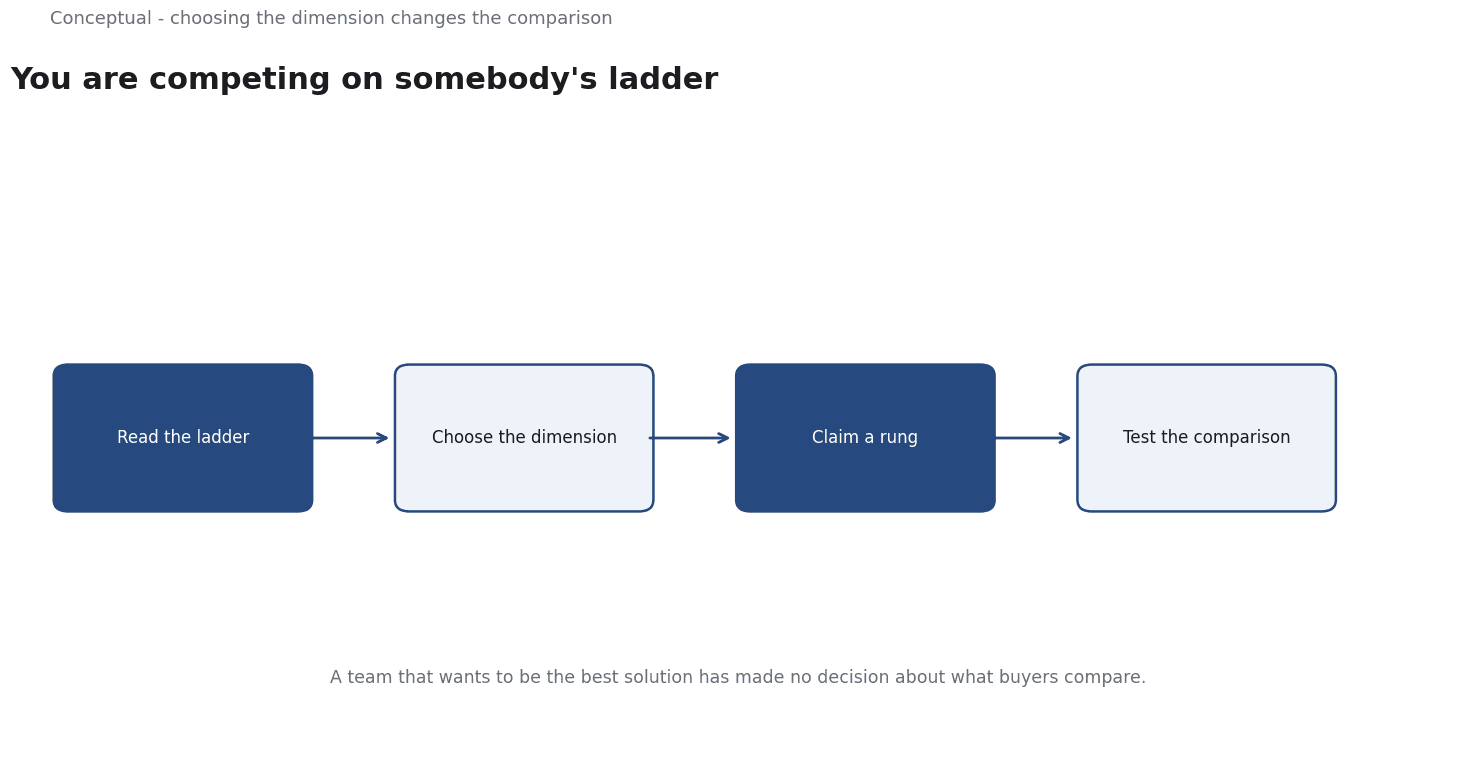
Two moves
Climb the existing ladder. Buyers already compare options on a dimension — price, speed, reliability. Choose the one where you can win and that buyers value, then support it with activities, as Porter's fit argument requires.
Change the ladder. Reframe the problem so the old criteria matter less, which the category-design article describes as creating new market space. This is harder and requires educating buyers, as the waitlist article notes about building demand before a product is understood.
Three consequences follow:
- The dimension must be valued by buyers, not chosen for internal convenience, as the value-proposition article argues.
- The claim must be defensible, which the positioning workshop tests with customers.
- The ladder can shift, which the monitoring article treats as a change trigger.
A worked example
The following is hypothetical and illustrative.
A project-management tool competes on a ladder where incumbents are ranked by feature breadth. It cannot win there. Two options:
- Climb with a different criterion. Choose setup time — the tool is usable in an afternoon — and test whether buyers rank on that. If yes, build messaging and product around it, as the landing-page article recommends for B2B clarity.
- Change the ladder. Frame the problem as "coordination without meetings" rather than "project management software", which the category-design article describes. This requires evidence that buyers experience the problem that way, as the positioning workshop requires.
Three checks decide:
- Buyer evidence. Do customers actually rank on the chosen dimension? Survey with AAPOR-style wording and a defined population, as the survey standards require.
- Defensibility. Can competitors copy the claim without changing anything, as the positioning workshop asks? Setup time backed by architecture is more defensible than a tagline.
- Outcome. Does the new frame change qualified conversion and retention, as the funnel article measures stages?
Three conclusions follow:
- The dimension is tested, not declared, as How to Run a Competitive Positioning Workshop recommends.
- Climbing is cheaper than changing the ladder, which the waitlist article treats as an education cost.
- Both require a real difference, as the strategy article argues for activities that support a position.
Reading the market's ladder
You cannot choose a ladder you cannot see. Three sources reveal it:
Buyer language. The words customers use to describe alternatives, which the voice-of-customer article recommends gathering with AAPOR-style wording, reveal the categories they already hold.
Lost-deal notes. Why buyers chose a competitor tells you which dimension decided it, which the competitive-intelligence article treats as primary evidence for positioning.
Switching behaviour. What made customers leave a competitor shows the criterion that mattered at the moment of choice, as the retention article analyses causes of churn.
These sources are evidence, not opinion, which the evaluation-rubric article requires for any claim about what the market ranks on.
The practical value of a ladder is that it turns a vague ambition into a specific choice.
Naming the ladder forces a question about which dimension actually decides the purchase and whether the business can defend a position on it. That discipline is useful even when the conclusion is to compete on familiar ground, because it makes the reason explicit and gives the team something to test.
What positioning ladders cannot do
They cannot create a benefit. A frame highlights a real difference; it does not manufacture one, which the value-proposition article argues.
They are not permanent. Competitors and buyer needs change, which the monitoring article covers as a change trigger.
They do not replace execution. A position on a ladder is a claim that the product must keep, as the reputation article warns about claims that experience contradicts.
The counterargument — that all positioning is perception — misses the strategic point.
Perception is shaped by what the business actually does, which the strategy article treats as the substance behind a position.
A decision test
- Name the ladder buyers currently use, as the positioning workshop recommends.
- Identify the dimensions they rank on, with AAPOR-style evidence.
- Choose where you can win and that buyers value, as the value-proposition article argues.
- Test changing the ladder only with evidence of a different frame, as the category-design article requires.
- Support the claim with activities, as Porter's fit argument requires.
- Measure qualified outcomes, as the funnel article recommends.
- Review on market change, as the monitoring article advises.
For the strategic frame, see Brand Positioning; for the workshop, see Competitive Positioning Workshop.
References & Further Reading
- Michael E. Porter, 1996. What Is Strategy? — The differentiation-versus-cost argument behind competitive-advantage analysis.
- Wikipedia contributors, 2026. Blue Ocean Strategy - Wikipedia — The strategy framing of creating uncontested market space rather than competing in an existing one; secondary reference.