Pricing Strategy Advanced: Dynamic Pricing, Revenue Management, and Price Optimization
Dynamic pricing is a controlled policy, not ad-hoc discounting. Read how inventory, time, and fairness shape the rules.
Dynamic pricing has a bad reputation because its most visible implementations — surge pricing, airline fares, last-minute discounts — feel arbitrary to the customer paying them. Used deliberately, it is neither arbitrary nor unfair; it is a policy for allocating a perishable resource when demand is uncertain and capacity is fixed. The ethical and commercial questions are the same question: what rule are you applying, and would a customer accept it if they knew it?
Direct answer:
Dynamic pricing works when a perishable, fixed-capacity product is sold to customers whose willingness to pay varies with time and circumstance.
It fails when it is used as an unprincipled way to extract more from whoever happens to arrive. The distinction is the rule: a published, consistent policy that responds to observable demand and inventory can be defended; a hidden, individualised price that depends on what a customer seems willing to bear cannot. The economics behind it are elasticity and scarcity, and the constraint is trust.
Why the product has to be perishable
Revenue management began in industries with a specific property: an unsold unit cannot be sold later. An empty airline seat, an unbooked hotel night, and an unfilled advertising impression all expire at a fixed moment. That perishability, combined with fixed capacity, is what makes varying price rational.
For a product that can be stored or reproduced at will, the case is much weaker. If you can make another unit tomorrow, holding back supply to raise price is a choice to sacrifice volume, and the customer can usually wait. Dynamic pricing is therefore not a general technique; it is a response to a particular economic structure.
The practical test is simple: what is lost if the unit is not sold in this window? If the answer is "nothing, we can sell it later", dynamic pricing is probably the wrong tool.
The mechanics are about segments and time
A revenue-management system answers three questions: how much capacity to make available at each price, when to open and close price levels, and how to revise the plan as demand arrives.
The underlying economics is elasticity, and the CORE Econ microeconomics text provides the right framing: buyers and sellers respond to constraints, and a price change's revenue effect depends on how quantity responds. In a perishable setting there is an additional term — the opportunity cost of selling too early at too low a price to a customer who would have paid more, versus selling too late and losing the unit entirely.
This is why the policy is usually structured around observable proxies for willingness to pay: booking lead time, flexibility, time of day, remaining capacity. Each proxy is imperfect, which is why the system needs measurement and revision. A rule that was optimal at the start of the season can be badly wrong at the end, and the data to correct it arrives continuously.
Two capabilities make the system work in practice: a demand forecast that updates, and a way to experiment without breaking the customer relationship. On the experimental side, Google's geo experiments are the appropriate design when a price policy applies to an entire market rather than to individual users — the published work describes them as "one approach that Google has successfully employed to measure advertising effectiveness" with "a systematic and effective design process".
The fairness constraint is a real constraint
The reason customers object to dynamic pricing is rarely the variation itself. It is the perception that the seller knows something about the buyer and is using it.
Two forms of variation are generally accepted: time-based — prices change for everyone at the same moment, driven by demand and inventory — and segment-based with a visible rationale — a flexible ticket costs more than a restricted one, and the difference in conditions is obvious. A third form, individualised pricing based on inferred willingness to pay, is where trust breaks, because the customer cannot see the rule and cannot predict it.
There is also a legal and regulatory dimension that a pricing system cannot ignore. A published rule is auditable; an opaque one is difficult to defend to a regulator or to a marketplace partner. This is the same logic that makes a legible attribution model better than an invisible one: Google Ads notes that "attribution models let you choose how much credit each ad interaction gets for your conversions" — and the choice is at least visible. A price rule should be too.
Price optimization is a model, and models drift
Automated price optimisation fits a demand model and chooses the price that maximises an objective, subject to constraints. It is powerful and it fails in specific ways.
The model sees correlations, not causes. If past prices were changed in response to demand, the data confounds cause and effect, and the optimiser can learn exactly the wrong relationship — charging more when demand was weak because weak demand caused a discount. This is the same problem as any observational causal claim, and it is why controlled price experiments are worth their cost.
Competitors respond.
The structure here is an oligopoly, and the decision is interdependent, not an isolated optimisation.
The objective may be the wrong one. Maximising short-run revenue can degrade repeat purchase, brand trust, and long-run margin. The objective must include the consequences the model cannot see, which usually means a constraint on how fast prices can move and how far they can diverge from a reference.
A sequence for a policy you can defend
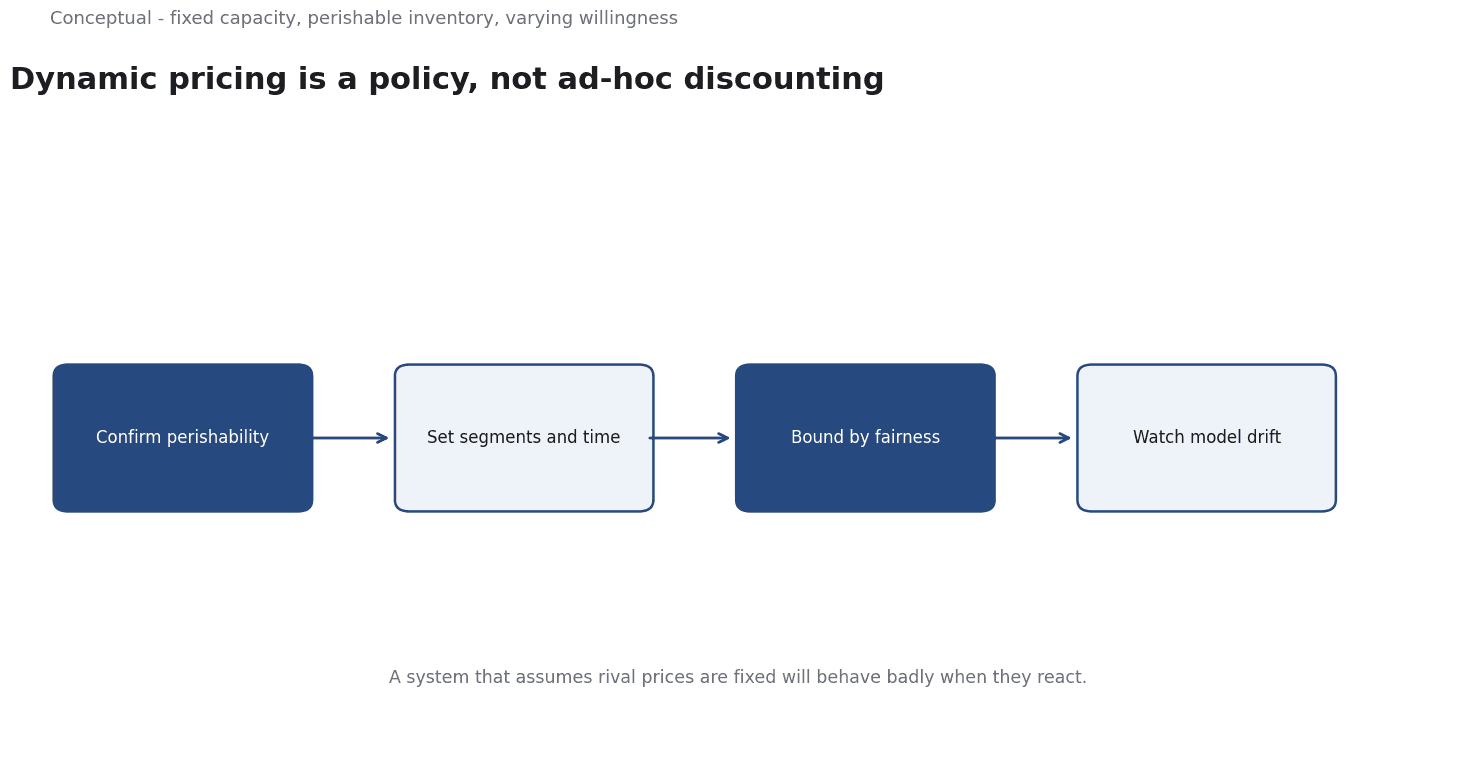
- Confirm the product is perishable and capacity is fixed. If not, use a different pricing approach.
- Define the rule in advance, including which signals move price and by how much.
- Make the variation explainable to the customer — time, flexibility, or capacity, not inferred willingness to pay.
- Experiment at the level the policy applies, with geo-level designs for market-wide changes.
- Measure revenue and repeat behaviour, not just the immediate conversion.
- Put bounds on the optimiser — maximum change over a period, and a reference price it cannot stray far from without human review.
- Audit the model for causal mistakes by comparing its predictions against controlled price tests.
For the underlying microeconomics, see Microeconomics for Decision Makers; for the experiment design, see A/B Testing.
A worked example
The following is hypothetical and illustrative. A regional hotel group is considering variable rates for rooms that go unsold each night. Because the inventory is perishable and capacity is fixed, the team treats this as a revenue-management question rather than a general price rise and runs three checks. First, it confirms that an unsold room cannot be sold later, which the CORE Econ supply-and-demand framing supports; if rooms could be stored, the policy would be the wrong tool. Second, it makes the variation explainable: rates move with booking lead time and remaining capacity, signals visible to every guest, and never reflect an inferred trait of a particular visitor, keeping the rule legible in the spirit of the attribution analogy. Third, it bounds the optimiser and tests at the right level, using market-level geo experiments because the policy applies to whole markets, then comparing predictions with controlled price tests. The bounded outcome is a published rule that lowers rates midweek when occupancy is soft and holds them on peak nights, with a reference price the system cannot stray far from without human review and guest trust tracked through repeat bookings.
A counterargument
The fairness argument carries more weight than the sources give it. CORE Econ covers supply, demand, and elasticity, not customer attitudes toward pricing, yet the article asserts that time-based and segmented variation is 'generally accepted' while individualised pricing breaks trust. The Google Ads attribution reference is invoked by analogy - 'at least visible' for credit rules means a price rule should be visible too - but the cited measurement documentation says nothing about how customers judge a pricing policy. The geo-experiments source measures advertising effectiveness, not price tests.
A critic would say the economic mechanics are well grounded but the ethical conclusion is a reasoned position, not a documented result; the claim that a published rule 'can be defended' is a judgement the economics sources do not supply.
References & Further Reading
- Econlib, 2026. Core Econ: The Economy — A complete free economics textbook covering supply, demand, and elasticity.
- Aswath Damodaran, 2026. Damodaran Online: Home Page for Aswath Damodaran — Publicly maintained datasets for industry averages, WACC, and valuation.
- Options Industry Council, 2026. The Options Industry Council (OIC) - Home — A primary industry reference for option pricing mechanics and Greeks.