Search Intent Mapping: Matching Content to the Decision Stage
The same keyword can mean different things at different stages. Read how to map intent to a decision and a worked example.
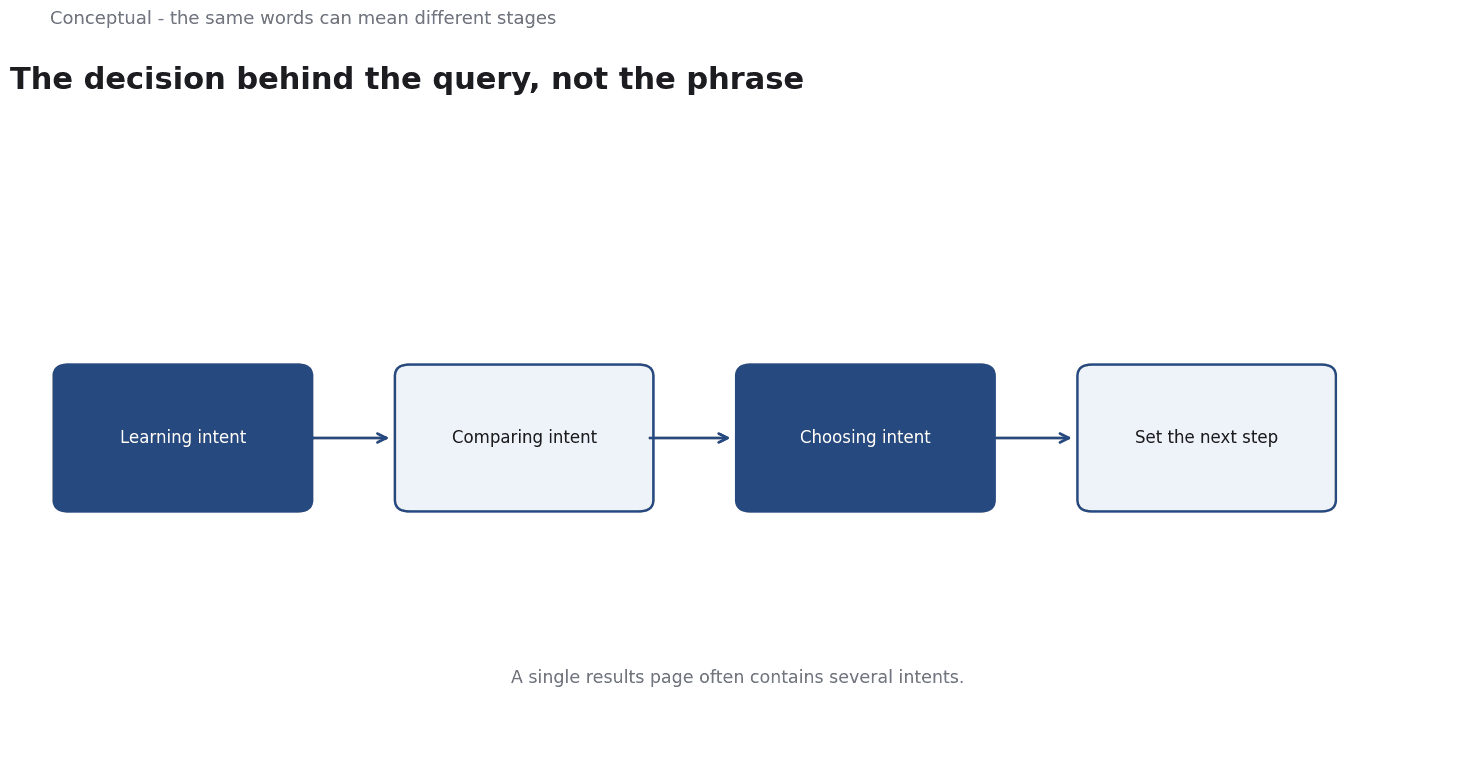
A search for "project management software" might come from someone learning what the category is, someone comparing vendors, or someone ready to buy. These are different questions wrapped in the same words. Content built for one will fail the others, which is why intent mapping is about the decision behind the query, not the phrase itself.
Direct answer:
Map each query to the decision the searcher is trying to make — learning, comparing, or choosing — and build the page that serves that decision, with the appropriate next step.
Demand-generation principles explain the stages, and AAPOR's standards apply if you use surveys to learn what your audience actually searches for. The boundary: intent categories are a model, not a fact about a person, and claiming a query "means" one thing without evidence is an assumption, as the keyword-research article warns.
Four intent families
Informational. The searcher wants to understand a problem or concept. A guide that teaches, with no hard sell, serves this stage, as the content-marketing article argues for value before asks.
Navigational. The searcher knows where they want to go. Clear branding and findable pages matter, which the brand-awareness article covers for direct signals.
Commercial investigation. The searcher is comparing options. A comparison framework with honest criteria serves this stage, as the landing-page article recommends for B2B buyers.
Transactional. The searcher is ready to act. A clear offer and a short path to the action serve this stage, which the CRO article explains through conversion design.
Three consequences follow:
- The same phrase can appear in several families, which is why the words alone are insufficient.
- The next step should match the stage — a buying page pushed on a learner is premature, which the funnel article explains.
- A page should have one dominant intent, which the SEO planning standard treats as a reader-first requirement.
A worked mapping
The following is hypothetical and illustrative.
A company targets three queries around "workflow automation":
- "what is workflow automation" — informational. Serve a clear explainer with a worked example; next step is a related guide.
- "workflow automation tools compared" — commercial investigation. Serve an honest comparison framework with criteria; next step is a trial or evaluation guide.
- "workflow automation software pricing" — transactional. Serve a clear pricing page with a worked cost example, as the pricing-page article recommends; next step is a purchase or demo.
Three checks decide whether the mapping is right:
- SERP observation, not assumption. Look at what currently ranks for each query, which the keyword-research article treats as evidence of the dominant intent, without inventing volume figures.
- Downstream quality. Does the page produce the right next action for its stage, as the funnel article recommends for transition metrics?
- Audience evidence. Survey a sample of visitors with AAPOR-style wording about what they were trying to do, which the voice-of-customer article covers for turning feedback into decisions.
Three conclusions follow:
- One asset cannot serve all three queries well, which the content-repurposing article explains as a reason to adapt, not to duplicate.
- The comparison page needs honest criteria, which the positioning-workshop article recommends for defensible differences.
- Intent mapping is a hypothesis, which the AI-search keyword article argues should be checked against observable signals.
Handling mixed intent
Three practices help:
Serve the dominant intent, then offer paths. A guide that answers a learner's question can link to a comparison for those ready to choose, which the funnel article describes as a transition design.
Use page structure to separate purposes. An explainer with a short "compare options" section serves both without confusing either, as the landing-page article recommends for B2B clarity.
Watch behaviour, not assumptions. If visitors to an informational page click comparison links, the intent mix is different from the one assumed, which the A/B testing article treats as observable evidence.
These practices treat intent mapping as a working hypothesis, which the keyword-research article argues should be checked against current signals rather than declared once.
What intent mapping cannot do
It cannot guarantee ranking. No structure guarantees a position, which the publication standard makes explicit for SEO generally.
It cannot read minds. A query is a weak signal of a person's full context, which the AAPOR standards remind us when interpreting survey answers.
It stays valid only while the market does. New use cases change what a phrase means, which the monitoring article treats as a change trigger.
The counterargument — that modern search blurs intents — is fair.
The response is to serve one dominant intent well and provide paths to adjacent stages, which the funnel article describes as a transition design.
A decision test
- Observe the current results for the query before assigning intent.
- Name the decision the searcher is making, not just the phrase.
- Give each page one dominant intent, as the SEO standard requires.
- Match the next step to the stage, as the funnel article recommends.
- Measure downstream quality, not only traffic, as the A/B testing article advises.
- Use AAPOR-style wording if you survey visitors, with a defined population.
- Re-check when the SERP or product changes, as the keyword-research article recommends.
For the planning frame, see Demand Generation vs Lead Generation; for the measurement, see Marketing Attribution.
References & Further Reading
- Wikipedia contributors, 2026. Demand generation - Wikipedia — An overview of demand generation as a marketing discipline distinct from lead generation; secondary reference used with the lead-generation entry.
- American Association for Public Opinion Research, 2026. AAPOR — The professional association for public opinion and survey research; its standards and resources underpin the survey-design discussion.