Why People Buy Products They Don't Actually Need
Consumer purchases are driven by psychology as much as utility. Learn how identity, status, scarcity, and habit shape demand—and what that means for product and marketing
People do not buy only what they need. They buy what signals who they are, what relieves anxiety, what feels scarce, and what everyone else is buying. Understanding these drivers separates demand creation from demand fulfillment.
Direct answer:
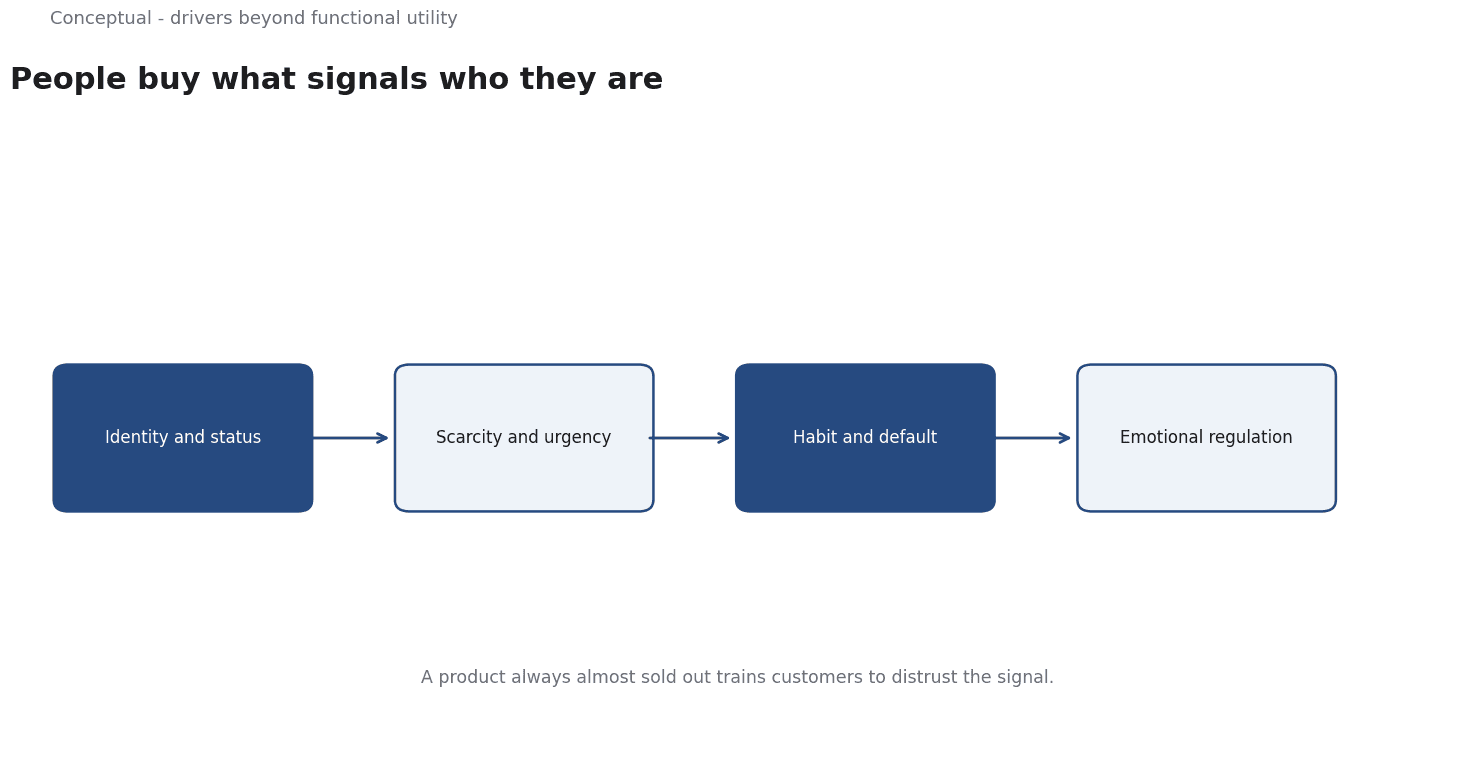
Consumers purchase products for reasons that extend beyond functional utility: identity expression, social status, emotional regulation, scarcity response, and habit.
These psychological drivers often outweigh objective need in purchase decisions. Recognizing them explains why demand exists for products that solve no clear problem, and why better products do not always win.
Identity and self-signaling
Products are social signals. A purchase says something about the buyer to others and to themselves. A luxury watch is not primarily a timekeeping device; a running shoe is not primarily foot protection; a specialty coffee is not primarily caffeine. Consumers buy products that align with, or aspire to, a self-image.
This means demand is partly constructed, not discovered. A product category can exist because it gives people a way to signal taste, values, or belonging—not because it solves a previously unmet functional need.
Status and relative position
Much consumption is positional: value depends on what others have. A product that is rare or expensive conveys status because not everyone can afford it. When a product becomes common, its status value declines, and consumers move to the next scarce signal.
This explains why demand can shift without any change in product quality or price. A product loses appeal not because it worsened, but because it became accessible to the wrong people. Markets for fashion, collectibles, and certain technology are driven more by this dynamic than by utility.
Scarcity and urgency
Perceived scarcity increases perceived value. Limited editions, countdown timers, and "only a few left" messages trigger fear of missing out. The effect works even when scarcity is manufactured: customers respond to the signal, not the actual inventory position.
This is a powerful demand lever, but it is manipulative when used dishonestly.
Habit and default choice
Many purchases require no decision at all. Customers buy the same brand because it is what they bought last time, because it is on the usual shelf, or because switching costs—even small ones—outweigh potential benefits. Habit is a major source of demand stability for incumbents and a major barrier for challengers.
Disrupting habit requires more than a better product. It requires making the new option the easier default: lower switching cost, more prominent placement, or a trigger that breaks the old routine.
Emotional regulation
Purchases can regulate mood. Retail therapy is not a myth; buying provides a sense of control, novelty, or reward. Products marketed as treats, indulgences, or self-care tap into this driver. The purchase is less about the object and more about the feeling it produces in the moment.
This driver is context-sensitive. The same product may be a necessity in one emotional state and an indulgence in another.
What this means for product and marketing
If demand is partly psychological, then product and marketing decisions must address psychology, not just features:
- Positioning matters as much as specification. How a product is framed—luxury, practical, rebellious, caring—determines who buys it and why.
- Scarcity should be real, not manufactured. Fake urgency destroys trust when exposed.
- Habit is a barrier to entry and a moat for incumbents. New products need to break existing routines, not just offer better specifications.
- Identity alignment precedes feature comparison. Customers decide whether a product is "for someone like them" before comparing specifications.
None of this means consumers are irrational. It means their utility function includes social and emotional terms that standard economic models often omit.
For the related question of how consumers make decisions under uncertainty, see [Correlation vs Causation: The Most Common Mistake in Data Analysis]—this publication does not yet have that article, so treat it as a planned topic rather than a published link.
For the behavioural mechanisms behind non-essential purchases, see Behavioral Finance: Cognitive Biases in Investing and Spending, and for how retailers use the resulting data, see How Retailers Use Data to Optimize Product Placement.
A bias taxonomy applied to the shelf
Kahneman's Nobel lecture, the primary source for the bias taxonomy referenced here, describes systematic ways judgment departs from standard economic assumptions. Read through that lens, the drivers in this article are not random quirks of taste. Identity signaling, scarcity response, and habit each map to a recognizable pattern in which the context of a choice changes the choice itself.
That matters for how a team interprets demand. If a product sells well despite weak specifications, the instinct is to attribute it to irrational customers. The taxonomy suggests a different reading: the utility function includes social and emotional terms, so the purchase may be rational given the buyer's actual objectives. Scarcity messaging, for instance, changes perceived value without changing the product at all.
The honest implication is that manufactured scarcity can manufacture demand, but only until the signal is exposed. A product that is always almost sold out trains customers to discount the claim. The bias is real; exploiting it dishonestly spends the trust that makes future demand possible.
Reading demand in the channel data
The following is hypothetical and illustrative. Consider a launch where sell-in looks strong because retailers stocked heavily, but sell-out stalls because the product never signaled identity or displaced a habitual choice. Read only at the sell-in number, the launch looks like a success; read at sell-out, it is a demand failure.
That gap is why the National Retail Federation's distinction between sell-in and sell-out matters here. Sell-in measures what manufacturers ship to retailers; sell-out measures what consumers actually buy. Urgency messaging can lift sell-in by filling shelves while leaving sell-out flat, revealing demand that was never there.
The same lens tests durability. If scarcity messaging produces a sell-out spike that decays when the message stops, the effect was a response to the signal, not a durable preference. If habit holds sell-out steady across seasons, the incumbent's moat is the default routine rather than product superiority. Channel data is what separates demand creation from demand fulfillment, and it is the check that keeps a psychological explanation from becoming an excuse.
A counterargument
A fair critic would object that the framing risks making every purchase psychological and therefore unfalsifiable. If identity, status, scarcity, habit, and emotion are always available as explanations, no observation could count against them, and Kahneman's taxonomy - the article's primary source - describes systematic departures from standard assumptions, not a licence to read motives into any purchase. The piece half-concedes this by insisting consumers are not irrational and that utility includes social and emotional terms, but that makes the thesis hard to test: if those terms are always present, the claim that psychological drivers often outweigh need requires a comparison it never supplies.
The NRF sell-in versus sell-out lens is its one genuine check, yet it flags a demand failure without isolating the driver.
References & Further Reading
- Daniel Kahneman, 2002. Daniel Kahneman Prize Lecture - NobelPrize.org — The primary source for the bias taxonomy used in behavioural finance.
- National Retail Federation, 2026. NRF Press Releases | Latest Statements & Announcements | NRF — Primary retail-sales and channel data for sell-in versus sell-out definitions.